By: Rajshree Chandra
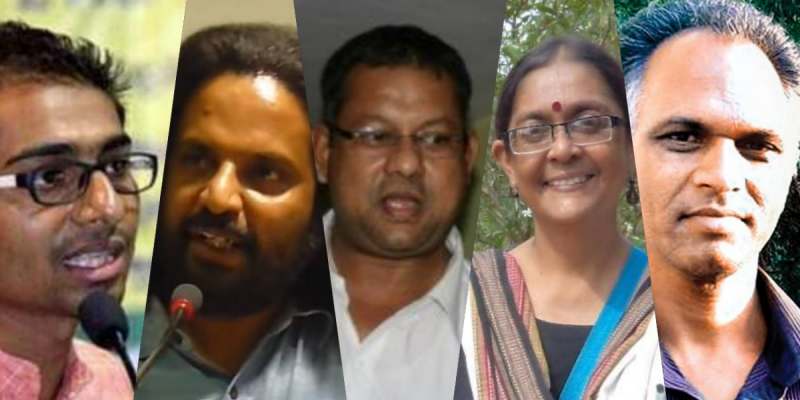
Since June 2018, ten human rights activists and lawyers have been arrested and charged under several sections of the draconian Unlawful Activities Prevention Act (UAPA), an anti-terror law. The first arrests were made on June 6 when a Dalit rights lawyer, a professor of English, a Marathi poet, a political prisoners’ activist and anti-displacement activist were picked up on the suspicion of having instigating violence at the Elgar Parishad event in Bhima Koregaon in January 2018.
The second round of five arrests were conducted on August 28. Folks arrested had exactly the same profiles – a lawyer, professor of law, trade unionist, poet, civil liberties and human rights activist. Common to all these people is that they speak for and represent the interests and claims some of the most dispossessed citizens of our country who have been excluded from access to both rights and resources. They were all charged under the draconian UAPA.
There’s something deeply worrying about the sanction that laws like UAPA carry and the range of activities they routinely bear upon. Under vague and nebulous definitions of terror and unlawful activity, they often encompass a wide range of non-violent political activity and suppress contrarian, dissenting ideological or political perspectives. They allow for a 180-day detention without a chargesheet, create a strong presumption against bail, admit in-custody confessions and tacitly sanction torture. Over the years, their victims have been many innocent lives, whose stories of incarceration ought to bear upon the collective conscience of this nation.
It is still not entirely clear what the charges against the lawyers and activists are, because no chargesheet has yet been filed. If the charge is involvement in the Bhima Koregaon violence, then why were none of them named in the first FIR filed on January 8 (which actually named two right-wing members Shambhaji Bhide and Milind Ekbote, charges against both have now been dropped). If it is for their involvement in a Maoist plot to assassinate the prime minister, why were “the letters”, that purportedly hatched the plot, not produced in any court of law and are not mentioned in the remand applications filed before the Magistrates?
Seeking relief from alleged police fabrication and trumped-up charges, the five activists arrested on August 28th petitioned the Supreme Court. The petitioners’ plea was only for a probe by a special investigation team (SIT), given the glaring lapses and bizarre conclusions in the rather tendentious findings of the Mumbai police. In one instance, the inflammatory speech referred to in the FIR was actually a Marathi translation of verses from the German play The Good Persons of Szechwan by Betrolt Brecht.
In another, despite “the letters” undergoing forensic analysis, they were selectively flashed by ADG of Maharashtra police at a press briefing to suggest that the arrested activists were involved in a plot to assassinate the prime minister. All this was evidence placed before the court. It was therefore intriguing that the majority judgment delivered on September 28 by Chief Justice Dipak Mishra and A.M. Khanwilkar did not take into account facts which had been of critical relevance to Justice Chandrachud’s dissenting opinion. Nothing explains why the two judgements – the majority judgment and dissenting judgment in the Bhima-Koragaon case – relied on two different sets of facts. When a judgment omits considering certain relevant circumstances in the factual chain of events that were critical for the dissenting judgment, it falls short of being a fair judicial process.
The dissenting opinion of Justice Chandrachud is unsparing in its observations about the real reason behind the arrests. It is “an attempt by the state to muzzle dissent… each of them is being prosecuted for being a defender of persons subjected to human rights violations”. Under these circumstances it was the duty of the court to ensure that the administration of criminal justice is not derailed. The question is why did the court not grant this limited plea? Why did the highest court of the land take refuge in technicalities and not ensure remedies guaranteed by Article 32 of our constitution? All the SC granted them was four-week relief that ended on October 26. On the same day, the SC dismissed the (five accused’s) review petition, and the Pune sessions court refused bail to Sudha Bharadwaj, Vernon Gonsalves and Arun Ferreira. It has also stayed Bombay high court’s denial of extension of time to conclude probe and file a chargesheet. Recall that the arrested can remain in police custody for up to 6 months without a chargesheet.
By extending the time of custody, by not granting bail, by not sanctioning an SIT, the courts may claim to have implemented the letter of the law (UAPA). But they have also chosen to renege on the larger responsibility the conduct of extraordinary laws mandates. This responsibility mandates that the actions of the accused and the prima facie evidence point in the direction of terror or threatening activities. If it doesn’t, as Justice Chandrachud’s judgment points, then there is reason enough for the courts to exercise their interpretative leeway and interpret law and actions in the context the political and evidentiary setting. By equating routine, even exemplary, acts of lawyering and speaking for the dispossessed with “terror”, the police and the adjudicating courts have redefined what it means to be an Indian citizen whose constitutional rights and duties are no longer a certainty.
For now, a chilling signal has been sent to all those who dare to speak for the voiceless, in courts of law, in media, in plays, through poetry, in songs and stories. The deployment of UAPA, and other exceptional laws is meant to signal the reach of the Indian state and meant to teach those who use their democratic rights to speak out, just how fragile the edifice of their entitlements is. For now the exceptional, has been made the new normal.
Rajshree Chandra is associate professor, Department of Political Science, Janki Devi Memorial College, Delhi University, and senior visiting fellow, Centre for Policy Research.
Courtesy The Wire