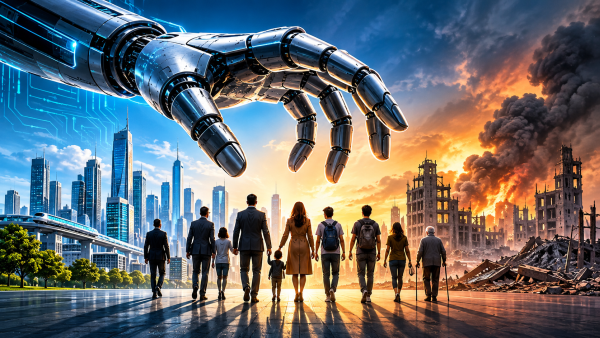
For decades, several science-fiction films have portrayed threats that are no longer entirely fictional. Some predicted technologies that now exist; others anticipated dangers that humanity is actively creating. Importantly, the films did not necessarily predict exact events, but their underlying warnings have become increasingly relevant. Films such as The Terminator (1984), WarGames (1983), The Matrix (1999), Minority Report (2002), Contagion (2011), Leave the World Behind (2023), Don’t Look Up (2021), WALL-E (2008), etc., once seemed to belong entirely to the world of imagination. Today, some of their scenarios appear increasingly close to reality.
THE FRAGILITY OF OUR TECHNOLOGICAL WORLD
Consider the reported $6.34 billion cryptocurrency theft involving Binance on October 29, 2026, described as one of the largest digital asset thefts ever recorded. It exposes the vulnerability of financial systems on which millions depend. Imagine lifelong savings disappearing within minutes, without a physical robbery or any possibility of immediate recovery.
Recent aviation disruptions in the United States offer another warning. An FAA nationwide ground stop on November 13, a United Airlines technology outage, and a Delta Air Lines weight-and-balance system failure demonstrated how technical vulnerabilities can disrupt essential services. These were not all cyberattacks, but they exposed our dependence on interconnected systems.
A failure in one critical system can affect thousands of lives.
WHEN EVEN OUTER SPACE BECOMES A BATTLEFIELD
More alarming are reports of Russia allegedly developing a nuclear-armed anti-satellite weapon, reportedly called Sputnik-S. Western intelligence assessments suggest that such a weapon could use a nuclear detonation in orbit to disable large numbers of satellites through electromagnetic and radiation effects.
Although deployment remains unconfirmed, the implications are frightening. Satellites support communications, navigation, weather forecasting, financial transactions, and disaster management. Their widespread destruction could disrupt the technological foundations of modern civilisation, affecting even countries uninvolved in the conflict.
We have reached a point where a military confrontation between a few powerful nations could threaten the infrastructure on which the entire world depends.
THE BUSINESS OF PREPARING FOR DESTRUCTION
While governments speak about peace and development, their military investments tell another story. According to the International Campaign to Abolish Nuclear Weapons (ICAN), global spending on nuclear weapons reached a record $118.8 billion in 2025, increasing 19 per cent over the previous year.
Beyond nuclear arsenals, countries are investing heavily in autonomous weapons, AI-driven warfare, cyber capabilities, hypersonic missiles and space-based military systems.
The justification is familiar: every nation needs stronger defence because its rivals are becoming stronger. But if everyone follows this logic, where does the race end?
There is a fundamental contradiction in measuring national security by the ability to threaten others rather than by the collective ability to prevent conflict.
MUST DESTRUCTION COME BEFORE DIALOGUE?
History has already given us a devastating warning. Hiroshima and Nagasaki demonstrated the destructive power of nuclear weapons in 1945. The United Nations was established that same year, and the Nuclear Non-Proliferation Treaty followed in 1968. Yet, more than eight decades later, nuclear weapons remain central to global security calculations.
Have we learnt anything beyond developing more sophisticated ways to destroy one another?
Must humanity experience another catastrophe before nations come to the negotiating table? In a large-scale nuclear conflict, there would be no meaningful winners. The consequences would extend far beyond national borders, political ideologies, and military alliances.
THE QUIETER DISRUPTION: ARTIFICIAL INTELLIGENCE
Another transformation is unfolding with equally profound consequences. Artificial intelligence is changing employment, industries, and human decision-making at an extraordinary pace.
Research from Stanford and ADP in 2026 identified declining employment among young workers in some AI-exposed occupations, although it does not establish that AI is responsible for all the decline.
The concern is not technological advancement itself. It is our apparent failure to prepare society for its consequences. What happens when machines replace human capabilities faster than economies can create new opportunities? Who benefits from the resulting wealth, and who bears the cost?
We seem almost complicit in this transition, celebrating technological breakthroughs without asking sufficiently difficult questions about employment, inequality and human dignity.
WHO IS PROTECTING HUMAN SECURITY?
Governments frequently speak about national security, strategic interests and military superiority. But where does human security stand?
Security should also mean protecting livelihoods, savings, essential services, healthcare, education, food supplies and the environment. It should mean living without the fear that a distant conflict, a cyberattack, a technological failure or an automated system could suddenly destroy one’s future.
This is not an argument against national defence. Nations have legitimate security concerns. But defence without diplomacy, technological progress without accountability and economic growth without human security are incomplete measures of civilisation.
THE APOCALYPSE IS A HUMAN CHOICE
Perhaps the most frightening aspect of our times is not the possibility of an apocalypse, but our apparent indifference to the conditions creating it.
We watch science-fiction films depicting humanity’s destruction while overlooking the real decisions bringing some of those scenarios closer. We fear unidentified powers from outer space while failing to question the destructive capabilities we are developing ourselves.
The real measure of human intelligence is not how powerful our weapons become, how much wealth we accumulate, or how effectively we dominate our adversaries. It is whether we can use our collective intelligence to protect life and prevent our own destruction.
Science fiction may have imagined the end of humanity. But humanity itself may turn that fiction into reality, not through an alien invasion, but through its own ambition, arrogance, and failure to act responsibly.