JAMMU: Chief Justice of the High Court of Jammu and Kashmir and Ladakh, Dr Justice Pushpendra Singh Bhati, on Friday highlighted the enduring strength and flexibility of the Constitution of India, calling upon the younger generation to uphold its values and contribute towards strengthening democracy and the nation.
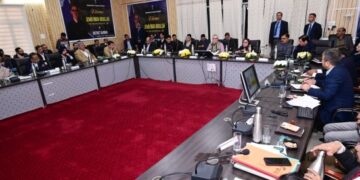
He was speaking at a Constitution Day programme organised by the Jammu and Kashmir Legal Services Authority (JKLSA), in collaboration with the High Court Legal Services Committee and District Legal Services Authority (DLSA), Jammu, at the Police Auditorium, Gulshan Ground.
The event commemorated the 77th anniversary of the adoption of the Constitution and reaffirmed the commitment to its ideals of Justice, Liberty, Equality and Fraternity. Justice Bhati, who is also Patron-in-Chief of the JKLSA, attended as the chief guest in the presence of Justices Rajnesh Oswal, Wasim Sadiq Nargal, Rajesh Sekhri, Sanjay Parihar and Yash Paul Bourney, all judges of the High Court.
In his presidential address, the Chief Justice interacted with students and used real-life examples to explain the three dimensions of justice—social, economic and political—as enshrined in the Preamble to the Constitution.
Highlighting the principle of political equality, he said every citizen’s vote carries equal value irrespective of their social or economic standing. He stressed, however, that sustained efforts were needed to achieve social and economic equality and ensure a dignified life for every individual.
Referring to the foresight of the Constitution’s framers, Justice Bhati said Article 395 severed the remaining constitutional links with colonial rule. He described the Constitution’s inherent flexibility as its greatest strength, enabling it to bind the country’s geographical, cultural and social diversity into a unified national fabric.
Reflecting on the judicial heritage of Jammu, Kashmir and Ladakh, he referred to the establishment of the High Court in 1928, which is approaching its centenary, as a reflection of the region’s deep-rooted constitutional values.
Drawing upon his recent experiences in Ladakh, the Chief Justice highlighted the functioning of judicial institutions and Legal Services Authorities in remote and high-altitude areas despite geographical and climatic challenges. He described their functioning as a manifestation of the Constitution’s strength.
He urged young people to keep constitutional values alive, channelise their potential constructively and contribute meaningfully towards strengthening the Constitution, democracy and the nation.
Speaking on the occasion, Justice Rajnesh Oswal described the Preamble as the essence of the Constitution and elaborated on its four foundational ideals of Justice, Liberty, Equality and Fraternity.
Emphasising equality and liberty, he stressed the need to safeguard the constitutional rights of every citizen, ensure equality of opportunity and uphold individual dignity. He said constitutional freedoms must be exercised responsibly and with due regard for the rights of others, while calling for greater constitutional awareness among young people so they remain conscious of both their rights and responsibilities.
The programme also featured addresses by Prof. Dr Sanjay Gupta of the Faculty of Law, University of Jammu, and Senior Advocate Seema Khajooria Shekhar of the High Court. They shared academic and professional perspectives on the historical evolution of the Constitution, constitutional morality and contemporary challenges.
Presentations by a trainee judge, law students and a Para Legal Volunteer highlighted different aspects of constitutional values and legal awareness.
An informative video presentation on the E-Nyay Saarthi Portal, developed by the Department of Law, Justice and Parliamentary Affairs, showcased the role of technology in facilitating access to justice.
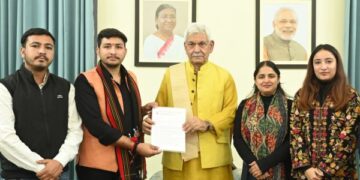
A major highlight of the programme was the release of a booklet on Fundamental Duties by the Chief Justice. Published by the JKLSA, the booklet seeks to familiarise citizens with the Fundamental Duties enshrined under Article 51A of the Constitution in a simple and accessible manner.
The initiative aims to promote constitutional literacy, encourage civic and moral responsibility and familiarise citizens with the values expected to guide their everyday conduct.