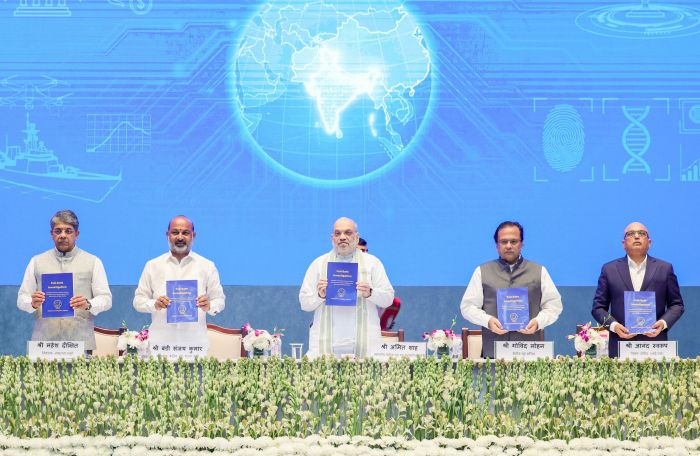
NEW DELHI: The sixth Anti-Terror Conference of the National Investigation Agency (NIA) concluded on Friday with a renewed commitment to strengthen India’s counter-terrorism framework through closer coordination between Central and state agencies, intelligence-led investigations and effective prosecution of terror cases.
The two-day conference, held on November 19 and 20 under the theme “Cross-Border Terrorism”, was inaugurated by Union Home Minister Amit Shah and brought together senior officers of state police forces, Central agencies and other stakeholders.
According to the NIA, the conference was attended by 40 Directors General and heads of state police forces and Central agencies, besides 230 participants from anti-terror investigation units of different states.
The main sessions focused on the links between organised crime and terrorism, radicalisation, cross-border terror financing, international cooperation, technology and coordinated government action.
Discussions covered the use of drones and digital platforms by terrorist and criminal networks, cross-border smuggling of arms and narcotics, online radicalisation, lone-actor threats and financial channels such as hawala and trade-based money laundering. Participants also examined mechanisms for extradition, deportation and international evidence-sharing.
The sessions further explored the use of artificial intelligence, big data analytics and digital forensics in counter-terrorism investigations.
A separate track, introduced during the previous conference and made a regular feature this year, focused on the prosecution of terror cases. It brought together investigators, prosecutors and legal experts to discuss the application of new criminal laws, admissibility and handling of digital evidence, investigation procedures, trial strategy and case management.
The deliberations also covered special provisions under the Unlawful Activities (Prevention) Act and the Bharatiya Nagarik Suraksha Sanhita (BNSS), witness protection and the use of government platforms such as e-Sakshya, e-Prosecution and e-Forensics.
Participants stressed that professional investigations must lead to effective prosecution and timely convictions.
In his concluding address, Union Home Secretary Govind Mohan called for translating the national counter-terrorism framework PRAHAAR into coordinated action at the state, district and police-station levels.
He urged states to strengthen their Anti-Terrorism Squads (ATSs) in line with the Model ATS structure, enhance specialised training and forensic capabilities, and ensure that financial investigations are initiated alongside probes into the principal terror offence.
Mohan also stressed early identification of radicalisation, effective use of technology and intelligence platforms, and closer coordination between investigating and prosecuting agencies.
On fugitives operating from abroad, he called for a proactive approach to securing their return through updated dossiers, INTERPOL mechanisms and the Extradition Portal, in coordination with the Ministry of Home Affairs, Ministry of External Affairs and other stakeholders.
The conference reaffirmed the importance of a coordinated, whole-of-government and inter-agency approach to tackling evolving terrorist threats. It also provided a platform for sharing operational experiences, identifying gaps in existing capabilities and developing strategies to strengthen India’s counter-terrorism preparedness in line with the vision of Viksit Bharat 2047.