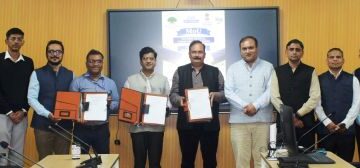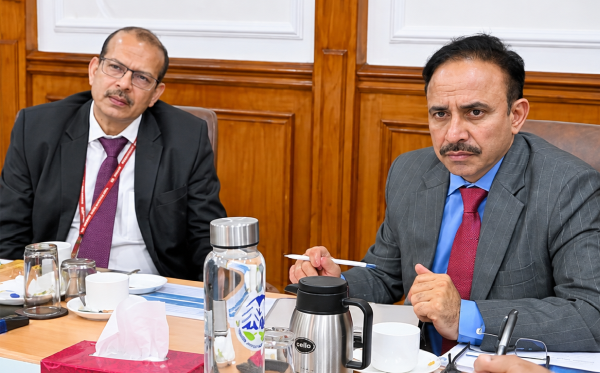
Jammu: Special Secretary, Cabinet Secretariat, Government of India, K.K. Pathak on Wednesday reviewed the progress of deregulation reforms in Jammu and Kashmir with Chief Secretary Dr. Sajjan Singh Yadav, appreciating the pace of implementation and calling for the Union Territory to go beyond national benchmarks and emerge as a model for other regions.
Pathak, who heads the Centre’s Task Force on Deregulation and Compliance Reduction, co-chaired the meeting to assess the implementation of identified Priority Areas, their impact on the ground and the extent to which regulatory simplifications were benefiting businesses, institutions and the general public.
Appreciating J&K’s progress under Deregulation 1.0 and 2.0, Pathak said several initiatives had the potential to serve as best practices for other states and Union Territories. He stressed that the objective should extend beyond meeting prescribed reform parameters to establishing a progressive, facilitative and business-friendly regulatory environment.
Advocating a risk-based approach, he called for categorising sectors and activities into low-, medium- and high-risk categories. He suggested self-certification for low-risk activities, third-party certification for medium-risk sectors and necessary regulatory oversight for high-risk activities. Such an approach, he said, would reduce unnecessary inspections and procedural hurdles without compromising public safety or quality standards.
Pathak also called for a comparative assessment of compliance requirements before and after the introduction of reforms in each Priority Area to quantify reductions in compliance, processing time, costs and procedural requirements.
Chief Secretary Yadav directed departments to organise stakeholder workshops and extensive Information, Education and Communication (IEC) campaigns to inform businesses, institutions, professionals and other stakeholders about the changes introduced under different reform areas.
He stressed that the success of deregulation should be measured by its actual impact rather than the issuance of notifications, amendments or government orders. Departments, he said, must ensure that the benefits reach intended stakeholders through effective implementation, accessibility and measurable outcomes.
During the review, Commissioner Secretary, Industries and Commerce, Vikramjit Singh presented the progress achieved under both phases of the reform programme.
Under Deregulation 1.0, 20 Priority Areas have been agreed as implemented, while two have been accepted as not applicable by the Deregulation Review Committee.
Under Deregulation 2.0, 11 Priority Areas have been agreed as implemented, while nine implemented areas are awaiting acceptance by the Task Force or Deregulation Review Cell. Eight other areas remain under implementation, including five being addressed through the J&K Ease of Doing Business Act, 2026.
The sectoral reforms reviewed include removal of dual licensing requirements for businesses, simplification of licensing procedures under the Legal Metrology Act and empowering industrial development authorities as nodal agencies for approvals within industrial clusters.
Measures to facilitate micro, small and medium enterprises (MSMEs) through self-declaration and simplified approval mechanisms were also discussed, along with rationalisation of regulatory requirements for private educational institutions.
The meeting was informed that amendments to the J&K School Education Rules, 2010, had eased infrastructure and certification requirements for private schools. The J&K Ease of Doing Business Act, 2026, provides a legislative framework for reforms relating to land use, industrial clusters, higher education institutions and professional registrations.
Other areas reviewed included rationalisation of fire safety norms, promotion of quality and affordable tourist accommodation through the Homestay Policy and streamlining of healthcare-related licensing requirements.
Yadav reiterated the administration’s commitment to institutional coordination, continuous monitoring and outcome-oriented implementation to ensure that deregulation translates into tangible benefits for citizens, entrepreneurs and institutions across Jammu and Kashmir.