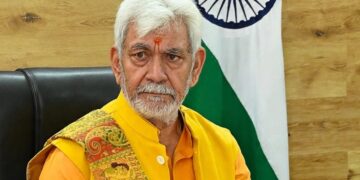
Jammu: Chairperson of the National Commission for Safai Karamcharis (NCSK), Bhagwat Prasad Makwana, on Monday called for ending manual scavenging in Jammu and Kashmir and directed officials to ensure mechanised sanitation, insurance coverage, protective equipment and social security for all sanitation workers.
Chairing a meeting at the Convention Centre in Jammu to review the implementation of the Prohibition of Employment as Manual Scavengers and their Rehabilitation Act, 2013, Makwana said manual cleaning of dry latrines, sewers, septic tanks, open drains and railway tracks was prohibited under the law.
He directed officials to prioritise mechanised cleaning and said manual intervention could be considered only in exceptional circumstances, subject to approval by the competent authority and the prevailing conditions.
Seeking a detailed assessment of the Act’s implementation in Jammu and Kashmir, Makwana also directed the administration to reconstitute the District Vigilance Committee constituted under the legislation.
On occupational safety, he asked officials to ensure that every sanitation worker receives insurance coverage, adequate training and personal protective equipment (PPE). He also directed that Employees’ Provident Fund (EPF) and Employees’ State Insurance (ESI) contributions be deposited for all eligible workers.
The NCSK chairperson called for organising multi-departmental awareness camps to inform sanitation workers about their legal rights and welfare schemes, including the Pradhan Mantri Awas Yojana, Pradhan Mantri Jan Dhan Yojana and Ayushman Bharat. He also directed that free health check-ups be provided at these camps.
Raising concerns over the dignity and social rights of the Valmiki community, Makwana directed officials to ensure that derogatory caste-based terminology was not used in official or public communications. He also called for issuing caste certificates to communities engaged in sanitation work under the name ‘Valmiki’.
He highlighted the safeguards available under the Scheduled Castes and Scheduled Tribes (Prevention of Atrocities) Act, 1989, against caste-based discrimination, abuse and humiliation.
The meeting also discussed long-pending demands concerning land rights for sanitation workers’ families living in different localities of Jammu. Makwana directed the administration to prioritise the development of residential areas inhabited by sanitation workers and provide community halls for social functions.
On financial assistance, he said children of sanitation workers could avail education loans of up to Rs 10 lakh for studies in India and Rs 20 lakh for education abroad. Sanitation workers could also access loans of up to Rs 50 lakh to establish businesses.
Under the Swachhta Udyami Yojana, individual sanitation workers can avail loans of up to Rs 15 lakh, while self-help groups and cooperatives can access assistance of up to Rs 50 lakh to purchase mechanised sanitation equipment and vehicles.
The meeting was informed that 16 sanitation workers had availed loans amounting to Rs 2.40 crore under the scheme.
Makwana also discussed other occupational concerns of sanitation workers and issued directions to the Jammu Municipal Corporation for necessary action.
The meeting was attended by Jammu Deputy Commissioner Minga Sherpa, Director Social Welfare Jammu Ranjeet Singh, Director Urban Local Bodies Jammu Kapil Sharma, representatives of various departments, officers associated with the NAMASTE scheme and sanitation worker representatives.