Jammu: Chief Minister Omar Abdullah on Saturday reiterated his government’s commitment to fostering entrepreneurship in Jammu and Kashmir, with a focus on strengthening the start-up ecosystem, easing access to credit and simplifying approval processes to help aspiring young entrepreneurs turn their business ideas into viable ventures.
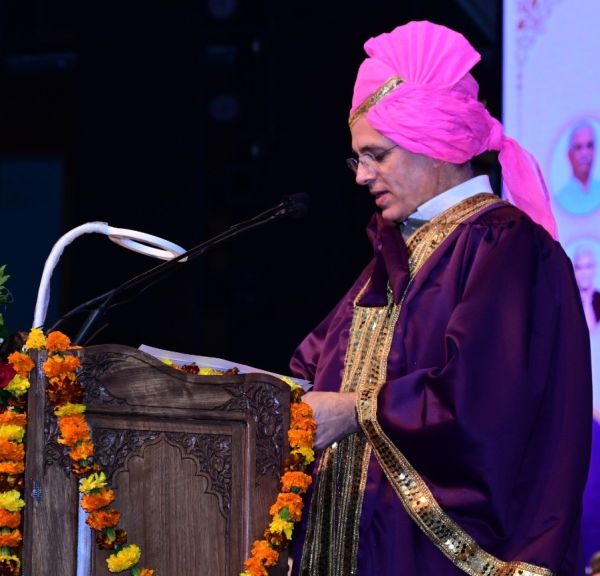
Abdullah was addressing the first-ever convocation of Cluster University of Jammu, describing the institution as a bold educational experiment conceived to bring together the region’s strongest academic traditions and modernise higher education.
Congratulating the graduating students and gold medallists, the chief minister described them as pioneers whose achievements would lay the foundation for future generations.
He also acknowledged the contribution and sacrifices of parents, families and teachers in shaping the academic journeys of the graduates.
Identifying agribusiness and food processing, sustainable tourism, cultural heritage, renewable energy, disaster resilience and the digital economy as sectors with significant potential, the chief minister called upon graduates to leverage their academic knowledge to develop enterprises and generate employment.
He pointed out that Jammu and Kashmir’s agricultural produce, including basmati rice, Bhaderwah rajmash, saffron, walnuts, kaladi and citrus fruits, offered considerable scope for value addition, branding and access to wider markets.
Similarly, he said, graduates could explore opportunities in heritage tourism, eco-tourism, digital media, renewable energy, climate-resilient infrastructure and technology-enabled services.
“My government is determined to support young entrepreneurs by strengthening the start-up ecosystem, simplifying clearances and improving access to credit,” the chief minister said.
Highlighting the distinctive character of Cluster University of Jammu, Abdullah, who was a special guest on the occasion, said the institution was conceived as a collegiate federation bringing together five established institutions-GGM Science College, MAM College, SPMR College of Commerce, Government College for Women, Gandhi Nagar, and Government College of Education.
He said the concept of pooling academic resources, faculty, libraries and laboratories while encouraging multidisciplinary learning had helped create a collaborative model of higher education.
Referring to the University’s placement in the 151–200 band of the National Institutional Ranking Framework (NIRF), he described it as an encouraging achievement.
The chief minister, however, stressed the need for sustained investment in common infrastructure, digital connectivity, modern laboratories and hostel facilities, particularly for students from far-flung areas such as Poonch, Rajouri, Doda and Kishtwar.
He also emphasised the importance of timely academic calendars and examination cycles, asserting that no student should lose an academic year waiting for examinations or the award of a degree.
“My government is committed to providing our universities with the necessary institutional support, academic autonomy, faculty strength and infrastructure to enable them to become genuine centres of knowledge, innovation and regional problem-solving,” he said.
Addressing the graduating students, the chief minister said rapid technological changes, particularly the emergence of artificial intelligence, had transformed the employment landscape, making continuous learning, critical thinking, judgement and empathy increasingly important.
He urged young graduates to look beyond conventional career paths and explore entrepreneurship and emerging economic opportunities, observing that government employment alone could not absorb every graduate.
“Sustainable prosperity in Jammu and Kashmir will come when our youth move beyond being exclusively job seekers and become value creators, innovators and entrepreneurs,” he said.
Emphasising the importance of character and social responsibility, Abdullah urged graduates to remain lifelong learners, respect the dignity of labour, uphold integrity, stay connected with their communities and prioritise their mental and physical well-being.
He also called upon them to carry Jammu and Kashmir’s pluralistic cultural ethos and heritage wherever their professional journeys took them, while contributing their skills, experience and ideas towards the development of their home region.