

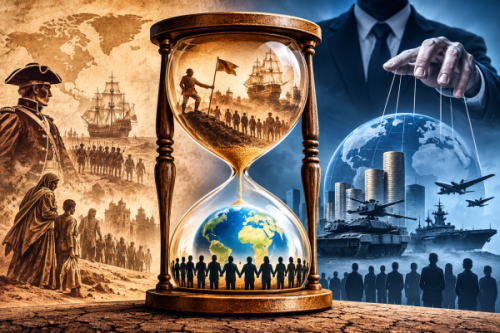
Humanity has an extraordinary ability to remember the wrongs committed against it and a remarkable ability to forget the wrongs it commits against others. This contradiction lies at the heart of many conflicts that continue to divide the modern world. We condemn the imperial conquests, colonial exploitation and territorial occupations of previous centuries, yet often remain silent when similar ambitions of domination emerge in new forms today. Have we really learned from history, or have we simply changed the language and instruments of power?
Much of today’s geopolitical tension has its roots in history. Empires expanded through conquest, colonial powers redrew boundaries, communities were displaced, cultures were suppressed, and resources were extracted for the benefit of distant rulers. Even ancient and mythological narratives continue to influence modern identities, religious beliefs, and territorial claims. These historical experiences deserve recognition. Injustices cannot be dismissed simply because they happened generations ago.
But there is a fundamental difference between acknowledging historical injustice and using it as a permanent justification for present-day hostility. How far back should we go to settle historical accounts? Which generation should be held responsible? If every nation, community or civilisation insists on reclaiming what it believes was once taken from it, will the world ever run out of territorial claims, grievances and reasons for conflict?
History is not a simple account of one side’s innocence and another’s guilt. Borders have shifted, populations have migrated, empires have risen and fallen, and different civilisations have dominated others at different points in time. Almost every society has experienced both victimhood and power. Selecting convenient chapters from history to establish permanent moral superiority is not historical justice; it is political manipulation.
The greater hypocrisy, however, is visible in the conduct of the modern world. Nations that criticise colonialism sometimes pursue economic arrangements that keep weaker countries dependent. Governments that condemn historical territorial expansion may support contemporary occupations or military interventions when strategic interests demand it. Those who speak passionately about sovereignty may disregard the sovereignty of others. The language of freedom, democracy, security and civilisation can become a convenient justification for pursuing influence, controlling resources and maintaining geopolitical dominance.
Has imperialism disappeared, or has it simply become more sophisticated?
Today’s domination does not always require planting a flag, establishing a colony or appointing a foreign governor. It can operate through economic dependency, financial pressure, control over strategic resources, military alliances, technology monopolies, sanctions, political interference, and unequal trade arrangements. Powerful countries and corporations can exercise enormous influence over the choices available to weaker societies without formally governing them. The methods have evolved, but the underlying question remains: who controls the resources, decisions and future of others?
This is not an argument that every international agreement, military partnership or economic relationship is imperialistic. Nor should every exercise of power be treated as domination. The distinction lies in whether relationships are based on genuine mutual benefit, consent and respect for sovereignty, or whether power is being used to deny others meaningful choices.
The same double standards appear in the way historical grievances are used in domestic politics. Political movements often invoke past invasions, religious conflicts and cultural humiliation to mobilise present-day populations. Instead of addressing unemployment, inequality, education, governance and social justice, leaders find it easier to revive old wounds and identify contemporary enemies. History becomes a political instrument rather than a source of learning.
Meanwhile, new grievances are being manufactured. Ethnic and religious polarisation, economic inequality, resource competition, arms proliferation, environmental exploitation and the suppression of dissent are creating the conditions for tomorrow’s conflicts. We are so occupied with debating who wronged whom centuries ago that we seem less concerned about who is being wronged today.
The lesson of history should be reconciliation, not inherited revenge. Europe, after centuries of wars and two devastating world conflicts, eventually recognised that cooperation and economic integration offered a better future than permanent confrontation. South Africa’s reconciliation process and the Northern Ireland peace process, despite their limitations, also demonstrate that acknowledging injustice and building a shared future are not mutually exclusive.
Reconciliation, however, must not become an excuse to avoid accountability. Historical truth must be preserved, injustices acknowledged and legitimate remedies pursued. But justice must be guided by evidence, law and fairness, not collective punishment or the transfer of guilt from one generation to another. Where complete historical restoration is impossible, the priority should be a just and peaceful future for those living today.
The modern world has international institutions, diplomatic mechanisms, legal frameworks and communication technologies that earlier generations could scarcely imagine. Yet, our ability to cooperate appears increasingly weaker than our ability to compete, polarise and destroy. We have developed sophisticated weapons and powerful technologies, but have we developed the political maturity to use power responsibly?
Perhaps it is time to ask a more uncomfortable question: Are today’s powerful nations genuinely interested in correcting historical injustices, or are some using historical grievances to justify their own strategic ambitions? And are societies genuinely seeking justice, or are political leaders teaching them to remain angry because anger is easier to mobilise than reason?
Humanity cannot rewrite its past, but it can refuse to reproduce it. We cannot condemn imperialism in history while practising domination in the present. We cannot demand justice for our ancestors while denying dignity and justice to others today. Nor can we build a peaceful future by teaching every new generation whom to hate.
History should be a lesson, not a licence; memory should promote justice, not justify revenge; and power should be measured by the ability to coexist, not by the capacity to dominate.
The real question facing humanity is not how many historical wrongs we can settle, but how many new wrongs we can prevent. Are we prepared to leave behind the politics of inherited grievances and build a world based on mutual respect, shared responsibility and cooperation? Or will future generations look back at our time and ask why a civilisation that understood the failures of imperialism chose to reproduce them in different forms?

