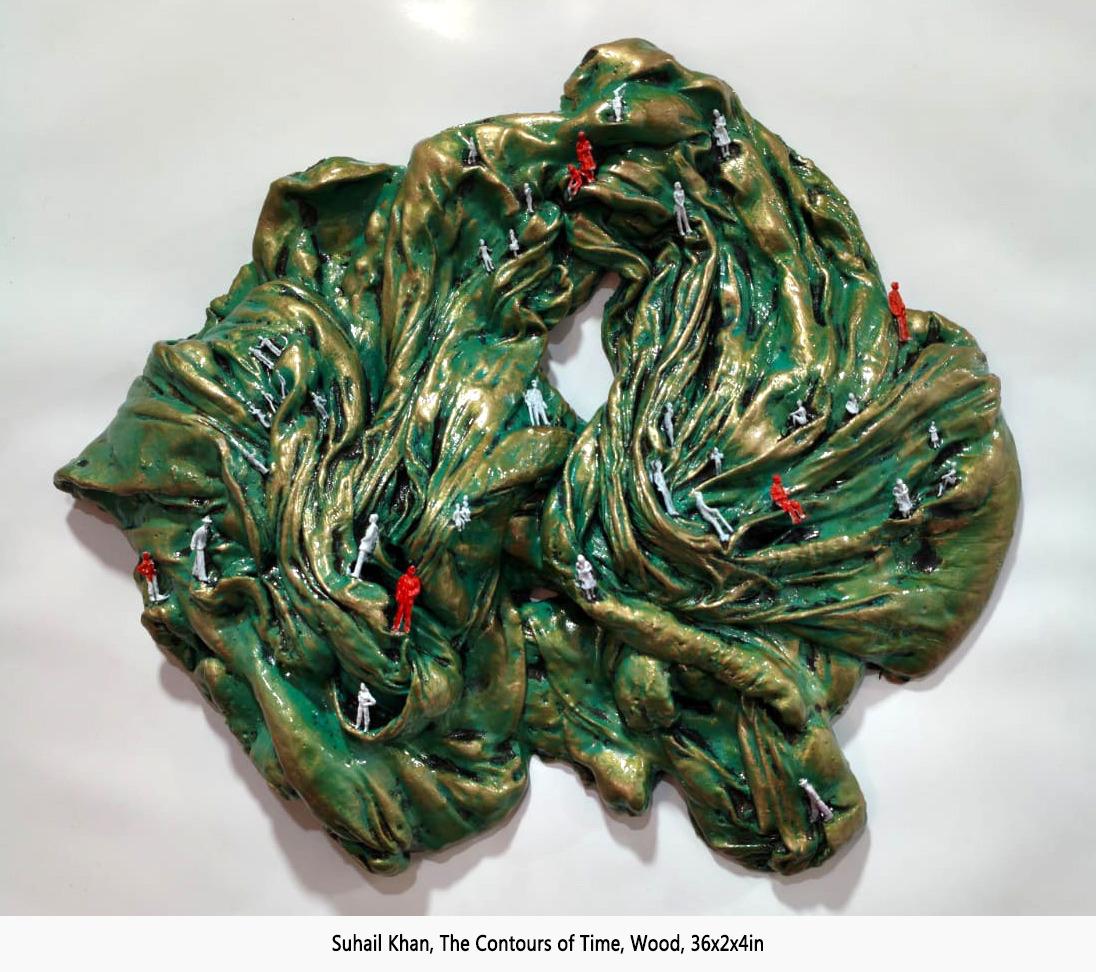
Self and Silence, a sculpture exhibition by Suhail Khan, is being presented at Art Harbour Gallery, Munawar Abad, Srinagar. Curated by Yousuf Naqshbandi, the exhibition opened on 8 November and will remain on display until 15 November. Bringing together a collection of small- and medium-sized sculptures, the exhibition offers an opportunity to engage with the artist’s exploration of human anatomy, material experimentation, personal expression, and the possibilities of communication beyond spoken language.
Upon entering the gallery, visitors encounter a collection of sculptures arranged throughout the exhibition space. As one approaches these works, observes their intricate details, examines their subject matter, and explores the different ways in which materials have been combined and arranged, a deeper engagement with the artist’s visual language begins to emerge. Each sculpture offers an opportunity to understand the artist’s creative sensibilities while simultaneously encouraging viewers to develop their own interpretations and associations. The experience gradually becomes an exploration of the relationship between the artist’s intentions, the material qualities of the sculptures, and the viewer’s perception.
Suhail Khan, an artist with hearing and speech impairments, uses sculpture as a medium to communicate his thoughts, feelings, and personal experiences. His artistic practice demonstrates how visual expression can become an important means of communication beyond conventional spoken language. Through his sculptural explorations, he attempts to establish a distinctive artistic vocabulary through which personal experiences and emotions are translated into physical forms. His works invite audiences to look beyond the immediate appearance of objects and engage with the ideas, associations, and expressions embedded within them.
One of the significant aspects of the exhibition is the artist’s exploration of human proportions, anatomical structures, and different parts of the human body. Several sculptures draw attention to individual body parts, particularly hands, ears, faces, and other organic forms. Through these explorations, the artist investigates the expressive possibilities of the human body, transforming familiar anatomical elements into independent sculptural subjects. Some works are highly detailed and appear to communicate individual narratives, while others take a more experimental, installation-based approach, incorporating mechanical components and unconventional arrangements.
Suhail demonstrates a remarkable interest in delicate workmanship, experimentation with different mediums, and the exploration of materials. His approach suggests an attempt to move beyond conventional sculptural practices and develop a distinctive visual language. The works are not merely representations of physical forms; rather, they invite viewers to consider the possible meanings and associations embedded within their structures.
The curatorial concept provides another important perspective through which to understand the exhibition. As curator Yousuf Naqshbandi observes in his curatorial note:
“Self and Silence features sculptural meditations by Suhail Khan, whose intuitive, tactile works transform everyday forms into symbols of listening, reflection, and belonging—moving between playful and profound. Hands, ears, faces, and organic forms recur as metaphors for communication beyond words: threads flow like unspoken narratives, ears become monuments to listening, and introspective figures embody contemplation. Silence emerges not as absence but as a space of reflection and creativity. Khan invites us to listen differently, challenging conventional ideas of communication and revealing inner worlds beyond language. Ultimately, Self and Silence celebrates perception—reminding us that some of the deepest human truths are felt rather than spoken.”
An interesting interpretation of the exhibition emerges through the recurring representation of ears and other human anatomical elements. Considering the artist’s hearing and speech impairments, these recurring forms may be understood as a personal exploration of communication, perception, and the experience of interacting with the world. The repeated presence of ears, in particular, invites viewers to reflect upon the significance of listening and the relationship between hearing, understanding, and expression. Although this interpretation remains open to individual perception, it provides an interesting perspective through which to engage with the artist’s work. The sculptures encourage us to consider how personal experiences and individual circumstances can become important sources of artistic exploration.
Another important dimension of Suhail’s practice is his willingness to experiment with portraiture, human body parts, and different material combinations. He explores the possibilities of transforming ordinary objects and materials into sculptural forms, sometimes introducing mechanical elements to create unusual structures. In this process, familiar shapes and found objects are recontextualised and brought together to produce new visual relationships. His approach demonstrates an interest in discovering how different materials can interact with one another and how their combination can generate meanings beyond their original functions.
One particularly interesting aspect of the exhibition is the artist’s experimentation with kinetic elements. In one of the sculptures, movement becomes an integral part of the work, introducing a dimension beyond the static nature traditionally associated with sculpture. This incorporation of movement demonstrates the artist’s curiosity about mechanical possibilities and his willingness to explore different approaches to sculptural expression. Such experimentation adds another layer to the viewing experience, allowing audiences to engage with the work not only through its physical appearance but also through its movement and changing visual character.
The combination of different materials within individual sculptures is another significant feature of the exhibition. Rather than relying on a single medium, Suhail brings together various materials, textures, and forms to construct compositions that possess their own visual identity and narrative. The relationship between these materials creates an interesting dialogue within each sculpture. Similarly, his use of ordinary shapes and found objects demonstrates an ability to recognise artistic possibilities in everyday materials and transform them into distinctive sculptural forms.
Beyond the conceptual and experimental aspects, the exhibition also draws attention to the importance of craftsmanship, finishing, and presentation in sculptural practice. The works demonstrate how even relatively small sculptures can achieve a complete and refined visual presence through careful construction, detailing, and finishing. Their display within the gallery further highlights the importance of scale, arrangement, and spatial relationships in presenting sculptural works. This aspect of the exhibition is particularly valuable in understanding how an artist can transform small-scale explorations into thoughtfully finished and professionally presented artworks within a formal exhibition setting.
Throughout the exhibition, one encounters different layers of meaning, experimentation, and material exploration. The sculptures reveal an artist who is continuously investigating the possibilities of form, structure, texture, and expression. His practice reflects a process of learning, observation, experimentation, and the gradual development of an individual artistic vocabulary. The works also demonstrate how sculpture can serve as a medium through which personal experiences, thoughts, and emotions can be communicated without depending entirely on verbal expression.
Through his sculptures, Suhail creates an alternative space in which his thoughts, feelings, and creative imagination become visible. Audiences are given an opportunity to engage with his artistic sensibilities and explore the ideas communicated through his works. Bringing such a body of work before a public audience is a significant achievement, reflecting the artist’s dedication, perseverance, and commitment to his practice. The exhibition provides a platform through which his artistic abilities can be recognised and appreciated, while also encouraging viewers to reconsider conventional assumptions about communication, artistic expression, and creative ability.
The role of the curator is equally important in this context. The thoughtful selection and presentation of Suhail’s works establish a meaningful relationship between the individual sculptures and the broader conceptual framework of the exhibition. By bringing together works that explore the human body, communication, material experimentation, and personal expression, the curator creates an opportunity for audiences to engage with the artist’s practice from multiple perspectives. The curatorial approach also helps viewers understand the relationship between the individual works and the larger ideas of silence, listening, perception, and belonging that inform the exhibition.
Ultimately, Self and Silence stands as a meaningful presentation of Suhail Khan’s artistic journey, highlighting his exploration of materials, forms, mechanical structures, and the expressive possibilities of sculpture. More importantly, it demonstrates that artistic expression is not restricted by the limitations of spoken communication. Through his sculptures, Suhail establishes a visual language of his own, inviting audiences to look closely, interpret freely, and recognise the many ways in which human experiences can be transformed into art. The exhibition leaves us with an important reflection: communication does not always require words, and sometimes the most profound expressions emerge through forms that can only be experienced, observed, and felt.