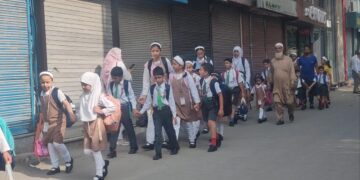

For as long as menstruation has existed, so has the silence around it. In homes, schools, and communities across Jammu & Kashmir and around the world, periods have been wrapped in coded language, fear, and myth. A girl’s first period is often met not with education but with exclusion: she cannot cook, cannot pray, cannot touch pickles, cannot sleep in her own bed, cannot be seen at all. These rules are presented as tradition, but they teach a girl, at a significant stage of her development, that her body is something to be hidden and ashamed of. Breaking myths and stigma are the foundation of menstrual hygiene work.
Where the Myths Come From
Menstrual myths are not uniquely Kashmiri, nor uniquely Indian. Across cultures, menstruation has been associated with impurity and contamination ideas rooted in longstanding beliefs about a bodily process that was poorly understood. In South Asia, they fused with religious and domestic customs and hardened into inherited rules. In some communities in J&K, they may also be linked to social expectations, family reputation, and the authority of elders.
The result is a culture of concealment. In some places, pads are wrapped in black plastic at the chemists. Girls invent headaches to skip school. Mothers whisper instructions that confuse more than they inform, and each generation reinvents the shame from scratch.
The Myths That Hold Girls Back
Some persistent myths sound harmless until one examines their cost: Menstruation is dirty or impure. In reality, it is a normal, healthy biological process: the shedding of the uterine lining and a sign that the body is working as it should. Periods should not be discussed with men or boys. This silence leaves girls without support and boys without understanding, embedding misinformation in the next generation.
Menstruating girls cannot cook, clean, or participate in daily life. These restrictions steal confidence and normalcy at exactly the age when both matter most. Pain and heavy bleeding must simply be endured. In truth, dysmenorrhea, PCOS, and Anaemia are common and treatable, but stigma delays diagnosis for years. Menstrual blood is unhygienic. It is simply not; the real risks come from poor washing facilities and unclean reused cloth, problems of infrastructure, not biology.
The Price of Shame
Stigma is a measurable harm. Studies link menstrual shame to school absenteeism and dropout, anxiety and low self-esteem, unsafe practices such as using rags or ash, untreated infections, and early marriage. In J&K, where girls in remote districts already face long distances, harsh winters, and limited facilities, stigma turns every infrastructural gap into a reason to stay home. A girl who cannot ask about her own body cannot manage her own health. Shame is, quite literally, a public health problem.
How the Conversation Is Changing
The most powerful myth-buster is honest conversation, and across Jammu & Kashmir it is finally happening now. Menstrual Hygiene Day provides an opportunity to raise awareness, while government initiatives, including the Menstrual Hygiene Scheme for girls aged 10–19 in rural areas and the Rashtriya Kishor Swasthya Karyakram, aim to improve access to menstrual health information, products and adolescent-friendly services. Their reach and impact depend on effective implementation at the local level.
The real heroes are on the frontlines: Anganwadi workers, ASHAs walking village to village, teachers who stay after class, and health workers who raise menstruation at Village Health, Sanitation and Nutrition Days. When a respected local woman says the word ‘period’ aloud in a panchayat gathering, something shifts in the room. Visibility normalises; normalisation liberates. Films, journalism and social media have carried the conversation from closed kitchens into open debate.
Everyone Has a Role to Play
Breaking stigma cannot be the job of girls alone. Fathers must learn to buy pads without embarrassment, brothers must be taught the science, not the jokes, and male teachers and doctors must join the same trainings as their female colleagues. Religious and community leaders hold particular power: when a respected imam, priest, or panchayat elder states plainly that menstruation is a matter of health, not defilement, generations of confusion can be undone in a single sentence.
Even health workers report hesitation in raising menstrual health in mixed meetings. Safe, women-led spaces, routine counselling rather than special sessions, and trained male educators are proven ways to accelerate change.
From Silence to Dignity
A myth survives only in the dark. Every open conversation in a classroom in Srinagar, an Anganwadi centre in Doda, a health camp in Kathua is a small act of daylight. Awareness programmes are reaching more schools than ever, a new generation of girls is asking questions their mothers never could, and communities are relearning a simple truth: menstruation is not a curse, a contamination, or a disgrace. It is health. It is life.
Periods without shame are not a luxury; they are a right to knowledge, dignity, education, and health. The myths took generations to build, and dismantling them will take persistence, but the conversation is no longer whispered. In Jammu & Kashmir, silence is losing its monopoly, and dignity, at last, is finding its voice.