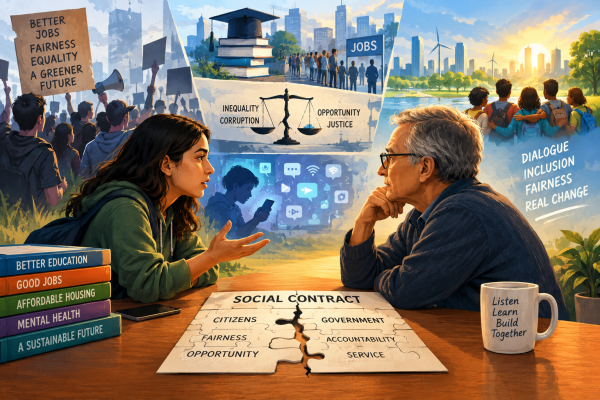
The older generation brings valuable experience and historical knowledge, but must recognise that the world facing today’s youth is very different. Artificial intelligence, changing job markets, climate change, economic pressures, and rising education and housing costs have made financial security and independent living more difficult.
The world is experiencing profound political, economic, and social transformations. Across countries and continents, younger generations are questioning established systems of governance, traditional political loyalties, and the promises made by those in power. Their concerns go beyond individual policies or political ideologies. They reflect a deeper dissatisfaction with a world in which education does not always lead to employment, hard work does not guarantee financial security, and democratic institutions often appear more concerned with retaining power than serving the public.
For the older generation, these developments should not be dismissed as youthful impatience, rebellion or a lack of respect for authority. They may represent a warning that the social contract between governments and citizens, and between one generation and the next, is coming under increasing strain. Understanding this change requires looking beyond the immediate protests and examining the conditions that are shaping the aspirations, anxieties and political attitudes of Generation Z.
Democracy Without Delivery
Democracy remains widely valued, but public confidence in its performance is weakening. Research by Pew Research Center and other organisations reveals growing dissatisfaction with democratic governance. Pew surveys across 24 countries found that, despite continued support for representative democracy, a median of 31% were open to authoritarian alternatives.
When governments fail to deliver jobs, quality education, affordable housing, public safety and economic stability, citizens begin to question whether elections alone are enough. Frustration drives some towards strong leaders who promise decisive action and an end to corruption.
Yet concentrated power can weaken courts, silence the media, suppress dissent and create new opportunities for corruption. Economic insecurity, inequality, polarisation and the perception that governments favour the wealthy further erode public trust. When frustration replaces reasoned debate, democracy faces a deeper crisis: not merely a loss of public confidence, but a failure to deliver meaningful change.
A New Form of Political Power
Modern authoritarianism increasingly operates through disinformation, online harassment, selective censorship and digital manipulation rather than overt repression. Elections may continue, but democracy weakens when independent institutions are undermined and public debate manipulated. Meanwhile, cooperation among authoritarian governments can help them resist international pressure over human rights and democratic standards.
Yet technology also empowers young people to expose wrongdoing, share information and organise collective action beyond traditional political structures. But digital platforms can spread falsehoods, fuel hatred and deepen divisions. Access to information alone does not guarantee wisdom. Young people must learn to distinguish evidence from propaganda, criticism from hatred, and genuine public movements from those manipulated by political or commercial interests.
What the Restlessness of Young People Reveals
Youth-led protests worldwide reflect growing frustration over corruption, unemployment, inequality, rising living costs and shrinking opportunities. At their heart lies a common fear: that the promise of a better future may never be fulfilled.
Education has long been seen as the path to employment, independence and dignity. But unfair examinations, biased recruitment and unemployment despite qualifications are eroding that promise. Meanwhile, rising costs and concentrated wealth leave many young people feeling that privilege matters more than merit and hard work.
When institutions appear unfair and unresponsive, frustration turns into resistance. Such protests are not necessarily a rejection of democracy or authority, but a demand for accountability, fairness and equal opportunity.
Public power is not a personal possession but a responsibility towards citizens. Governments and public institutions must serve the people and answer for their failures.
From Traditional Hierarchies to Networked Movements
Unlike traditional movements led by political parties, unions and established figures, today’s youth movements often emerge through digital networks and social media. Humour, satire, videos and online campaigns help spread grievances rapidly, building solidarity across regions and social groups without central leadership.
This decentralised structure challenges conventional power, making it difficult for authorities to silence or negotiate with movements that have no single leader. However, such movements may struggle to unite around common goals, negotiate reforms or build lasting alternatives. Their anger can also be exploited by political groups that replace existing leaders without addressing deeper problems.
Mobilisation alone cannot transform society. Lasting change requires clear proposals, democratic organisation, transparency and sustained civic participation. Challenging those in power is only the beginning; building a fairer society is the real test.
Why the Older Generation Must Pay Attention
The older generation brings valuable experience and historical knowledge, but must recognise that the world facing today’s youth is very different. Artificial intelligence, changing job markets, climate change, economic pressures, and rising education and housing costs have made financial security and independent living more difficult.
Constant access to information also exposes young people to global inequalities, creating both greater awareness and rising anxiety. Their dissatisfaction should not automatically be dismissed as indiscipline, entitlement or a lack of patriotism. Listening does not mean agreeing with every demand, but understanding genuine grievances and responding with evidence rather than prejudice.
Parents, educators, employers and political leaders must ask whether young people have access to quality education, fair recruitment, meaningful employment, affordable housing and a genuine voice in decisions affecting their future.
These are not merely youth issues; they are fundamental questions about the future stability, fairness and well-being of society.
Beyond Generational Conflict
It would be a mistake, however, to portray the older generation as an obstacle and the younger generation as the automatic agent of progress. Every generation contains reformers and conservatives, idealists and opportunists, people who defend public values and people who exploit them. Youth does not guarantee wisdom, just as age does not guarantee sound judgment.
Young people can be manipulated by misinformation, political opportunists, and emotionally charged narratives. Their understandable anger can be redirected towards scapegoats rather than the institutions and economic structures responsible for their difficulties. A movement that begins by demanding fairness can become intolerant of disagreement or indifferent to democratic procedures if it believes that its cause justifies every method.
The older generation must therefore do more than listen; it must engage in an honest exchange. Young people need access to historical experience, constitutional principles and an understanding of the difficult compromises involved in governing diverse societies. Older people, in turn, must be willing to reconsider outdated assumptions and acknowledge that established systems may require fundamental reform.
The objective should not be to transfer unquestioned authority from one generation to another. It should be to build institutions that are more transparent, responsive, inclusive and accountable to everyone.
Rebuilding the Social Contract
Governments must choose between suppressing youth dissatisfaction and treating it as an opportunity for reform. Repression may silence dissent temporarily, but it deepens resentment and weakens public trust. Restoring confidence requires fighting corruption, strengthening independent institutions, ensuring fair recruitment, improving education, creating jobs, providing affordable housing and promoting equal opportunities. Criticism must not be mistaken for disloyalty.
The private sector, educational institutions, digital platforms, families and civil society also have responsibilities. Education must encourage critical thinking and practical skills, while young people need spaces to question, debate and participate freely. Above all, governments must prove that peaceful participation can bring meaningful change and hold the powerful accountable.
Change is inevitable. The real question is whether institutions will adapt or allow frustration to grow into alienation and instability. Older generations should not fear the questions Gen Z asks, but a society in which young people stop believing their voices matter.
Young people may be impatient or mistaken, but their demand for dignity, opportunity and a say in their future deserves attention. Societies preserve their achievements not by forcing new generations to accept inherited arrangements, but by correcting failures and adapting to changing realities. The challenge is to unite the wisdom of age with the energy of youth to build a fairer future.
The future will be shaped not simply by whether Gen Z challenges the old order, but by whether the older generation has the courage to listen, the wisdom to distinguish legitimate demands from dangerous illusions, and the humility to reform what no longer works.
aijazqaisar@yahoo.com