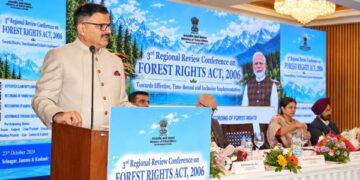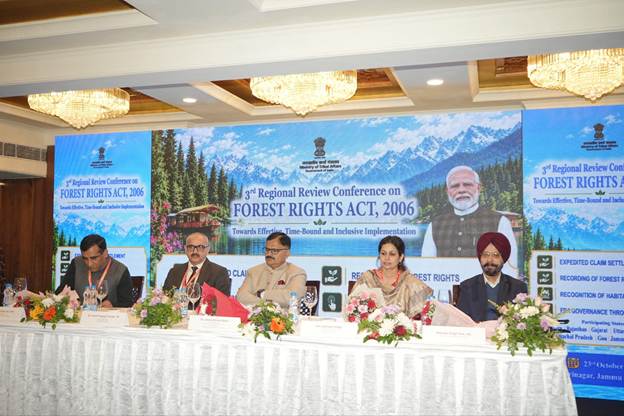
SRINAGAR: The Ministry of Tribal Affairs on Friday convened the third regional review conference on the implementation of the Forest Rights Act (FRA), 2006, in Srinagar, with officials from seven states and Jammu and Kashmir reviewing pending claims, recognition of community forest resource rights and measures to strengthen forest-dependent livelihoods.
The conference brought together senior officials from Maharashtra, Gujarat, Himachal Pradesh, Uttar Pradesh, Goa, Rajasthan and Jammu and Kashmir to assess progress, discuss implementation challenges and identify priority actions. It followed regional reviews held in Bengaluru on September 10 and Kolkata on October 9.
Jammu and Kashmir Minister for Tribal Affairs, Jal Shakti, and Forest, Ecology and Environment Javed Ahmed Rana said the Act safeguards the dignity, livelihoods and future of forest-dependent communities. He called for transparent and timely disposal of claims, stronger interdepartmental coordination and greater participation of Gram Sabhas, stressing that recognition of forest rights, conservation and sustainable development must progress together.
In his keynote address, Joint Secretary of the Ministry of Tribal Affairs Anant Prakash Pandey said that, as of August 31, 2026, around 54 lakh claims had been received nationally under the Act. Of these, 43.56 lakh, or 80.64 per cent, had been disposed of, while 25.42 lakh titles had been distributed over nearly 238 lakh acres.
He said 10.45 lakh claims remained pending and 18.13 lakh had been rejected. Pandey stressed that every rejection must be supported by a reasoned order communicated to the claimant, with statutory appeal rights preserved. He called for district-wise plans to expedite pending claims and review rejected cases, particularly in Gujarat, Maharashtra, Goa and Himachal Pradesh.
On Community Forest Resource Rights (CFRR), Pandey called for sustainable management and convergence of Community Forest Resource Management Plans with Forest Department Working Plans. He also stressed that recognised rights should be incorporated into revenue records to facilitate access to schemes such as PM-KISAN and agriculture, fisheries and livelihood programmes.
He urged states to expedite Habitat Rights recognition for Particularly Vulnerable Tribal Groups (PVTGs), noting that rights had so far been recognised for only 11 of the country’s 75 PVTGs.
Other priorities included quarterly meetings of State Level Monitoring Committees, regular submission of Monthly Progress Reports, integration of state FRA records with the National FRA Portal and use of online courses on the iGOT platform for awareness and capacity building.
Director of the Jammu and Kashmir Tribal Affairs Department Mohd Mumtaz Ali, in his welcome address, highlighted the region’s difficult terrain, dispersed settlements and seasonal pastoral movements, calling for locally appropriate administrative arrangements.
Samidha Singh, Director (FRA) in the Ministry of Tribal Affairs, outlined financial assistance of ₹25 lakh per state for FRA mapping under the Support to Tribal Research Institutes scheme and ₹15 lakh per Community Forest Resource Management Plan under DA-JGUA, along with ₹1 lakh for technical support.
She called for reconciliation of data discrepancies, stronger Gram Sabhas, greater awareness, post-claim support and preparation of Community Forest Resource Management Plans.