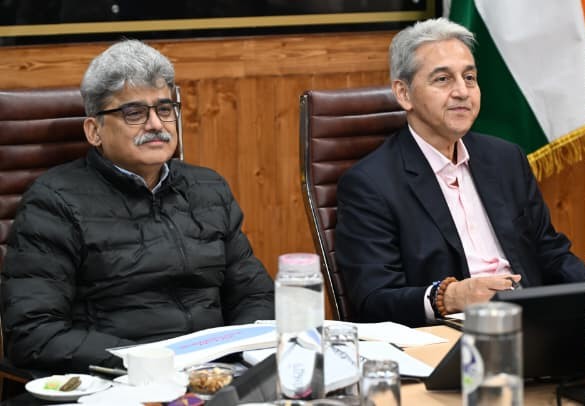
SRINAGAR: Union Secretary, Ministry of Social Justice and Empowerment, Sudhansh Pant, on Thursday lauded Jammu and Kashmir’s grassroots welfare outreach and coordinated campaign against drug abuse, calling the initiatives a model that could be replicated across the country.
Pant made the remarks during a review of social welfare schemes chaired jointly with Chief Secretary Atal Dulloo. The meeting assessed progress under beneficiary-oriented programmes, drug de-addiction and rehabilitation initiatives, scholarships, senior citizen welfare and safeguards for disadvantaged communities.
Dulloo reiterated the administration’s commitment to ensuring that welfare schemes reach all eligible beneficiaries, particularly vulnerable and underprivileged sections.
Under the Nasha Mukt J&K 100 Days Abhiyan, the department reported more than 7.21 million outreach events. Addiction Treatment Facilities had handled 66,594 outpatients, while drug de-addiction and rehabilitation centres had provided care to 1,053 people.
Police had registered 1,187 FIRs and arrested 1,349 persons in drug-related cases. Financial investigations led to the seizure or attachment of 125 immovable properties valued at ₹98.28 crore and 60 movable assets worth ₹7.04 crore belonging to drug traffickers.
The meeting was also informed about a proposed Rehabilitation and Socio-Economic Reintegration Scheme for Drug Abuse Victims, 2026, envisaging a structured three-year recovery framework. Head of Psychiatry at Government Medical College Srinagar, Dr Arshad Hussain, outlined the UT’s “Circle of Care” approach, covering treatment, rehabilitation, social reintegration and long-term monitoring.
Pant called for documenting beneficiary success stories and strengthening rehabilitation of people engaged in begging, including efforts to achieve “Begging-Free City” status in urban centres through sustained support and collaboration with non-governmental organisations.
Under the Pradhan Mantri Adarsh Gram Yojana, 419 villages had been selected for development as model villages, of which 28 had been declared Adarsh Grams. The department reported completion of 81 development works during 2026-27 so far. It also reported utilisation of ₹496.59 lakh under the Grants-in-Aid component of PM-AJAY for infrastructure, skill development and income-generating assets.
Under the Atal Vayo Abhyuday Yojana, 17 senior citizen homes were operational across J&K, accommodating around 450 people.
For the 2026-27 academic year, 20,611 applications had been received against a target of 24,817 under PM-YASASVI scholarships for Other Backward Classes, Economically Backward Classes and De-notified, Nomadic and Semi-Nomadic Tribes, as of October 15. The department had also received 5,613 post-matric and 2,866 pre-matric scholarship applications for Scheduled Caste students.
Under the National Action for Mechanized Sanitation Ecosystem (NAMASTE), 741 sewer and septic tank workers had been profiled across 74 urban local bodies, with 734 validated. Of 5,862 urban waste pickers profiled, 4,508 had been validated. The department had distributed 721 personal protective equipment kits to sewer and septic tank workers and 3,854 kits to waste pickers.
The review also covered implementation of safeguards under the Protection of Civil Rights framework and the Scheduled Castes and Scheduled Tribes (Prevention of Atrocities) Act. The SAMBAL 2.0 portal had resolved 63 of 66 registered online grievances, while ₹58.60 lakh had been disbursed through direct benefit transfers to 50 victims of atrocities between 2022 and 2026.
The J&K administration sought the Ministry’s intervention for release of the pending central share for certain Other Backward Classes hostel projects to facilitate their completion.
Pant stressed coordinated implementation and effective delivery of welfare schemes, while Dulloo called for sustained interdepartmental efforts to ensure benefits reach every eligible person.
The meeting was attended by senior officials from the Home, Education, Social Welfare and Health departments, along with representatives of welfare boards and other concerned departments.