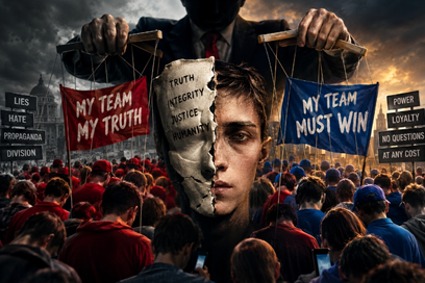
Humanity has advanced in science, technology and communication, but are we regressing in our ability to think, question and distinguish right from wrong? Across the world, politics, religion, nationalism and ideology are turning people into rival camps, each convinced of its own righteousness. The new rule seems brutally simple: my team must win, whatever the cost. Truth can be sacrificed, morality bent, laws ignored, and human suffering justified, as long as our side emerges victorious.
What happened to our conscience? When did loyalty become more important than integrity, and when did defending a leader become an excuse for abandoning our own principles? We no longer seem interested in asking whether our leaders are right. We want them to win, and we are prepared to manufacture reasons why they must always be right. The result is a disturbing spectacle: people who demand honesty from their opponents enthusiastically defend lies from their own side, and those who preach justice selectively excuse injustice when it serves their interests.
Consider the political double standards that have become commonplace. When an opponent spreads misinformation, supporters demand punishment. When their own leader does the same, they call it a misunderstanding, a strategic statement or a necessary response to provocation. When an opposing government attacks democratic institutions, it is condemned as authoritarian. When a favoured government weakens those same institutions, supporters find excuses. The facts have not changed; only the identity of the offender has. Is this political conviction, or simply hypocrisy wearing the mask of patriotism?
The same moral bankruptcy is visible in wars and international conflicts. Civilian deaths caused by an enemy are described as atrocities, while similar deaths caused by an ally are dismissed as unfortunate consequences of military necessity. One side’s suffering fills our screens; the other side’s suffering becomes an inconvenience to our narrative. We mourn selectively, condemn selectively and defend selectively. Apparently, even human life must now pass a political loyalty test before it deserves our sympathy.
This is not merely a failure of political leadership. It is a failure of citizens who surrender their judgment to the groups they support. Leaders may exploit divisions, but who gives them the licence to do so? Who spreads their propaganda, repeats their falsehoods, and attacks those who demand accountability? Who turns a blind eye when the powerful violate the very principles they claim to defend? The uncomfortable answer is that the public itself can become an accomplice to the erosion of its own freedoms.
Why do people behave this way? Because belonging can become more important than truth. Our political party, religion, nation, or ideology becomes an extension of our identity. A criticism of the group feels like an attack on us personally. Admitting that our leader is wrong begins to feel like admitting that we were wrong to support that leader. Rather than face this discomfort, we defend the indefensible.
Confirmation bias and motivated reasoning make the process easier. We accept information that flatters our beliefs and reject evidence that challenges them. Social media intensifies the problem, rewarding outrage and sensationalism while allowing unverified allegations to travel faster than corrections. We share what makes our opponents look bad, not necessarily what is true. We forward what strengthens our side, not what helps society understand an issue. The question is no longer whether a message is credible, but whether it is useful to our cause.
When we knowingly spread falsehoods because they benefit our side, we cannot continue pretending that we are merely innocent victims of propaganda. We have become its distributors.
The danger grows when leaders exhibit arrogance, intolerance of criticism, exaggerated self-importance, and contempt for accountability. Instead of recognising these as warning signs, devoted followers may celebrate them as strength. A leader who refuses to admit mistakes is praised for being decisive. One who humiliates opponents is admired for being fearless. One who attacks independent institutions is defended for taking control. Gradually, the leader’s personality becomes more important than the principles, laws, and institutions the leader is supposed to serve.
Criticism becomes betrayal. Journalists become enemies. Independent judges become obstacles. Opposition parties become threats to the nation. Citizens who question authority are accused of disloyalty. And the leader’s supporters, instead of asking why their representative fears scrutiny, join the attack on those demanding answers.
History offers a terrible warning. Nazi Germany demonstrated how propaganda, extreme nationalism, the persecution of minorities and the destruction of democratic safeguards could help turn prejudice into organised persecution. Today’s political disagreements are not automatically comparable to those atrocities, but history teaches us why the normalisation of dehumanisation, unquestioning obedience and hostility towards dissent must never be dismissed as harmless political theatre.
Are we, in our own ways, becoming political zombies; repeating slogans, defending contradictions and surrendering independent judgment? We condemn dishonesty in our opponents but rationalise it in our leaders. We demand freedom for ourselves but may support restrictions on those who disagree with us. We claim to value democracy but sometimes accept its rules only when our preferred side wins. We praise compassion but can become indifferent to suffering when the victims belong to another group.
The tragedy is that most people do not wake up one morning and decide to abandon their conscience. The surrender happens gradually. First, we excuse a small wrongdoing. Then we dismiss a larger one because the stakes are supposedly too high. Eventually, we stop asking whether our side has crossed a moral boundary and concentrate entirely on finding excuses for crossing it. Every new violation becomes easier to defend because we have already defended the previous one.
The phrase “the end justifies the means” becomes a convenient escape from responsibility. But what kind of victory is worth winning through dishonesty, hatred, injustice, or the destruction of constitutional safeguards? What is the value of a political victory if it leaves society more divided, institutions weaker, and citizens less willing to trust one another? And what does it say about us if we are willing to sacrifice our values merely to ensure that the other side loses?
The consequences are already visible wherever public life becomes a permanent battle between hostile identities. Institutions lose credibility. Facts become contested along partisan lines. Public debate deteriorates into insults and accusations. Families and communities fracture over political allegiances. Real problems – poverty, inequality, education, public health, employment, and environmental destruction – receive less attention than the daily drama of political confrontation.
Democracy cannot be reduced to winning elections. It also requires respect for constitutional limits, independent institutions, minority rights and the legitimacy of peaceful disagreement. A leader’s popularity does not place that leader above the law. An electoral mandate is not a blank cheque to do whatever one wishes. And a majority’s victory does not make every action morally or constitutionally acceptable.
Nor does genuine impartiality mean pretending that every side is equally responsible. Evidence matters. Some claims are demonstrably false; some actions violate the law; some policies cause greater harm than others. The point is not to avoid judgment but to judge consistently, rather than changing our standards according to whose interests are at stake.
We must recover the courage to question our own side. Before sharing an allegation, verify it. Before defending a leader, examine the conduct. Before condemning an opponent, ask whether we would apply the same standard to a friend. Above all, recognise that loyalty without independent judgment is not a virtue. It is a vulnerability that those seeking power can exploit.
Perhaps the most revealing test of a person’s integrity is not how fiercely they expose the wrongdoing of their opponents, but whether they can acknowledge the wrongdoing of their own leaders. It takes little courage to criticise those we dislike. It takes character to challenge those we admire, support or depend upon.
A society does not become morally corrupt only when its leaders lie, abuse power or violate the rules. It becomes vulnerable when its citizens decide that such conduct is acceptable as long as their own side benefits.
Our leaders may be ambitious, arrogant or hungry for power. But why should their ambitions become our moral obligations? Why should their victories matter more than our values? And why should the defence of a political, religious or national identity require us to abandon the humanity we claim to cherish?
The choice before us is not between loyalty and betrayal. It is between blind allegiance and moral responsibility. We can support a party without worshipping its leader, love our country without excusing its mistakes, practise our faith without endorsing intolerance, and defend our convictions without dehumanising those who disagree.
The question we must confront is brutally simple: Do we have the courage to demand truth and justice from our own side, or do we possess principles only when they can be used against our opponents?
If our team must win at any cost, then the cost may ultimately be our conscience, our democracy and our humanity. And when we finally recognise what we have sacrificed, our leaders may have won, but society will have lost.