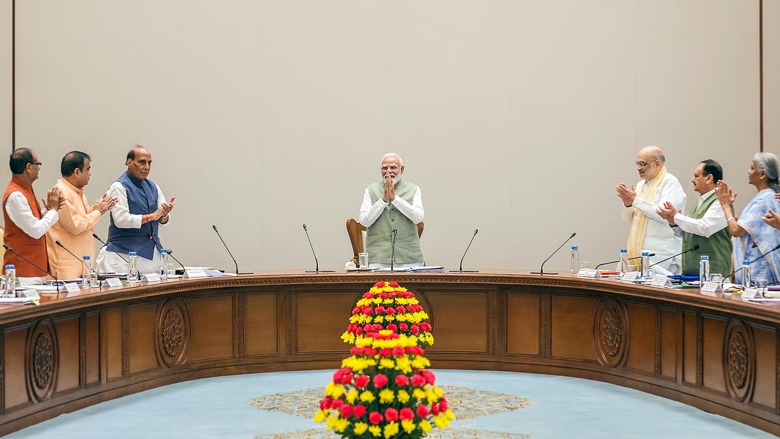
Srinagar: The Union Cabinet on Tuesday highlighted a series of decisions and developments relating to Jammu and Kashmir, Pakistan and national security while adopting a resolution marking Prime Minister Narendra Modi’s completion of 25 years as head of government, first as Chief Minister of Gujarat and later as Prime Minister.
The resolution described the abrogation of Article 370, counter-terror operations across the Line of Control and inside Pakistan, the decision to place the Indus Waters Treaty in abeyance, and the transformation of border villages as among the significant milestones of Modi’s tenure.
Referring to Jammu and Kashmir, the Cabinet said the abrogation of Article 370 was one of several major decisions implemented under Modi’s leadership after having remained pending for decades. The resolution listed the move among key measures taken in what it described as the national interest.
The Cabinet further stated that unrest in Jammu and Kashmir had for decades remained a major internal security and national security challenge, but asserted that a “new chapter of peace, development and trust” is now being written in the Union Territory. According to the resolution, governance reforms, development initiatives and security measures undertaken during the past decade have contributed to changes in the region.
On national security, the resolution said the Prime Minister had clearly defined India’s “red lines” and highlighted a series of military actions undertaken against terrorism. It cited the 2016 surgical strikes carried out by the Indian Army across the Line of Control and the 2019 air strikes by the Indian Air Force on terrorist facilities in Balakot, Pakistan.
The Cabinet also referred to Operation Sindoor in May 2025, stating that successful strikes were carried out against terrorists and their patrons across Pakistan. It said these actions had established what it described as a “new normal” in India’s fight against terrorism.
The resolution further highlighted the government’s decision to place the Indus Waters Treaty in abeyance, describing it as part of a broader strategy linked to national security and India’s response to cross-border terrorism.
A separate section of the resolution focused on border regions. It noted that border villages had traditionally been viewed as the “last villages” of the country, resulting in inadequate development and migration. The Cabinet said the government had sought to redefine them as the nation’s “first villages” and launched programmes accordingly. It stated that development initiatives in frontier areas were helping improve infrastructure, reduce migration and strengthen national security.
The Cabinet specifically referred to the Vibrant Villages Programme, saying it had contributed to the transformation of border settlements while advancing socio-economic development and strategic objectives in sensitive frontier regions.
While commending Modi’s leadership in matters relating to national security, the Cabinet said measures undertaken during his tenure had strengthened India’s response to terrorism, enhanced self-reliance in critical sectors and promoted peace and development in conflict-affected regions.
The resolution was adopted a day before Modi completes 25 consecutive years as head of government, beginning with his swearing-in as Gujarat Chief Minister on October 7, 2001, and continuing through his tenure as Prime Minister since May 2014.