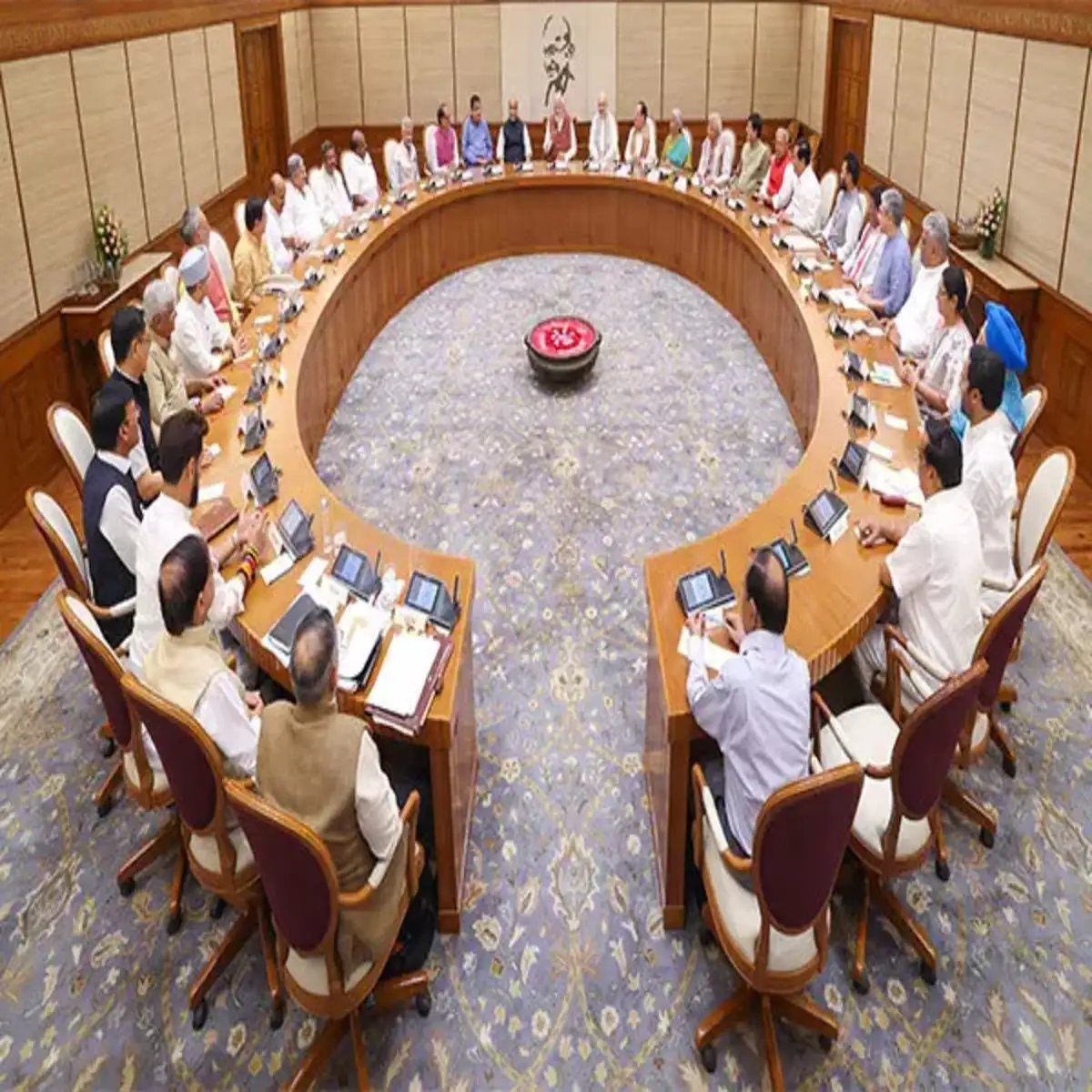
New Delhi: The Union Cabinet on Tuesday adopted a resolution marking Prime Minister Narendra Modi’s completion of 25 consecutive years as head of government, highlighting major policy decisions, welfare programmes, economic reforms, national security measures and India’s growing global profile during his tenure.
The resolution was adopted a day before Modi completes 25 years in executive office, having first assumed charge as Chief Minister of Gujarat on October 7, 2001, before becoming Prime Minister in May 2014.
Describing the period as one marked by governance reforms and institutional changes, the Cabinet cited initiatives ranging from financial inclusion and infrastructure expansion to digitalisation, manufacturing growth and social welfare programmes.
The resolution said around 60 crore Jan Dhan bank accounts had been opened since 2014, while tap water coverage in rural households had increased from about 17 per cent in 2019 to 82 per cent under the Jal Jeevan Mission. It also highlighted the construction of more than four crore houses under the Pradhan Mantri Awas Yojana and the provision of free foodgrain to 80 crore beneficiaries.
According to the Cabinet, more than 60 crore people are covered under the Ayushman Bharat health insurance scheme, while direct benefit transfer mechanisms linked to Jan Dhan, Aadhaar and mobile connectivity have reduced leakages in welfare delivery.
The resolution highlighted women-centric initiatives, including self-help groups, Mudra loans and the Lakhpati Didi programme, stating that around 3.5 crore women had achieved that status. It also referred to the Nari Shakti Vandan Adhiniyam, which provides for one-third reservation for women in the Lok Sabha and state legislative assemblies.
On youth and employment, the Cabinet cited the National Education Policy, Startup India and digital innovation initiatives, noting that India now has more than two lakh recognised startups. It also pointed to growth in sports infrastructure and athlete development programmes.
The resolution highlighted support measures for farmers, including the PM-KISAN scheme, under which more than ₹4 lakh crore has been transferred to over 10 crore farmers. It also referred to expanded institutional credit facilities for livestock rearers and fishermen.
On economic reforms, the Cabinet cited the implementation of the Goods and Services Tax (GST), expansion of digital payments through the Unified Payments Interface (UPI), and increased public capital expenditure. It said annual capital spending had risen from about ₹2 lakh crore in 2014 to over ₹12 lakh crore, while the national highway network had expanded from around 91,000 km to more than 1.46 lakh km.
The resolution also highlighted growth in electronics manufacturing, defence production and exports, semiconductor initiatives and renewable energy capacity. It noted that India’s solar power capacity had increased from less than 3 gigawatts in 2014 to over 160 GW.
On national security, the Cabinet referred to the abrogation of Article 370 in Jammu and Kashmir, implementation of One Rank One Pension, creation of the Chief of Defence Staff post and replacement of colonial-era criminal laws with the Bharatiya Nyaya Sanhita.
It also cited the 2016 surgical strikes across the Line of Control, the 2019 Balakot air strikes and Operation Sindoor in May 2025. The resolution said these actions reflected a more assertive approach to counter-terrorism. It further referred to the government’s decision to place the Indus Waters Treaty in abeyance.
Referring to Jammu and Kashmir, the Cabinet said the Union Territory had entered what it described as a “new chapter of peace, development and trust” following governance, development and security initiatives undertaken over the past decade.
The resolution also highlighted efforts to tackle Left Wing Extremism and promote peace and development in the Northeast through peace accords, rehabilitation measures and connectivity projects.
On foreign policy, the Cabinet said India’s influence on global platforms had expanded significantly over the past decade. It cited India’s G20 presidency, its role in BRICS, advocacy for the Global South and support for the African Union’s inclusion in the G20.
The Cabinet also highlighted initiatives linked to climate action, including the International Solar Alliance, Coalition for Disaster Resilient Infrastructure, Global Biofuel Alliance and Mission LiFE. It said these efforts had strengthened India’s role in international climate discussions.
The resolution further referred to cultural and heritage initiatives, including the recognition of International Day of Yoga by the United Nations, the declaration of 2023 as the International Year of Millets, redevelopment of the Kashi Vishwanath corridor and the consecration of the Ram Temple in Ayodhya in January 2024.
The Cabinet also noted programmes such as Aspirational Districts, Aspirational Blocks, Vibrant Villages and cooperative federalism initiatives through institutions including NITI Aayog, the GST Council and the PRAGATI platform.
Concluding the resolution, the Cabinet congratulated Modi on completing 25 years in office and reaffirmed its commitment to the goal of a developed India by 2047. It said the government would continue to pursue development under the slogan “Sabka Saath, Sabka Vikas, Sabka Vishwas and Sabka Prayas”.