

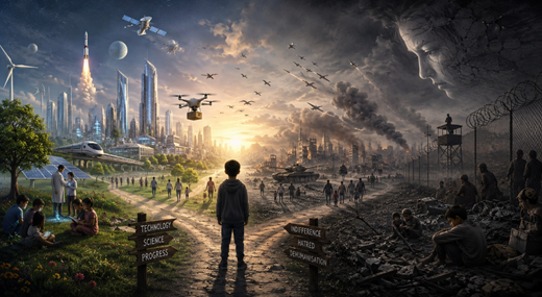
Humanity has advanced at an astonishing pace in science and technology. We can place machines on Mars, edit genes, transplant organs, communicate instantly across continents, predict storms, produce food on an industrial scale and use artificial intelligence to solve problems that once seemed beyond human capacity. Infant mortality has fallen dramatically, life expectancy has increased, literacy has expanded, and billions have access to technologies that were unimaginable even a century ago.
But technological progress is not the same as human progress.
A civilisation can become more intelligent without becoming wiser. It can become more powerful without becoming more humane. And it can develop extraordinary tools without developing an equally extraordinary sense of responsibility for how those tools are used.
The same science that gives us vaccines can produce biological weapons. Nuclear physics can provide clean energy—or weapons capable of destroying cities. Artificial intelligence can help diagnose disease and educate children, but it can also amplify propaganda, surveillance and manipulation. Social media can connect billions while simultaneously turning differences of opinion into hostility and hatred.
The question, therefore, is not simply “How far have we advanced?” It is “What have we become with the power we have acquired?”
Have we become less sensitive to human life?
There is a disturbing contradiction in the modern world. We speak more than ever about human rights, dignity, equality and freedom, yet millions of people continue to be killed, displaced, starved or treated as statistics in conflicts.
Modern warfare has made killing increasingly distant. A person sitting thousands of kilometres away can operate a weapon capable of killing someone he or she will never see. The physical distance between the decision-maker and the victim can make the moral consequences easier to ignore.
Perhaps this is one of the great dangers of technological civilisation: the more efficiently we can distance ourselves from suffering, the easier suffering becomes to rationalise.
A civilian becomes “collateral damage.” A refugee becomes an “immigration problem.” A starving population becomes a “humanitarian crisis.” A dead soldier becomes a number on a military briefing.
Language itself can become a mechanism for distancing ourselves from human beings.
Yet humanity has also advanced morally
But it would be unfair, and historically inaccurate, to conclude that humanity has simply become worse.
There has been enormous moral progress.
Slavery, once accepted by many societies, is now widely condemned. Colonial domination has largely disappeared. Women have gained rights and political participation that were denied to them for centuries. Child labour, racial discrimination, torture and genocide are increasingly recognised as violations of universal human dignity. International institutions and humanitarian organisations exist precisely because humanity has developed a stronger understanding that suffering in one part of the world cannot simply be dismissed as somebody else’s problem.
Even our outrage has changed.
When a child dies in a distant war, millions can see the image within seconds. A disaster thousands of kilometres away can generate an immediate global response. People increasingly recognise that human dignity should not depend entirely on nationality, religion, race or geography.
That is genuine progress.
But something else has happened
While our technological world has become more interconnected, our societies can simultaneously become more psychologically divided.
Algorithms often reward anger more than understanding. Political movements discover that fear mobilises people more effectively than reason. Nationalism can transform neighbours into outsiders. Religious and ideological identities can become weapons. Online platforms can turn human beings into profiles, audiences, consumers and targets.
We have gained unprecedented access to information, but information has not necessarily produced wisdom.
In fact, we now face a strange phenomenon: a person can know more and understand less.
We can instantly find thousands of facts, but struggle to distinguish truth from manipulation. We can communicate with millions but fail to listen to the person sitting next to us. We can debate global problems while becoming increasingly incapable of having a civil conversation with someone who disagrees with us.
The real crisis may be a crisis of values
Perhaps the central problem is not that humanity has become less human, but that our technological power has grown faster than our moral maturity.
Our scientific capabilities have expanded exponentially. Our ethical development has been slower and more uneven.
We have created machines that can calculate at extraordinary speed, but we still struggle with ancient human problems: greed, jealousy, tribalism, hatred, revenge, domination and fear.
The human brain that invented the internet is still capable of thinking in terms of “us” and “them.”
The scientist who discovers a new technology may be motivated by curiosity and the desire to improve life. The politician may see the same technology as a means of controlling populations. The corporation may see it as a source of profit. The military may see it as a weapon.
Technology has no inherent morality. It magnifies the morality, or immorality, of those who control it.
So, have we progressed or regressed?
Perhaps the answer is both.
We have progressed enormously in our ability to understand nature, prevent disease, communicate, travel and create. We have also made significant moral progress in recognising the dignity and rights of individuals.
But our capacity to destroy has grown alongside our capacity to create.
That leaves humanity at a dangerous crossroads.
The defining question of the 21st century may not be whether artificial intelligence will become smarter than humans, or whether technology will transform the economy. It may be much more fundamental:
Can human wisdom catch up with human power?
Because civilisation will ultimately not be judged by how sophisticated its machines became, how wealthy its economies grew or how far its spacecraft travelled.
It will be judged by something much simpler:
How did it treat human life when it had the power not to care?
And perhaps that is the uncomfortable paradox of our age: we have learned how to conquer nature, but have we learned how to conquer our own indifference?


