

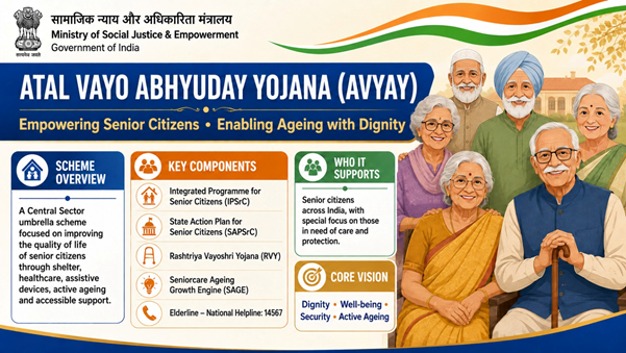
In the light of Vasudhaiva Kutumbakam (the world is one family), the glory of the elderly is their insight, their knowledge and their wisdom.
In Indian homes, there is always a memory everyone carries, a grandfather narrating an adventurous story from his childhood or a grandmother demonstrating knitting while sitting in the balcony on a fine winter afternoon. These ordinary afternoons are where a family’s real inheritance gets passed on quietly, one small skill and one shared story at a time.
We often speak about the generation gap, about grandparents who do not understand smartphones and grandchildren who do not have the patience for long stories of golden past. But I think we speak far less about generation bridges. Almost invisible ways in which the old and the young still complete each other.
What Each Generation Is Actually Giving The Other?
A grandparent gives a child something no school can teach: time, that asks for nothing in return. With growing urbanisation and both parents often working, a child’s day is usually structured around strict timetables but, a grandparent is often the one person willing to simply sit. To listen to a story being told for the fifth time. To wait while a shoelace is tied. That unhurried attention given to children shapes a sense of being valued in ways we rarely measure.
And what do these children have for giving back? Presence, which seems something very modest, yet it is not. A grandchild’s visit changes the shape of an elderly person’s whole week. A video call from a grandson away at college or a granddaughter telling her grandmother how much she misses her cooking, a great-grandchild simply climbing into a lap- these moments do for an elderly what medicine alone cannot. This is the logic behind ‘Ageing At Home’, an idea that elderly people are happiest and healthiest not in an institution but in their own home, surrounded by the family and neighbourhood they have always known and cherished.
This is not a new discovery for us. In most parts of India, touching the feet of an elder for their blessing remains one of the first gestures a child learns, a small act that teaches something no lecture could: that age is to be honoured. The Sanskrit teaching ‘Matru Devo Bhava, Pitru Devo Bhava’, ‘Regard Your Mother And Father As You Would The Divine’, remains the foundation of the values Indian families try to instil in their children. Those who raise us, deserve our reverence in return. There is another divine saying, “Paradise Lies Beneath The Feet of Your Mother”, again reflects the eternal source of blessings and contentment one can earn through love, care and service to our parents and grandparents. It means that serving, respecting and lowering oneself to care for a mother is a direct path to earning God’s pleasure and entering Paradise. Besides, it acknowledges the immense pain, hardship, and lifelong sacrifice a mother endures while raising her children.
This is why, when families stay close across generations, under one roof some exchange happens. Children raised close to grandparents tend to grow knowing the stories that shaped their family, the values their elders lived by and experiencing what patience actually looks like. And elderly people who remain woven into a family’s daily life are healthier, less anxious and less lonely.
When The Thread Frays?
But we would be telling only half the truth if we did not admit that this thread is fraying across cultures in many Indian homes today. Migration for work, nuclear families, the sheer pace of modern life, all of these have quietly left many of our elders spending their days in empty houses, waiting for a call that comes less often than it used to.
This is not a failure of love. It is usually a failure of time and distance. And because ageing at home remains the outcome every family and every elderly person requires, the support that steps in should be built to help a parent stay in their own home rather than moving out.
What we need to fully understand and embrace that the elderly are a source of wisdom, experience and stability in a world that is constantly changing.
Under the visionary leadership of Hon’ble Prime Minister Shri Narendra Modi, the Central Government’s ELDER LINE, a toll-free helpline (14567), is there the moment they simply need to talk to someone, day or night.
And under the Rashtriya Vayoshri Yojana (RVY), elderly citizens receive walking sticks, hearing aids, spectacles and other assistive devices free-of-cost, so that independence is never out of reach for want of means. These quiet supports exist precisely so that distance does not have to mean disconnection. When a grandchild does finally visit, they find a grandparent who is well, engaged and still at home, full of stories, not one who has simply been waiting.
Even when a family genuinely cannot be present every day, ageing at home need not mean ageing without care. The SHATAYU (Senior Holistic Care Assistance and Training For Your Utility) dashboard is helping build something India has long needed, a trained, trackable network of geriatric caregivers available district-by-district, so that a qualified pair of hands can step in for the hours a working son or a distant daughter simply cannot. It is care that comes to the home, rather than care that requires leaving it.
For a smaller number of elders who have no family close by, this idea of home simply takes a different shape and government-supported old age homes, run under the Atal Vayo Abhyuday Yojana (AVYAY), step in to become exactly the family they need. Residents share meals together, celebrate festivals as a household would, take part in Yoga and health check-ups and have someone to talk to over tea. It is a family, rebuilt in a different form, so that no elder ever has to grow old entirely alone.
A Small Practice Worth Reviving
If there is one thing every family could do, it is to let the generations sit together. Just an evening where a grandparent tells a grandchild about their own childhood, or a teenager teaching their grandmother to send a voice note. Teaching her to use the JEEVAN (Joint Elderly Empowerment & Virtual Assistance Network) App on her phone, where she can check which welfare schemes she is eligible for or simply have an emergency help button within her reach. These moments cost nothing and require no grand gesture. They only require intention.
Because in the end, inter-generational bonding is not really about the old teaching the young or the young energising the old. It is about both generations reminding each other of something the middle years of life tend to make us forget.
Somewhere in India today, a grandparent is folding a paper boat with a child who will not remember why that afternoon mattered. It mattered anyway. Let us make sure there are many more such afternoons and with the quiet support of schemes built exactly for this purpose, no grandparent has to spend theirs alone.
Courtesy PIB, Srinagar
(Shri Sudhansh Pant, IAS is Secretary, Ministry of Social Justice and Empowerment, Government of India)
PIBART-06-TAR/KV/GA/RK


