

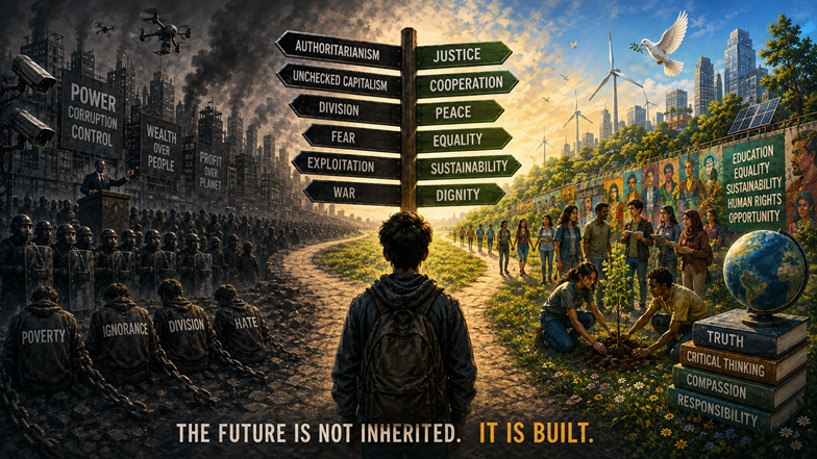
Every generation inherits a world it did not create. But today’s young people are inheriting a particularly contradictory one: extraordinary technological progress alongside inequality, enormous wealth alongside insecurity, unprecedented connectivity alongside loneliness, and greater access to information alongside misinformation and manipulation.
About 1.2 billion young people aged 15–24 worldwide represent roughly 16% of the global population. The United Nations identifies education, employment, poverty, conflict, climate change, migration and inequality among the major challenges confronting them.
The economic picture is equally troubling. The ILO (International Labour Organization) reported a global youth unemployment rate of 12.6% in 2024, even as many young people remain trapped in insecure or poorly paid work.
But the crisis is not only economic. Young people may have smartphones but little financial security; access to unlimited information but struggle to distinguish truth from propaganda; hundreds of online connections but little sense of community. The UN’s 2025 World Youth Report identifies education, employment, family circumstances, poverty, technology and societal attitudes as six interconnected factors shaping youth mental health and well-being.
The danger of easy answers:
This frustration creates fertile ground for political manipulation.
Authoritarian leaders, populists, extremists and ideological movements often offer young people simple explanations for complicated problems: blame immigrants, another religion, another nation, minorities, elites, capitalism, or democracy itself.
The message is seductive: your problems are not your fault; someone else is responsible.
History shows how dangerous this can become. Young people may overthrow one system of oppression only to create another. Replacing one powerful group with another is not transformation; it is merely a transfer of power.
The challenge, therefore, is not simply to rebel. It is to develop the judgment to understand what should replace the system being challenged.
The first revolution must be in the mind:
Young people need to become harder to manipulate.
In an age of artificial intelligence, social media and political propaganda, critical thinking is no longer an academic skill; it is a democratic necessity. The essential question should not be “Who said this?” but “How do we know it is true?”
Young citizens must learn to verify information, understand competing historical perspectives and question their own beliefs as seriously as those of their opponents.
Beyond the capitalism-versus-socialism debate:
The economic choice should not be reduced to capitalism or socialism.
Markets, entrepreneurship and private enterprise have generated enormous innovation and prosperity. But capitalism becomes destructive when profit becomes the only measure of success, when wealth buys political influence, monopolies become too powerful, workers are treated merely as costs and economic growth destroys the environment.
The goal should be an economy where innovation is rewarded but exploitation is not; wealth can be created but extreme inequality is challenged; and technology expands opportunity rather than insecurity.
The question is not whether capitalism should disappear. It is whether capitalism can be made responsible to society.
From identity to humanity:
Young people are also being pushed into increasingly narrow identities: my country, my religion, my race, my ideology, my political tribe.
Yet the greatest challenges facing them do not respect these boundaries. Climate change, pandemics, artificial intelligence, economic crises, and war cross borders.
This does not mean abandoning national, cultural or religious identities. It means refusing to turn identity into a justification for hatred.
Humanity’s problems are becoming global while politics remains trapped in tribal thinking.
Peace must become a project:
Peace is not simply the absence of war. It requires justice, opportunity, dialogue and institutions capable of resolving differences without violence.
Young people should demand investment not only in military strength but also in education, healthcare, employment, science, climate resilience and diplomacy. A society that gives its young people a future has less need to manufacture enemies.
But youth must also look in the mirror:
It is easy to blame politicians, corporations and previous generations. Some criticism is justified. But young people must also ask whether they are prepared to behave differently.
Can we demand democracy while refusing to listen to opposing views?
Can we demand justice while treating political opponents as enemies?
Can we condemn propaganda while believing everything that confirms our prejudices?
Can we demand peace while glorifying violence committed by our own side?
A better world cannot be built by reproducing the same intolerance in a new generation.
The revolution the world needs:
The next youth revolution should not simply replace one leader, ideology or system with another. It should change how power itself is organised.
Young people should demand independent courts, free journalism, transparent governments, accountable corporations, competitive elections, strong civil society, scientific education and international cooperation.
The question should not merely be “Who should rule?”
It should be: “How do we make sure that whoever rules can be held accountable?”
Imagine a generation that votes for competence and integrity rather than identity; entrepreneurs who measure success partly by the problems they solve; technology designed to strengthen human relationships rather than exploit attention; and citizens who verify information before sharing it and question their own leaders as fiercely as their opponents.
That would be a genuine revolution.
The objective should not be to move simply from authoritarianism to another form of authoritarianism, or from capitalism to another rigid economic ideology.
It should be a transformation from power over people to power with people; from competition without responsibility to cooperation with dignity; and from politics of fear to politics of possibility.
The future will not automatically become better because young people inherit it.
It will become better only when they understand that inheriting the future also means accepting responsibility for changing it.
Can the next generation move beyond authoritarian power, unchecked capitalism, and politics of division?
Every generation inherits a world it did not create. But today’s young people are inheriting a particularly contradictory one: extraordinary technological progress alongside inequality, enormous wealth alongside insecurity, unprecedented connectivity alongside loneliness, and greater access to information alongside misinformation and manipulation.
There are about 1.2 billion young people aged 15–24 worldwide, representing roughly 16% of the global population. The United Nations identifies education, employment, poverty, conflict, climate change, migration and inequality among the major challenges confronting them.
The economic picture is equally troubling. The ILO (International Labour Organization) reported a global youth unemployment rate of 12.6% in 2024, even as many young people remain trapped in insecure or poorly paid work.
But the crisis is not only economic. Young people may have smartphones but little financial security; access to unlimited information but struggle to distinguish truth from propaganda; hundreds of online connections but little sense of community. The UN’s 2025 World Youth Report identifies education, employment, family circumstances, poverty, technology and societal attitudes as six interconnected factors shaping youth mental health and well-being.
The danger of easy answers:
This frustration creates fertile ground for political manipulation.
Authoritarian leaders, populists, extremists, and ideological movements often offer young people simple explanations for complicated problems: blame immigrants, another religion, another nation, minorities, elites, capitalism, or democracy itself.
The message is seductive: your problems are not your fault; someone else is responsible.
History shows how dangerous this can become. Young people may overthrow one system of oppression only to create another. Replacing one powerful group with another is not transformation; it is merely a transfer of power.
The challenge, therefore, is not simply to rebel. It is to develop the judgment to understand what should replace the system being challenged.
The first revolution must be in the mind:
Young people need to become harder to manipulate.
In an age of artificial intelligence, social media and political propaganda, critical thinking is no longer an academic skill; it is a democratic necessity. The essential question should not be “Who said this?” but “How do we know it is true?”
Young citizens must learn to verify information, understand competing historical perspectives, and question their own beliefs as seriously as those of their opponents.
Beyond the capitalism-versus-socialism debate:
The economic choice should not be reduced to capitalism or socialism.
Markets, entrepreneurship and private enterprise have generated enormous innovation and prosperity. But capitalism becomes destructive when profit becomes the only measure of success, when wealth buys political influence, monopolies become too powerful, workers are treated merely as costs, and economic growth destroys the environment.
The goal should be an economy where innovation is rewarded, but exploitation is not; wealth can be created but extreme inequality is challenged; and technology expands opportunity rather than insecurity.
The question is not whether capitalism should disappear. It is whether capitalism can be made responsible to society.
From identity to humanity:
Young people are also being pushed into increasingly narrow identities: my country, my religion, my race, my ideology, my political tribe.
Yet the greatest challenges facing them do not respect these boundaries. Climate change, pandemics, artificial intelligence, economic crises, and war cross borders.
This does not mean abandoning national, cultural, or religious identities. It means refusing to turn identity into a justification for hatred.
Humanity’s problems are becoming global while politics remains trapped in tribal thinking.
Peace must become a project:
Peace is not simply the absence of war. It requires justice, opportunity, dialogue and institutions capable of resolving differences without violence.
Young people should demand investment not only in military strength but also in education, healthcare, employment, science, climate resilience and diplomacy. A society that gives its young people a future has less need to manufacture enemies.
But youth must also look in the mirror:
It is easy to blame politicians, corporations and previous generations. Some criticism is justified. But young people must also ask whether they are prepared to behave differently.
Can we demand democracy while refusing to listen to opposing views?
Can we demand justice while treating political opponents as enemies?
Can we condemn propaganda while believing everything that confirms our prejudices?
Can we demand peace while glorifying violence committed by our own side?
A better world cannot be built by reproducing the same intolerance in a new generation.
The revolution the world needs:
The next youth revolution should not simply replace one leader, ideology or system with another. It should change how power itself is organised.
Young people should demand independent courts, free journalism, transparent governments, accountable corporations, competitive elections, strong civil society, scientific education and international cooperation.
The question should not merely be “Who should rule?”
It should be: “How do we make sure that whoever rules can be held accountable?”
Imagine a generation that votes for competence and integrity rather than identity; entrepreneurs who measure success partly by the problems they solve; technology designed to strengthen human relationships rather than exploit attention; and citizens who verify information before sharing it and question their own leaders as fiercely as their opponents.
That would be a genuine revolution.
The objective should not be to move simply from authoritarianism to another form of authoritarianism, or from capitalism to another rigid economic ideology.
It should be a transformation from power over people to power with people; from competition without responsibility to cooperation with dignity; and from politics of fear to politics of possibility.
The future will not automatically become better because young people inherit it.
It will become better only when they understand that inheriting the future also means accepting responsibility for changing it.

