Kathmandu: The death toll from flash floods in Nepal rose to 788 on Saturday, with bodies continuing to be recovered, as authorities warned of increased water levels in the Bhotekoshi River and urged residents and rescue personnel in flood-hit districts to remain alert.
More than 2,500 people still remain missing, while nearly 9,500 people were rescued, according to the National Disaster Risk Reduction and Management Authority (NDRRMA).
The disaster, believed to have been triggered by a collapse or avalanche of ice and rock near the Nepal-Tibet border, devastated towns and villages in northern and central Nepal on August 26.
The Bhotekoshi River, which flows south from the Himalayan border region, carried the floodwaters downstream, sweeping away homes, vehicles, roads and bridges and damaging hydropower projects.
It killed 16 people on the Chinese side as well, while nearly 550 people remain missing in Tibet, according to Chinese media reports.
In a statement issued on Sunday, the NDRRMA warned that water levels in the Bhotekoshi River had risen again. “The water level in the flooded Bhotekoshi River has risen to some extent; all concerned are urged to take precautionary measures,” it said, adding that it will provide updates on the situation after receiving additional information.
As many as 2,502 people, including 591 foreigners, remain missing in Nepal following the disaster, according to authorities.
The Ministry of External Affairs (MEA) in New Delhi on Saturday said that more than 275 Indians and 128 persons of Indian origin remained missing or non-contactable in Nepal. On Sunday, the MEA on its X handle shared a list of 149 people who were rescued.
According to preliminary data released by Nepal’s education ministry, the missing persons include 238 students and 18 teachers from different schools in three flood-affected districts.
Nearly 9,500 people were rescued from flood-affected areas till Sunday evening, which includes locals and tourists from multiple countries, including India, the US, China, Russia, the UK, Spain, Belgium, Germany, Italy, Malta, Turkiye ,Switzerland and Portugal, officials said.
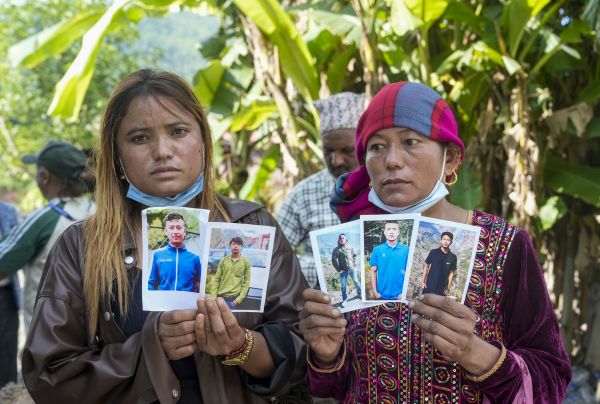
For survivors, the ordeal is now about piecing their lives back together, even as many remain separated from loved ones and uncertain about what lies ahead. Most survivors are now confronting the difficult task of rebuilding amid the destruction.
Bodies continued to be recovered in the Himalayan nation after the flash floods as search and rescue operations pressed ahead amid intermittent rainfall and rising water levels.
In Nepal’s hospitals, which have been witnessing major crowds of people looking for their missing relatives, the focus is increasingly shifting towards identifying the dead.
Photographs have been pasted outside hospital walls, where huge gatherings could be seen scanning them with attention.
However, of the bodies recovered so far, only 17 have been identified, police said.
“Only 17 bodies have been identified so far as most of the bodies are either in a dilapidated state or amputated,” said Rajendra Prasad Dhamala, spokesperson for the Bagmati Province Police Office, highlighting why identification of the bodies has emerged as a challenge.
Dhamala said 96 bodies had so far been buried after completing the necessary legal procedures. DNA samples were collected from the bodies before burial and preserved in designated places in accordance with existing regulations, he said.
The identified bodies are being handed over to family members after completion of the verification process, Dhamala added.
Nepal’s Foreign Secretary Amrit Bahadur Rai said in a press briefing on Sunday that the mortal remains of victims who could not be identified, including those that were unrecognisable, amputated or decomposed due to prolonged exposure to water, had been buried following “standard and accepted protocols”.
“Medical teams have taken DNA samples from every victim prior to the burial so that families can match records later. They will be allowed to exhume for necessary rituals,” Rai said.
He further said an 18-member team of forensic experts from India specialising in DNA analysis had arrived in Nepal and that coordination between the two countries was continuing.
The disaster also left 16 dead and 546 people missing on the Chinese side, where rescue operations continue at full pace amid similar difficulties. The missing in Tibet included 261 foreigners from 23 countries, including 49 Indians.
Fears of fresh flooding in Nepal were triggered after a lake formed on the Chinese side following the August 26 Himalayan glacier collapse. However, on Saturday, the threat appeared to recede as the barrier lake’s size began decreasing, according to Chinese media reports.
On Sunday, fresh reports said a landslide near the natural dam had led to the formation of another “dam lake”, prompting rescue personnel to evacuate the area.
Meanwhile, Nepal’s meteorology department on Saturday warned of fresh rainfall and thunderstorms in the country’s flash flood-affected areas, which could make rescue operations further difficult.
The Nepalese government has mobilised more than 20,000 security personnel for search and rescue operations, while helicopters have been making repeated sorties to evacuate stranded people and deliver relief supplies.
Transport services have been halted along the Prithvi Highway, a vital roadway linking capital city Kathmandu to Pokhara and western Nepal.
A section of the road was washed away by the Trishuli River at Krishnabhir. Officials said the highway’s reopening would take some time, and urged people to use an alternative way for their travel.
Nineteen motorable bridges and several highways and arterial roads were washed away when the flash floods struck the Himalayan nation on August 26.
The flash floods also damaged eight operational hydropower projects with a total capacity of 354 MW and five under-construction projects located in Nuwakot and Rasuwa districts, according to the Independent Power Producers’ Association Nepal.
Nepali Army engineers intensified efforts on Sunday to reach people believed trapped inside the Upper Trishuli-3A hydropower project tunnel in flood-hit Nuwakot, using heavy equipment and blasting to widen an opening into the buried structure.
As many as 537 workers and employees remained unaccounted for at nine hydropower projects in Nepal’s flood-hit Rasuwa and Nuwakot districts – the Trishuli-3A hydropower project tunnel is one of them.
An 11-member team from India is assisting the rescue operations of the trapped workers.
“The tunnel rescue team from India worked with the Nepali Army’s team to conduct search & rescue operations at hydropower tunnel sites in Chilime and Langtang area today. The team will continue to conduct search and rescue operations in close coordination with the Nepali Army,” the Indian embassy in Nepal posted on social media on Sunday.
So far, 37 trucks and 35 SUVs carrying food items and eight helicopters filled with food and non-food items have been dispatched to the affected areas.
Meanwhile, India has provided 68.5 tonnes of relief materials and sent technical teams, forensic experts and equipment to assist in search and rescue operations, according to the Indian embassy in Kathmandu.
“The fourth flight, carrying 11 tons of relief materials, has arrived in Nepal, and those relief materials have been handed over,” the Indian mission said. “This includes a tunnel technical team equipped for search and rescue operations, a team of forensic experts for DNA analysis, and relief materials such as blankets, sleeping bags, tarpaulins, plastic sheets, and hygiene kits.”