
Dear Prime Minister,
India is preparing to celebrate another Independence Day.
The Tricolour will rise. The anthem will play. Speeches will invoke sacrifice, sovereignty, freedom and the extraordinary journey of a nation that broke free from colonial rule.
On 15 August 2026, India will complete 79 years of Independence.
But somewhere beneath that same Tricolour will stand a Kashmiri Pandit who has celebrated 36 Independence Days away from home.
And, Prime Minister, that raises an uncomfortable question:
How many Independence Days must a displaced Indian celebrate before displacement itself becomes unacceptable?
As of March 2026, the Government of India continues to provide registered Kashmiri migrant families under the relief category a petty cash assistance per person per month, subject to a ominous ceiling, besides free ration.
A civilization was uprooted.
Thirty-six years later, rehabilitation can still be described partly in kilograms of rice and a monthly dole to a people who, once upon a time, were known for their literary and skilled acumen.
Through Sharda Peeth, it was Kashmiri Pandits, gave the world the music, the theory of beauty through Anandavardhana who developed the celebrated theory of dhvani, Abhinavbharti through which Abhinavgupta developed the understanding of rasa in Bharata’s Natyashastra commentary, then Somadeva’s Kathasaritsagara – the enormous “Ocean of the Streams of Stories,” and then Kshemendra, an astonishingly versatile Sanskrit writer, apart from Pandit Kalhana widely known and revered for Rajatarangini. It is one among us, who gave the world the zero – until, unfortunately, we were reduced to zero ourselves. The list is endless – as endless as the stories woven around the orphan of 36 years, which I will come to later.
But, that is not to suggest that nothing has been done.
Much has.
Your government deserves acknowledgement where acknowledgement is due.
Jobs have been created for migrant youth. Of the 6,000 posts earmarked for Kashmiri migrants, appointment orders had been issued to 5,896 candidates – 98.26 per cent – by March 2026. Of these, half were sanctioned under PM Package 2008 and half under PM Development Package 2015. What matters is the jobs, and not who sanctioned them and when. We Kashmiri Pandits wholeheartedly thank both the packages and subsequent developments that have and are happening in their connection.
The Government has also approved 6,000 transit accommodation units at 20 locations across the Kashmir Valley. Of these, 4,112 had been constructed and 3,257 allotted by March 2026.
Your government also gave displaced Kashmiris institutional political representation through changes to the J&K constitutional framework. The Union Government itself has repeatedly spoken about restoring their rights, properties and political voice. Thank you, again.
All of that deserves recognition.
But, Prime Minister, after 36 years the Kashmiri Pandit must be permitted to ask a different question.
Not: what has been done for us?
But: what has actually been restored to us?
There lies the Bitter Truth.
A 36-YEAR-OLD ORPHAN
The Kashmiri Pandit today resembles, metaphorically, a 36-year-old orphan living inside a 76-year-old Republic. Or a nation that is now 79-years-old free.
An orphan need not be starving – He may have relatives- Someone may pay his school fees- Someone may give him a room – Someone may provide an allowance – Everyone may express affection whenever the family gathers – But none of that gives him back his parents.
And none of it restores his inheritance.
For more than three decades, governments have changed. Prime Ministers have changed. Chief Ministers have changed. Governors became Lieutenant Governors. Political parties rose, fell, returned and reinvented themselves.
The vocabulary changed too.
Return – Rehabilitation – Packages – Jobs – Transit accommodation – Clusters – Security – Representation – Relief.
But one word stubbornly survived every government:
Migrant. Beg your pardon, we are not migrants – we are refugees in our own land.
Prime Minister, a teenager who left Kashmir in 1990 is today approaching retirement.
A child born in displacement is now middle-aged.
Many of those who carried the keys of their abandoned houses believing they would return after a few months have died carrying those keys.
The generation that could identify every boundary stone, every orchard, every spring, every small temple and every neighbour is disappearing.
With every funeral, therefore, return becomes a little less geographical and a little more archaeological.
The State is not merely racing a calendar anymore. It is racing mortality. And beg your pardon again, this wonderful nation owes us an answer for what it has done to our patriotism.
RELIEF IS NOT RESTORATION
There is an important distinction that the Government of India must now recognise.
Survival is not rehabilitation.
Ration ensures survival – Cash relief provides subsistence – A government job provides livelihood – A transit flat provides accommodation – Security provides protection.
All are necessary.
But none of them, separately or together, automatically recreates a homeland.
An orphan does not need only an allowance; he eventually needs his inheritance.
And the Kashmiri Pandit’s inheritance is not merely four walls.
It is his ancestral house; his agricultural land; his orchard; his temple; his Bhairav asthapan; his nag; his cremation ground; his language; his neighbourhood; his memories.
And above everything else, his unquestioned right to belong. We belong to none.
For 36 years, the Indian State has progressively become better at maintaining the orphan.
The time has come to ask whether it can now restore his inheritance. Or is it that maintaining the orphan is far more advantageous than rehabilitating him.
THEN THERE ARE THE LITTLE TEMPLES
There is one aspect of this displacement which I would particularly request you to look at.
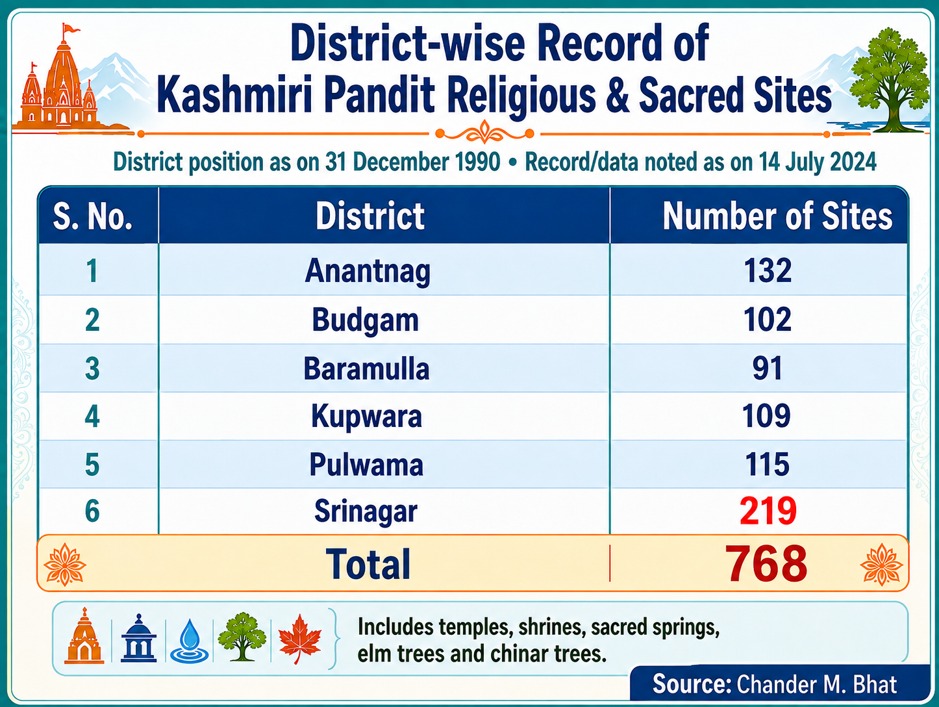
The temples Kashmiri Pandits left behind. Around 768, plus-minus a few more, in all across length and breadth of Kashmir.
And not merely the great shrines.
Not only Kheer Bhawani, Vicharnag Temple, Shankaracharya or those temples important enough to attract pilgrims, television cameras and political visits.
Please look for the little ones.
The tiny Shiva temple at the end of a village.
The small Bhairav shrine perhaps known only to twenty families who once lived around it.
The Devi asthapan behind an old wall.
The village nag.
The sacred spring.
The shrine beneath an ancient tree.
The cremation ground where generations of one village performed their last rites.
The great temples will usually survive because everybody knows their names.
But who remembers the temple of a village from which the last Pandit disappeared three-and-a-half decades ago?
Who lights its lamp? – Who knows its boundaries? – Who checks its revenue records? – Who knows whether its pathway still exists?
Who notices when one stone disappears, then another, then some attached land – and finally the shrine itself disappears from living memory? During the last 36 years much has disappeared from the living memory, and ever since you assumed the Prime Ministership – much more.
A civilization rarely disappears because somebody demolishes its largest monument.
It disappears when its smallest landmarks become nobody’s responsibility. Our places of worship, as on date, are as good or as bad orphans as we are.
That is why I would request your government to initiate something unprecedented:
A KASHMIRI PANDIT HERITAGE REGISTER
Order a Valley-wide, district-by-district and village-by-village inventory of every Kashmiri Pandit temple, shrine, asthapan, nag, sacred spring, cremation ground, dharamshala and attached property.
Geo-tag every one of them; photograph their present condition; digitise their revenue records; verify their boundaries; record their current possession; legally identify encroachments wherever they exist; classify damaged structures requiring conservation; record the oral history associated with each site before those who remember it are gone; and put the inventory in the public domain.
Because what cannot be counted can very conveniently be forgotten.
Before asking a civilization to return, Prime Minister, surely India must first know what remains of the civilization to which it is being asked to return.
A transit flat can accommodate a family; it cannot accommodate a civilization.
Our temples were the geographical punctuation marks of Kashmiri Pandit civilization.
Official figures presented by the J&K government over the years have themselves recorded hundreds of such religious places across the Valley and substantial numbers that were damaged or left dilapidated.
But perhaps the smallest temples matter the most.
The great shrine will usually survive because everyone knows its name.
The government should therefore undertake a Valley-wide, village-by-village inventory of every Kashmiri Pandit temple, shrine, asthapan, nag, cremation ground and attached property – large or small.
Each should be geo-tagged; its revenue records should be digitised; its land boundaries should be physically verified; its present condition should be photographed; Encroachments, where established through due process, should be recorded and acted upon; damaged structures should be categorised for conservation; And responsibility for every site should be clearly fixed.
Put the entire inventory in the public domain.
Because what cannot be counted can conveniently be forgotten.
There is an even larger question here.
We keep asking when Kashmiri Pandits will return. Even recently honorable lieutenant governor said during an event that time was ripe for Kashmiri Pandits to return.
Return to what?
A homeland is not merely the house in which you slept.
It is also the temple bell you heard in the morning, the spring where your mother went on a festival, the Bhairav under an old tree, the cremation ground where your ancestors were consigned to the flames and the shrine around which an entire village’s memory was organised.
Remove those things and you may restore property to a Kashmiri Pandit.
But you have not restored his Kashmir.
GIVE US A RETURN AUDIT
This Independence Day, instead of another symposium on Kashmiri Pandit rehabilitation, why not order a national Return Audit?
Let the Government tell the country:
How many Kashmiri Pandit families have permanently returned to Kashmir – not employees living there because their jobs require them to?
How many ancestral houses have been physically restored to their owners?
How much migrant agricultural land has been returned to actual possession?
How many property disputes remain pending?
How many alleged encroachments remain unresolved?
How many Kashmiri Pandit temples and shrines have been physically surveyed?
How many have authenticated land records and verified boundaries?
How many cremation grounds remain protected?
How many villages that had Pandit families in January 1990 have resident Pandit families today?
How many young Kashmiri Pandits have established businesses in the Valley?
And, perhaps most importantly:
Does the Government of India today possess an authoritative figure for how many displaced Kashmiri Pandit families have actually gone home permanently?
If it does, publish it.
If it does not, then after 36 years we must ask:
What exactly have we been measuring when we measure rehabilitation?
Do not tell the orphan merely how much money has been spent on him.
Tell him how much of his life has been restored.
RETURN MUST MEAN THE FREEDOM TO CHOOSE
There is another principle that needs to be stated clearly.
The Kashmiri Pandit does not need Kashmir exclusively.
He needs Kashmir equally.
He does not need somebody else removed so that he may return.
He needs the constitutional confidence to return beside the people who already live there.
The answer to one displacement can never be another displacement.
And therefore, genuine rehabilitation will have arrived not when a Kashmiri Pandit can live inside a protected complex, but when an ordinary Pandit family – with no government job, political connection or special influence – can say:
“We want to live in our ancestral village again.”
And the Republic answers:
“You have every right to. We will make that right real.”
That would be return.
Everything else is preparation for return. And rhetoric.
YOU DID NOT CREATE 1990
Prime Minister, you did not create the Kashmiri Pandit displacement.
Your government did not exist when those terrible events unfolded.
It would therefore be unreasonable to transfer the responsibility for 1990 onto 2026.
Indeed, your government can legitimately point towards measures it has undertaken – from employment and transit housing to representation and property-related initiatives.
Barring a few, most of the properties have been restored on papers and press notes. The ground reality there are still many Pandits struggling to get their properties returned back to them even after fighting for more than two decades.
Nothing has changed for them; except that some are approaching their end of life, and some grown too old to follow up with stubborn revenue system of the Valley.
But history sometimes gives leaders responsibility for problems they did not create.
And sometimes their legacy is determined not by the inheritance they received, but by what they decided to do with it.
You now have something many governments before yours did not possess: the political authority, administrative machinery and national mandate to convert “eventual return” from a phrase into a measurable national mission.
Thirty-six years is long enough for temporary displacement; it is long enough for relief; it is long enough for committees; it is long enough for packages; it is certainly long enough for the word migrant to have become hereditary.
PRIME MINISTER, GIVE THE ORPHAN HIS INHERITANCE
On 15 August, India will celebrate 79 years of freedom.
The Republic itself is 76 years old.
And within it lives a refugee who is now 36 years old.
Do not give this 36-year-old orphan another allowance.
Give him an inventory of his inheritance; Protect what remains; Restore what can still be restored; Bring his forgotten temples back onto the map; Restore lawful possession of his land and home; Give justice wherever justice remains possible and create conditions in which returning to Kashmir becomes an ordinary personal decision – not an act of extraordinary courage.
Kashmiri Pandits do not need another promise that someday they will return. Kashmiri Pandits are intelligent enough to understand how they are rebottled and resold as mineral-rich water from a freshwater Himalayan source.
They need a programme capable of telling them how.
Prime Minister, when the Tricolour rises this Independence Day, spare one thought for an Indian citizen who is completely free to live anywhere across this vast Republic – except, in the ordinary and uncomplicated sense of the word, where he came from.
That is the orphan India’s freedom must finally take home.
- How many Independence Days must a displaced Indian celebrate before displacement itself becomes unacceptable?
- A civilization was uprooted. Thirty-six years later, rehabilitation can still be described partly in kilograms of rice and a monthly dole.
- When a committee created to facilitate return itself has to be returned from exile, something has gone spectacularly wrong.
- Reconciliation cannot mean an annual conference where everyone agrees that Pandits should return.
- A house proves that a family lived there. A temple proves that a civilization did. As on date only few of both are left.
- Every forgotten asthapan is a missing coordinate on the map of Kashmiri Pandit civilization.
- What about cremation grounds? Most are under colonies now.
- Before inviting Kashmiri Pandits home, India should first ensure that their civilizational landmarks are still there to welcome them.
- The government is no longer racing against militancy. It is racing against mortality.
- Every year of delay takes away another witness who remembers where home actually was.
- With every funeral in exile, one more piece of Kashmir becomes oral history.
- Thirty-six years can turn memory into nostalgia, property into litigation and homeland into mythology.