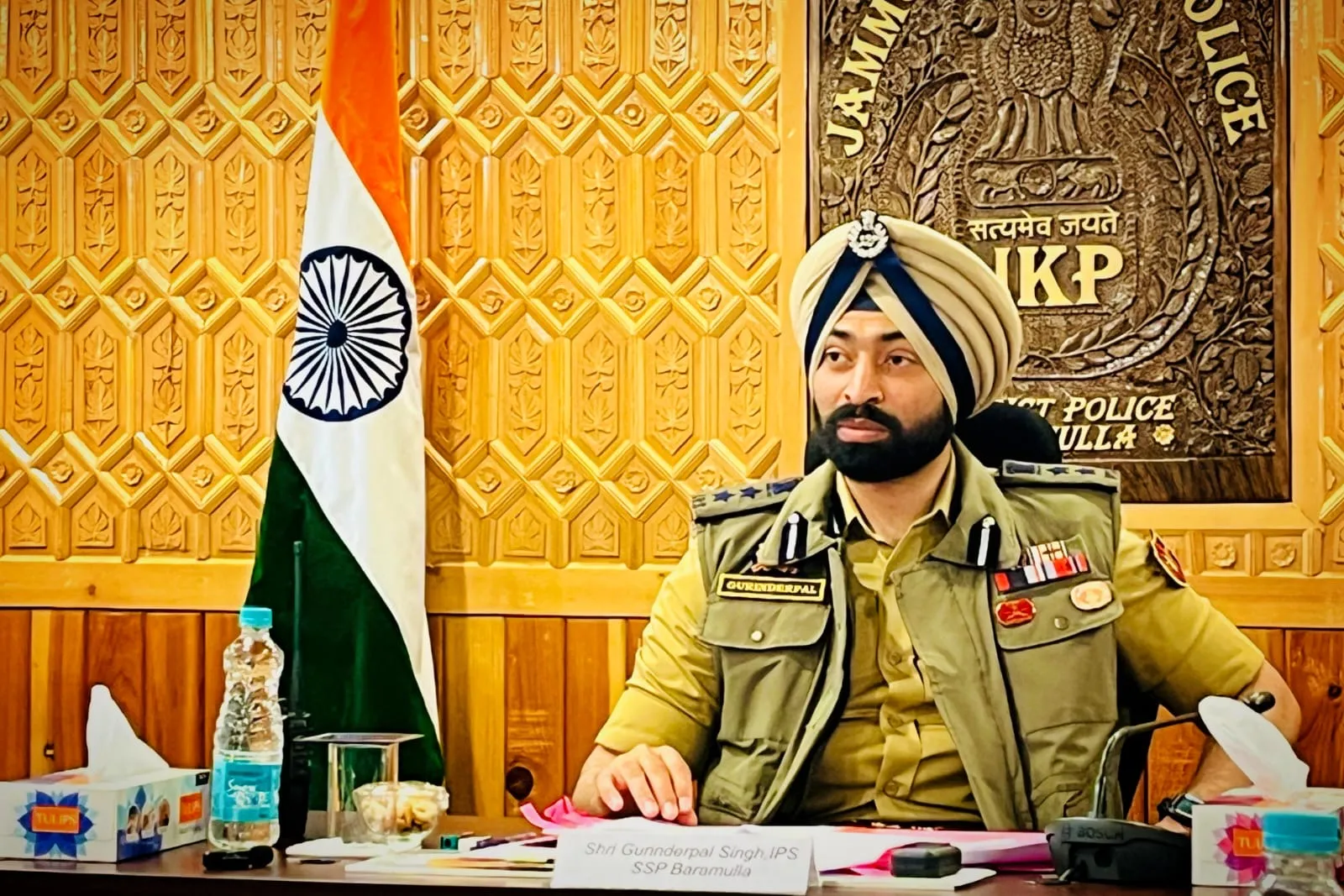
Srinagar: The Court of the 2nd Additional Sessions Judge, Srinagar, has allowed a revision petition filed by Senior Superintendent of Police (SSP) Srinagar Dr G.V. Sundeep Chakravarthy, IPS, setting aside an order passed by a Judicial Magistrate and closing the suo motu proceedings initiated against the senior police officer.
The court, while disposing of the revision petition, stressed the need for institutional coordination between the judiciary and police, observing that “the administration of criminal justice is not a contest between the judiciary and the police.”
The case arose after repeated non-execution of judicial warrants and failure to submit compliance reports before the concerned court. The Magistrate had initiated proceedings under Section 210(1)(c) of the Bharatiya Nagarik Suraksha Sanhita (BNSS), while also issuing notice under Section 223(2) BNSS and calling for a report from superior police authorities.
The Sessions Court held that the Magistrate’s concern over non-execution of judicial processes was legitimate, saying that “a criminal court cannot remain a silent spectator where its lawful commands repeatedly go unheeded.”
However, it found that certain observations in the impugned order, which allegedly attributed deliberate misconduct, intentional obstruction of justice and habitual disregard of judicial orders to the SSP, were premature at the preliminary stage.
The court observed that such conclusions should await completion of the statutory process and an opportunity for the concerned officer to explain the circumstances.
It held that the observations were “unnecessary at that preliminary stage” and required moderation in the interest of fairness and institutional harmony.
The court also took note of the fact that the accused whose non-production had triggered the proceedings had subsequently been produced before the competent court.
It, therefore, concluded that continuation of the parallel proceedings would serve no useful public purpose.
Significantly, the court issued a set of prospective directions to streamline execution of judicial processes in Srinagar district.
It directed that Judicial Magistrates should ordinarily send summons, bailable and non-bailable warrants, proclamation notices and other judicial processes meant for execution within Srinagar directly to the Station House Officer (SHO) of the concerned police station.
The court said the concerned SHO would be required to “personally ensure prompt execution” of such processes and submit compliance reports within the time stipulated by the issuing court.
Where execution was not possible, reasons supported by material particulars would have to be communicated to the court without delay.
Processes requiring execution outside Srinagar district would ordinarily be routed through the SSP concerned or another competent supervisory authority.
The court further directed the SSP Srinagar to issue standing instructions to all SHOs and subordinate officers and establish an effective mechanism to monitor pending warrants and summons.
Emphasising mutual institutional respect, the court said, “Courts speak through their orders; the police give life to those orders by faithful execution.”
In its final order, the court directed that all observations in the Magistrate’s order touching upon the SSP’s alleged culpability before completion of the Section 223 BNSS procedure “shall stand expunged”.
The suo motu proceedings were ordered closed, while the new administrative directions were made binding on Judicial Magistrates and the District Police Administration in Srinagar.