

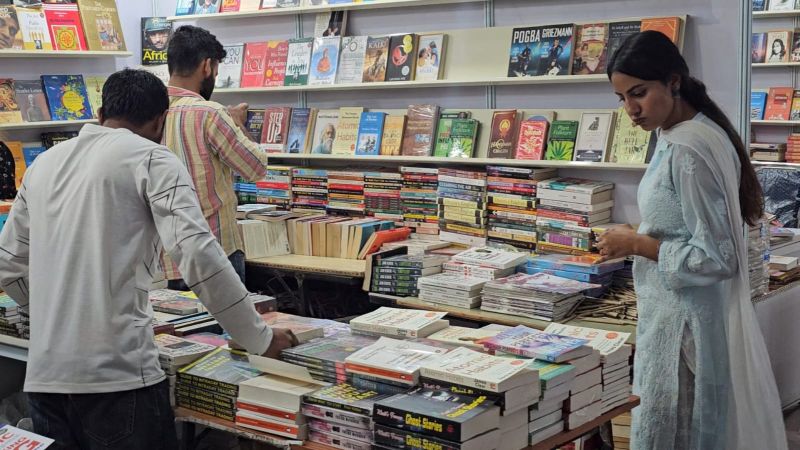
Every civilisation is, in the end, a story it tells its children. In Kashmir, that story has lived for nearly nine centuries in the verses of Kalhana’s Rajatarangini – the River of Kings – carried faithfully through the corridors of universities and research libraries, waiting for the moment it could reach the young readers who might draw the most meaning from it. This year, at the third edition of the Chinar Book Festival in Srinagar, that moment arrived, in a manner that feels less like an event and more like the start of a restoration.
The Chinar Book Festival began as a gathering, a celebration of the written word in a region whose relationship with literature has always been intimate. Across three editions, it has grown into something more deliberate: a working institution, a place where translation workshops are convened, where scholars and authors share their writings, and where the results of that labour are handed directly to the public within a year or two. It is this discipline festival as it that has now delivered three of the most substantial literary interventions Kashmir has seen in years.
To understand why the Stories from Rajatarangini initiative matters, it helps to understand what Rajatarangini actually is. Composed in Sanskrit between roughly 1148 and 1150 CE, it is among the earliest sustained works of historical writing produced anywhere in the Indian subcontinent – a chronicle, in verse, of Kashmir’s kings from legendary antiquity down to Kalhana’s own century. Kalhana was no distant observer of court life; he was the son of Champaka, chief minister to King Harsha of Kashmir, and the brother of the musician Kanaka. He wrote from inside the machinery of power, which makes his commitment to judging that power honestly all the more remarkable. The poet Mankhaka called him a master craftsman of narrative, and later chroniclers – Jonaraja, Srivara, Prajyabhatta and Shuka carried the tradition he began forward, extending the river of Kashmir’s recorded history for centuries after his death.
What sets Rajatarangini apart from court chronicles elsewhere in the medieval world is a single, striking claim Kalhana makes about his own method: that the true historian must write like an impartial judge, his account grounded in truth rather than attachment or favour. That ambition was unusual for its time, and it is why the text has endured as something closer to history than to hagiography. It is also why a work built on that founding principle feels less like an antique curiosity and more like a quiet, enduring model.
The text’s scholarly credentials were secured in the late nineteenth century, when the orientalist Sir Aurel Stein, working with the Kashmiri pandit Govind Kaul, produced the English translation that introduced Rajatarangini to a global academic audience. That translation, and the Hindi scholarship that followed it, secured the chronicle’s place in university syllabi and research institutions for well over a century. The next natural step and the one the Chinar Book Festival has now taken is to carry that same chronicle, in Kalhana’s own spirit of instructing rulers and citizens alike, into the hands of young readers who can meet Lalitaditya and Kota Rani in a story written just for them.
The Stories from Rajatarangini initiative exists to make that meeting possible, and it has been built with real care over real time. During the second edition of the Chinar Book Festival in 2025, the National Book Trust convened a dedicated Rajatarangini Workshop, bringing together novelists, historians and language scholars to work through a genuinely rewarding question: how does one take a twelfth-century court chronicle, rich with genealogy and statecraft, and shape it into something a contemporary young reader will love to finish? The participating writers weighed which figures carried the strongest narrative charge — Queen Yashovati, Avantivarman, Lalitaditya, Matrigupta, Queen Didda, Nar-Kinnara, Jayapida, Jayasimha, Kota Rani — and built outlines for each before a single chapter was drafted.
That patience has paid off handsomely. At this year’s festival, the Lieutenant Governor of Jammu & Kashmir, Shri Manoj Sinha, launched the first five completed novels in the series, each one built around a ruler whose story offers far more than a record of a reign:
- Lalitaditya, the Chakravarti Emperor, tells the story of Kashmir at its most expansive, an empire carried across northern, central and southern Asia into Tibet and Turkestan, frontiers successfully defended against Arab and Tibetan forces, and the construction of the magnificent Martand Sun Temple, whose ruins still draw visitors today. It is, among the five, the most overtly heroic account, and a natural entry point for readers drawn to scale and spectacle.
- Queen Yashovati offers something the historical record rarely preserves anywhere in the world: a woman ruler whose authority is the very centre of the story, not its footnote. Drawing on both Rajatarangini and the older Nilamata Purana, the novel follows a queen who steadied a kingdom exhausted by two wars, acted as capable regent for her young son, put down rebellion, and governed with a steadiness that earned her a lasting place in the chronicle. NBT celebrates her as among the earliest recorded female sovereigns in world history a distinction that deserves far wider recognition.
- Jayapida, grandson of Lalitaditya, is the most psychologically rich of the five, as much an inquiry into ambition, loyalty and self-reflection as it is a chronicle of conquest. It rewards slightly older readers especially well, since its depth lies as much in Jayapida’s inner journey as in his campaigns.
- Matrigupta tells a story of ascent: a poor but gifted and honest young man who rises to high office through integrity, perseverance and poetic talent, inspired along the way by the legendary Emperor Vikramaditya. It is the novel most directly built to model values such as duty, courage, fairness for a young readership, achieving this with genuine narrative charm rather than heavy-handed moralising.
- Kota Rani completes the first phase with a story of triumph and enduring legacy. Set amid the political turbulence of fourteenth-century Kashmir, it follows the daughter of the commander Ramachandra as she rises past entrenched patriarchal power to become one of the most formidable rulers in the chronicle’s later chapters – commissioning the Kuta Kul, the canal that still bears her name, and earning her place in history as the last Hindu woman ruler of Kashmir. It is the most reflective of the five, and perhaps the most quietly important, ensuring that Kashmir’s history is remembered in its fullness.
Taken as a set, these five novels amount to a curriculum in disguise — teaching statecraft through Lalitaditya, resilience through Yashovati, self-awareness through Jayapida, integrity through Matrigupta, and enduring courage through Kota Rani. NBT has been clear that this is only the first phase, with further novels planned on the remaining figures explored during the 2025 workshop — Avantivarman, Queen Didda, Nar-Kinnara, Jayasimha and others.
Standing alongside the Rajatarangini novels as this year’s most meaningful achievement is the release of twenty-four bilingual children’s books in Gojri. These titles – four in Dogri–Gojri, six in English–Gojri, three in Kashmiri–Gojri, and five each in Urdu–Gojri and Hindi–Gojri were produced through the region’s first-ever Gojri Translation Workshop, held during the 2025 edition of the festival and bringing together writers, translators and language experts to lay the foundation of a genuine children’s literature in Gojri.
Gojri is spoken widely and warmly among Kashmir’s Gujjar and Bakarwal communities, carried for generations through song and proverb, and now, thanks to this workshop, given its first substantial body of printed children’s literature. The workshop’s output was well-loved international and Indian children’s titles translated across five language pairs into Gojri representing genuine foundational work: books like What is a Tree, Friends, A Tale of Tails and Bond of Love now exist for the first time in a script and idiom that Gojri-speaking children can call entirely their own. For a child, learning to read in one’s mother tongue transforms the experience of reading itself, turning it from an obligation into a discovery.
Taken together, the Rajatarangini novels and the Gojri translations rest on the same underlying conviction: that access to literature is a right worth building deliberately into a language, a curriculum, and a childhood from the very start. A textbook can teach a child the dates of Lalitaditya’s reign. A well-told story can make that child feel a genuine claim on the land those dates describe. And holding a book written in the language one dreams in offers young readers something no curriculum can fully replicate on its own. The truest measure of this year’s festival will be seen in how far these books travel into the hands of its readers, into homes far beyond the festival tents where the launch took place.
What the Chinar Book Festival has demonstrated across three editions is that heritage and readership can grow together rather than compete for the same limited attention. A twelfth-century Sanskrit chronicle and a five-year-old’s first Gojri picture book can, with sufficient patience and craft, occupy the same festival and eventually the same bookshelf. That is a considerable achievement to state so simply. It may, in time, prove to be one of the more consequential things a book festival in this country has done.
Courtesy: The National Book Trust, India


