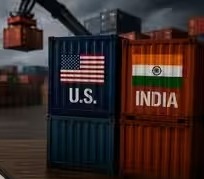
New Delhi: The government has amended the foreign trade policy to prohibit the import of goods produced using forced labour, amid a US investigation into forced labour practices in 60 countries, including India.
Amending the Foreign Trade Policy (FTP) 2023, the DGFT has inserted a paragraph that reads: “The import of goods produced or manufactured, wholly or in part, through the use of forced labour is prohibited”, according to a gazette notification dated July 13.
The government notification has not immediately banned any products or imports from specific countries. Instead, it empowers the government to prohibit identified goods through future notifications following investigations by the Directorate General of Foreign Trade (DGFT).
The provisions of the notification shall come into effect after the expiry of 30 days from the date of its publication in the official gazette, it stated.
The development has come amid the US Trade Representative (USTR) undertaking Section 301 investigations against 60 economies, including India, over concerns related to forced labour. The USTR has alleged that these countries have failed to enforce import bans on goods made with forced labour.
On June 3, the US proposed to impose 12.5 per cent tariffs on 54 countries, including India, for allegedly failing to prohibit the import of goods produced with forced labour..
Six countries, Canada, Ecuador, the European Union, Indonesia, Mexico, and Pakistan, would face an additional 10 per cent import duty as they have introduced domestic measures to prohibit imports made with forced labour.
According to the DGFT notification, the central government can issue a notification at any time to ban the import of specific goods if it finds, based on an inquiry or any other relevant evidence, that those goods have been produced using forced labour.
The procedure for conducting an enquiry by the DGFT into the use of forced labour in the production of such goods will be as prescribed in the Handbook of Procedures, 2023.
The DGFT has also added a new para under Chapter 11 (Definition) of the FTP, 2023, under which “Forced Labour” means all work or service which is exacted from any person under the menace of any penalty and for which the said person has not offered himself voluntarily, as defined under the ILO Forced Labour Convention, 1930 (No. 29).
India is engaged with the US on the matter as both sides are negotiating a bilateral trade agreement (BTA).
Commenting on the move, think tank GTRI said the order establishes a legal framework rather than an immediate import ban.
“Its effectiveness will depend on how the government conducts investigations, the evidence required to establish forced labour, and the products it ultimately targets,” GTRI Founder Ajay Srivastava said.
He said that India’s notification signals that it is strengthening its domestic legal framework in line with international standards, a step that could strengthen its position in future trade negotiations and market-access discussions.
The US authorities consider products such as cotton, textiles, solar-panel polysilicon, seafood, metals, batteries and electronics vulnerable to forced-labour risks, particularly when linked to China’s Xinjiang region, he said.
“Yet the US and the EU continue to import many such products from China, underscoring the challenges of enforcing forced-labour rules,” Srivastava said.
Agneshwar Sen, Trade Policy Leader, EY India, said that by adopting the ILO Forced Labour Convention, 1930 (No. 29) definition verbatim, India aligns itself with the same international benchmark the US invokes domestically.
“This is the principled core: India is not merely rebutting the US charge; it is asserting that it too can police forced labour in its supply chains, including, implicitly, goods produced through prison or bonded labour anywhere, not just those the US flags,” Sen said.