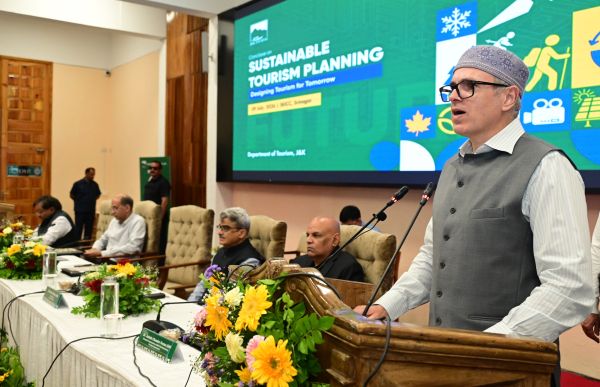
Srinagar: Chief Minister Omar Abdullah on Thursday called for a shift from volume-driven to value-based tourism, saying there is a need to develop Jammu and Kashmir as a sustainable tourism destination and regulate the flow of visitors.
Addressing the inaugural session of the Conclave on ‘Sustainable Tourism Planning – Designing Tourism for Tomorrow’, organised by the Department of Tourism at the SKICC here, Abdullah called for a paradigm shift in Jammu and Kashmir’s tourism strategy, an official press release informed.
It said Omar Abdullah urged the policymakers, industry stakeholders and local communities to move beyond volume-driven tourism towards a value-based and sustainable tourism model that safeguards the region’s fragile ecology while ensuring long-term economic prosperity.
The chief minister said that tourism devoid of sustainability inevitably leads to long-term decline.
“Tourism without sustainability is an unqualified disaster. It may survive for a few years, but it cannot endure in the long run unless sustainability is built into its very foundation,” he said.
Advocating premium tourism experiences, the CM said value-based tourism enables destinations to earn more while reducing environmental stress and improving visitor experiences.
“Value tourism is sustainable tourism. Our responsibility is to create conditions where local people earn better incomes while ensuring that tourism remains environmentally and economically sustainable for generations to come,” he added.
He said the conclave had been organised at a crucial juncture when Jammu and Kashmir was reassessing its tourism vision and determining whether its future lay in attracting an ever-growing number of visitors or creating greater value from a more sustainable tourism economy.
“We have to decide whether we wish to earn by charging one hundred tourists one rupee each, or by creating an experience where one tourist is willing to pay one hundred rupees. The answer to that question must shape all our future tourism master plans,” the CM said.
Welcoming the surge in the number of tourists visiting J&K, Abdullah said that for the future, the tourist flow may need to be regulated so that not only the tourist resorts are protected, but the tourists also enjoy in a serene environment rather than having to go through harrowing experience of traffic jams, poor facilities and over-crowding.
Reflecting on Jammu and Kashmir’s tourism journey over the past three decades, Omar Abdullah observed that the region had understandably pursued a volume-based approach to demonstrate normalcy after years of conflict. However, he said the recent fluctuations in tourist arrivals had once again exposed the vulnerability of the tourism ecosystem.
The chief minister remarked that last year before the Pahalgam incident, we were dealing with traffic congestion caused by huge tourist inflow. Soon afterwards, we were worried because hotels and destinations had become empty. This reminds us how fragile tourism can be in Jammu & Kashmir where a single incident can affect the whole season.
The chief minister underlined that sustainable tourism planning must comprehensively address critical issues including traffic regulation, parking infrastructure, waste management, water conservation, building regulations, carrying capacity and community participation.
Expressing concern over recurring traffic congestion at popular destinations, he said infrastructure creation alone would not solve the problem unless accompanied by effective utilisation and scientific traffic management.
He cautioned against introducing unplanned regulatory measures without adequate stakeholder consultation, citing recent experiences where traffic management decisions adversely affected tourists and transport operators.
“Sustainability cannot be based on knee-jerk reactions. Every intervention must be well-planned, thoroughly discussed with stakeholders and capable of delivering long-term solutions,” he said.
The chief minister also laid strong emphasis on scientific solid waste management, saying environmental degradation cannot simply be attributed to tourists.
Referring to ongoing waste removal efforts in Dal Lake, he observed that a significant portion of waste originates from local habitations, making community participation equally important.
He also stressed the need to eliminate single-use plastic and promote responsible civic behaviour.
“Government has a responsibility to manage waste, but citizens too have an equal responsibility. Unless we begin treating Gulmarg, Pahalgam, Sonamarg and Dal Lake as we treat our own homes, sustainability will remain elusive,” he said.
Highlighting the growing challenge of water scarcity, Omar Abdullah said sustainable tourism cannot be achieved without long-term water management strategies, particularly as visitor numbers continue to increase.
The chief minister also stressed the importance of strict enforcement of building regulations and tourism master plans.
“A master plan is only as good as its implementation. Selective enforcement breeds resentment and weakens public confidence. Tourism planning cannot be confined to offices; it must be prepared in consultation with local communities who have lived in these destinations for generations,” he observed.
Calling for scientific assessment of the carrying capacity of individual tourist destinations, he said each location possesses unique ecological sensitivities that must determine future visitor management strategies.
“Srinagar may comfortably accommodate far more visitors than ecologically fragile destinations such as Gulmarg or Gurez. We cannot adopt a uniform approach for every destination,” he said.
The chief minister said Jammu and Kashmir’s greatest tourism asset is its unmatched natural beauty rather than artificial attractions.
“We are not selling Disneyland, Universal Studios or Las Vegas. What attracts people here is our rivers, lakes, mountains, glaciers and landscapes. Protecting these natural assets must remain the central objective of every tourism master plan,” he asserted.
He also spoke about the increasing influx of tourist vehicles from outside Jammu and Kashmir. While acknowledging that their arrival had helped restore confidence about Kashmir’s reopening as a tourism destination, he said such trends also placed additional pressure on local infrastructure and adversely affected the livelihoods of local transport operators.
“We have to ensure that tourism generates greater benefits for our own people. The objective should be to move steadily up the value chain rather than simply chasing higher tourist numbers,” he said.
Advocating premium tourism experiences, the chief minister said value-based tourism enables destinations to earn more while reducing environmental stress and improving visitor experiences.
“Value tourism is sustainable tourism. Our responsibility is to create conditions where local people earn better incomes while ensuring that tourism remains environmentally and economically sustainable for generations to come,” he added.
The chief minister expressed hope that the deliberations of the conclave would contribute meaningfully towards framing a long-term sustainable tourism roadmap for Jammu & Kashmir and guide future policy interventions.
Advisor to the Chief Minister Nasir Aslam Wani, MLA Gulmarg Pirzada Farooq Ahmad Shah, Chief Secretary Atal Dulloo, Additional Chief Secretary to the Chief Minister Dheeraj Gupta and Additional Chief Secretary, Tourism, Ashish Chandra Verma were present on the occasion.
Managing Director J&K Tourism Development Corporation Shreya Singhal, Director SKICC Mufti Mohammad Farid-ud-Din, Director Tourism Jammu Vikas Gupta, Secretary Royal Springs Golf Course Haris Ahmad Handoo, Director Tourism Kashmir Syed Qamar Sajad, senior officers of the Tourism Department, Chief Executive Officers of various Tourism Development Authorities, tourism stakeholders and experts also participated in the conclave.
Delegations call on CM at Raabita, seek resolution of public issues
Chief Minister Omar Abdullah today met several public delegations at Raabita and listened to their grievances and demands concerning various public and sector-specific issues, an official press release informed.
It said a delegation of the Industrial POP Association, Khunmoh, called on the chief minister and highlighted the challenges confronting the Plaster of Paris (POP) industry in Kashmir due to the non-availability of gypsum.
The chief minister assured its members that the matter would be examined in consultation with the concerned departments to explore a sustainable solution.
Later, a delegation of the Khidmat Centre Association met the chief minister and submitted a proposal concerning them.
The chief minister assured the delegation that its representation would be examined on merit in consultation with the concerned departments, the press release said.