Tulmulla: Amid chants of Vedic hymns and the sounds of conch shells, thousands of devotees gathered at the Kheer Bhawani shrine here on Monday to celebrate Zeashta Ashtami, one of the most important religious festivals of the Kashmiri Pandit community, with many reiterating their demand for a dignified and secure return to their homeland.
The annual festival witnessed one of the highest footfalls in recent years, with devotees from across the country thronging the shrine complex in central Kashmir’s Ganderbal district to pay obeisance to Mata Ragnya Bhagwati.
The festival marks the appearance day of Goddess Ragnya Bhagwati.
It is celebrated at several shrines dedicated to the deity across Kashmir, including Kheer Bhawani at Tulmulla, Tripur Sundari at Devsar, Ragnya Bhagwati at Manzgam, Loktipora and Tikker.
A multi-layer security ring was thrown around the temple complex at Tulmulla and along the route leading to the shrine.
The temple, nestled in the shade of mighty chinar trees in this village of the central Kashmir district, wore a festive look as devotees from across the country congregated at the shrine complex to celebrate the ‘Mela’ on the occasion of ‘Jyeshta Ashtami’.
Walking barefoot and carrying rose petals, devotees jostled with each other to move closer to the main temple complex as devotional songs played in the temple compound.
The devotees offered tribute to the goddess, as men took a dip in the stream close to the shrine. The devotees paid obeisance to the deity while offering milk and ‘kheer’ (rice pudding) at the sacred spring within the complex.
It is believed that the colour of the sacred spring water, which flows below the temple, indicates the situation in the valley.
While most of the colours do not have any particular significance, black or darkish colour of the water is believed to be an indication of inauspicious times for Kashmir.
However, the water in the spring was clean and milky white this year.
The devotees prayed for peace and brotherhood in the valley.
“A huge number of devotees have arrived for the Mela this year. I prayed that the deity keep everyone happy, safe and let peace be there,” Chinmay Pandita, a devotee from Jammu, said.
Locals opened not only their homes but also hearts for the visiting devotees.
On the support of the local Muslim community, Pandita said the locals have always supported the celebrations.
“There is a tremendous support of the locals at every level. They are very supportive,” he said.
Another devotee, Mansi, expressed satisfaction over the arrangements.
“The administration has made very good arrangements. Security arrangements are top notch. There is deployment at every place. No doubt, there are very good security arrangements, but otherwise also we did not feel any fear. The atmosphere is very good,” she said.
The community prayed for peace in the valley and for their dignified return, putting an end to their ‘banwas’ (exile).
Sanjay Saraf, a local Kashmiri Pandit leader, said the annual Mela has always been a true example of Hindu-Muslim bonhomie.
“Every Kashmiri waits a year for this Mela. Muslims also wait so that they can see their Pandit brothers. We all pray there is a revival of the true Kashmiriyat,” he said.
For many displaced Kashmiri Pandits, the pilgrimage was not merely a religious journey but an emotional return to their roots.
Roopa, 78, originally from Srinagar and now settled in Bengaluru, said she prayed for an end to the community’s exile and hoped to spend her final years in her homeland.
Similar sentiments were expressed by Prem Nath, a native of Kilam village in south Kashmir who is now settled in Mumbai.
“We prayed collectively for the return of our community to its homeland in a safe and secure environment,” he said.
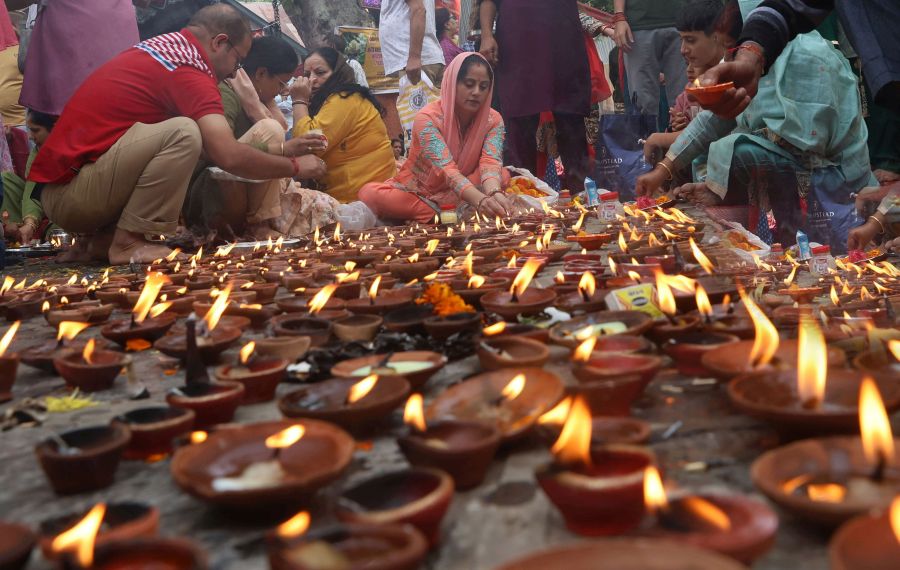
The shrine complex remained packed throughout the day as devotees offered prayers, lit earthen lamps and chanted hymns in praise of the Goddess. Long queues were witnessed outside the temple, the ‘yagya shala’ and community kitchens amid the heavy rush of pilgrims.
Emotional scenes unfolded at the shrine as local Muslims warmly greeted visiting Kashmiri Pandits, rekindling memories of their shared past and centuries-old bonds of coexistence.
Many displaced Pandits who had come to the Valley for the annual pilgrimage met former neighbours and friends, turning the religious gathering into an occasion of reunion and remembrance.
Shabir Ahmad Dar, a resident of Budgam, said he had come to meet his childhood friend Deepak, now settled in the United States.
“This is his first visit after many years, and our reunion came after 36 years,” Dar said.
He said the meeting was deeply emotional as they recalled their childhood and life in Kashmir before the migration of Pandits from the Valley.
Several similar reunions were witnessed at the shrine complex as members of the two communities exchanged greetings, recalled old times and expressed hope for the return of peace and harmony in Kashmir.
The scenes of Muslims and Kashmiri Pandits embracing each other drew attention of pilgrims and visitors alike, reflecting Kashmir’s traditional ethos of communal harmony and brotherhood.
Several political leaders also visited the shrine during the day and interacted with the pilgrims.
Meanwhile, thousands of devotees thronged Kheer Bhawani Peeth in Jammu’s Janipur area also to celebrate Jyeshtha Ashtami, one of the most important religious festivals of the Kashmiri Pandit community.
The temple, regarded as a replica of the revered Mata Kheer Bhawani shrine at Tulmulla in central Kashmir’s Ganderbal district, witnessed a steady stream of devotees from the early hours of the morning.
The first ‘aarti’ (prayer) was held at 3 am, marking the beginning of day-long religious ceremonies, including special prayers, ‘havan’, devotional singing and distribution of ‘prasad’.
Kheer Bhawani Peeth was constructed in Janipur following the mass migration of Kashmiri Pandits from the Valley in the early 1990s.
Built through community efforts, the shrine has over the years emerged as an important centre of faith and cultural identity for the displaced Kashmiri community, enabling devotees to continue age-old traditions associated with Mata Kheer Bhawani despite being away from their ancestral homeland.
Devotees said the shrine holds special significance for those who are unable to visit the original temple in Kashmir. Many described it as a spiritual link to their roots and a place where they continue to seek the blessings of the Goddess.
“Not everyone can travel to Kashmir, and this temple fills that void for us,” Sheela Kumari, who had come from the Bohri area of Jammu city, told PTI.
She said that devotees prayed for the health and well-being of their families and hoped that one day they would be able to return to their homeland and offer prayers at the original shrine in Kashmir.
The temple management said elaborate arrangements have been made for the annual festival. Traditional offerings, including kand (sugar candy), milk, flowers and incense, were arranged for devotees.
Over 20,000 earthen lamps were prepared as part of the celebrations, with devotees offering them while seeking fulfillment of their wishes.
Sushil Wattal, governing body member of the temple, said they also coordinated with various government departments to ensure uninterrupted services and medical assistance throughout the event. (With PTI Inputs)