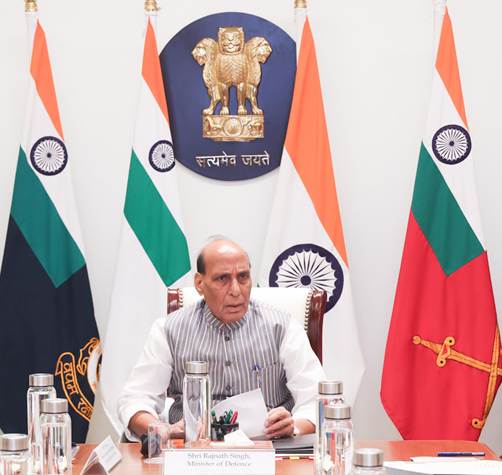
Nagpur: Defence Minister Rajnath Singh on Friday said conventional warfare and its means are as relevant today as they were in 1947 and that is why a military-industrial base will continue to hold importance in future as well.
When supply systems get affected during wars, every country wants essential items to be manufactured domestically, he said, adding that a country that is able to meet its own needs can move forward with great confidence.
Speaking after performing the ground-breaking ceremony for the state-of-the-art 10,000-tonne Aluminium Extrusion Press (AEP) at Yantra India Limited (YIL), Ordnance Factory at Ambajhari in Nagpur, he also said that India has now set the target of Rs 3 lakh crore defence production and Rs 50,000 crore defence exports in the next couple of years.
“Conventional warfare and its means remain as relevant now as they were in 1947 and their relevance will remain almost the same in 2047. We often say that the nature of war is changing. Borders are getting blurred. Enemies cannot be identified. Armies may stand in place and countries become destabilised. Much of this is true, but equally true is that conventional warfare and its means remain as relevant now as they were in 1947,” he said.
“More than that, their relevance will remain almost the same in 2047 as it is today. We must accept this reality as well. Therefore, the importance of the military-industrial base will continue for a long time to come. What I want to say is that its significance, which was so important in the past and is important now, will remain just as important in the future,” he said.
Singh said the ground-breaking ceremony of the aluminium extrusion press today reflects the country’s changing mindset.
The things for which India once had to look outward are gradually being manufactured in the country and they are being made by the countrymen, according to him.
“And I believe that is necessary. Because we all can clearly see the state of the world today. When wars are going on, the entire supply system gets affected. In such times, it is natural that every country wants essential items related to its security to remain in its own hands and to be produced by its own people,” Singh said.
A country that can meet its own needs can move forward with the greatest assurance and confidence. The vision of Atmanirbhar Bharat given by Prime Minister Narendra Modi rests on this very idea, he said.
Singh further said India’s defence production has increased to a record more than Rs 1,78,000 crore in 2025-26, which was just Rs 46,000 crore in 2014.
India’s defence exports were approximately Rs 1,000 crore in 2014, which have now risen to Rs 40,000 crore, he said, adding that this was not just an increase in the numbers but also in the capability of India’s skills and self confidence.
“We have set the target of Rs 3 lakh crore defence production and Rs 50,000 crore exports in next two to three years and it will be achieved before the set time-line,” the minister said.
Singh praised the efforts being made by YIL in making a significant contribution to advancing the goal of self-reliance. He stated that the corporatisation of the Ordnance Factory Board (OFB) was carried out to make the system stronger and more agile in view of the changing times, and emerging technologies, and YIL is a result of that transformation.
“Post-corporatisation, we envisioned that the new entities enjoy sufficient operational autonomy and gain opportunities to excel in innovation, risk-taking, research, and exports,” he said.
All the new Defence Public Sector Undertakings (DPSUs) have successfully moved in that direction. OFB’s production, which stood at Rs 12,755 crore in the pre-corporatisation year of FY 2019-20, has risen to Rs 26,282 crore in FY 2025-26. In defence exports, the figure stood at a mere Rs 81 crore prior to corporatisation. It has now surged to Rs 4,561 crore, with YIL contributing Rs 397 crore, he said.
He said research and development (R&D) and capital infusion, were the key elements that drive an industrial entity forward in today’s competitive world.
“R&D is pivotal for an entity to progress and compete in the long-term. Organisations that embrace innovation lead the future,” he said.
On capital infusion, he said that installing new machinery or investing in modern equipment brings a vital technological linkage.
“Through modern machinery, new technologies become part of the manufacturing system, increasing efficiency in production processes, improving quality, and making the system more modern and efficient,” he said.
Maharashtra Chief Minister Devendra Fadnavis said, “The world is recognising the growth of India’s defence sector as the nation is positioning itself as an exporter in the international market due to the Central government’s efforts.”
Describing ‘Operation Sindoor’ as a shining example of the technological prowess and unique capabilities of New India, he said growing collaboration between the DPSUs and the private sector is taking the nation to greater heights.
According to officials, the proposed extrusion press will be a major national asset for the defence manufacturing sector. It will strengthen the nation’s capability to produce large, high-strength and precision aluminium alloy extrusions to cater to the requirements of defence and aerospace sectors.