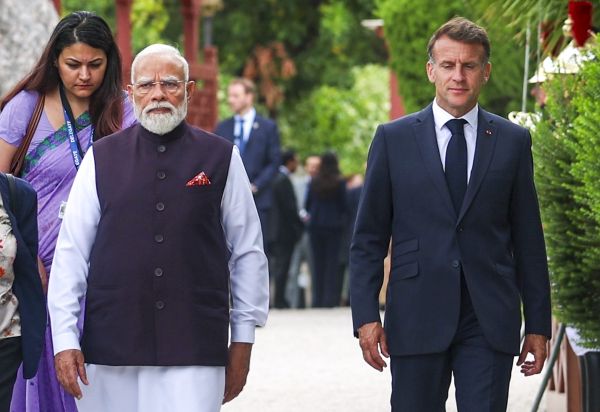
Nice (France): An innovation roadmap, a mechanism to double annual bilateral trade within next five years, and a joint artificial intelligence framework were among 13 outcomes to emerge from wide-ranging talks between Prime Minister Narendra Modi and President Emmanuel Macron on Sunday.
The two sides also firmed up a declaration for cooperation in the high-speed railway sector and a security pact to protect classified data. Additionally, they agreed to expand the footprint of India’s Unified Payments Interface (UPI) to the Paris airport and Nice.
The talks between the two leaders focused heavily on shoring up ties in technology and innovation, with PM Modi emphasising the need for a human-centric approach to scientific advancement.
Modi landed in this Mediterranean French city on Saturday night as part of his week-long tour of France and Slovakia.
Foreign Secretary Vikram Misri said the Modi-Macron discussions covered the entire range of bilateral relations, including defence, security, space, civil nuclear energy, trade and investment, technology, innovation, education, mobility and people to people ties.
“A key focus of the discussions was also on strengthening and diversifying bilateral ties in the fields of economic growth, technology and innovation. This is especially relevant in view of the conclusion of negotiations earlier this year on the India-EU free trade agreement,” he said.
The India-France Innovation Roadmap 2030 seeks to deepen cooperation in critical and emerging technologies as well as startup and incubator ecosystems besides promoting academic mobility and industry-academia linkages, External Affairs Ministry spokesperson Randhir Jaiswal said.
The two sides also announced creation of a high-level mechanism for realising the goal of doubling bilateral trade in the next five years.
The current volume of bilateral trade is approximately USD 16 billion. A separate dialogue mechanism for economic security was also announced.
The creation of the joint Artificial Intelligence (AI) Working Group is aimed at AI governance and to support joint research and development, capacity building, and industry exchanges.
The two sides also decided to expand the use of UPI (Unified Payments Interface) at Paris airport and Nice that will strengthen India’s digital public infrastructure footprint in Europe.
The move is also expected to help Indian tourists, students, diaspora community and business travellers.
Following the Modi-Macron meeting, the two sides also announced the establishment of a National Centre of Excellence for Skilling in Aeronautics and Allied Sectors at Kanpur.
The centre will support skilling, institutional linkages and research in aviation and aerospace sectors. It is also expected to strengthen the workforce for manufacturing and MRO (Maintenance, Repair, and Operations) sectors.
The rest of the outcomes were largely aimed at boosting cooperation in various aspects of innovation and digital space.
Misri noted the setting up of a high-level mechanism to double bilateral trade, the establishment of a dialogue on economic security, the adoption of an innovation roadmap 2030, signing of 19 agreements between institutions in the innovation ecosystem of both countries and the creation of a joint working group focusing on artificial intelligence as major highlights.
“The two leaders also discussed how to enhance the mobility of talent and the exchange of students from the two countries and also expand mutual recognition of educational qualifications,” he said.
“The prime minister in this context invited French universities to open campuses in India under the new education policy and welcomed President Macron’s commitment,” he said.