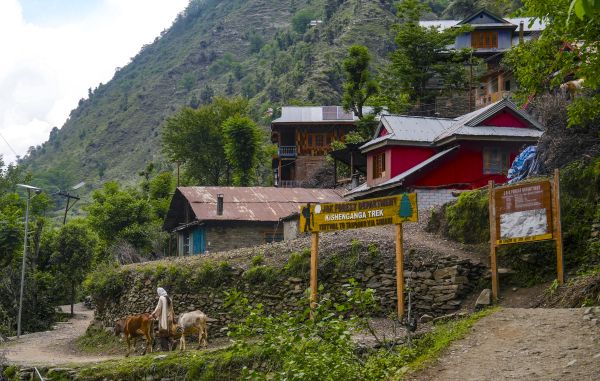
Simari (Kashmir): A river runs through it, cleaving the village between India on one side of the gushing waters and Pakistan Occupied Kashmir on the other. If Operation Sindoor has a ground zero, it is Simari where the sound of artillery fire still echoes for villagers trying to shake off memories from that night one year ago.
It is from this frontier village surrounded by high mountains that the Army fired shells across the Krishan Ganga river to signal the start of Operation Sindoor on the intervening night of May 6-7, 2025, India’s response to the terror attack in Pahalgam “to dismantle terror outlets in Pakistan”.
One year on, silence seems to have settled over the picturesque hamlet on the foothills of the Shamshabari mountains in Tangdhar sector, about 180 km from Srinagar. Life has resumed its everyday routine but outsiders are met with quiet and a certain distrust. Many walk away, saying they only understand Pahari.
Simari, at the literal edge of the country, has a population of 500 and just about 80 houses. There are a dozen odd modern concrete structures alongside traditional mud and timber dwellings. If it were not for the roaring river waters, people from one side to the other could literally shout out to be heard.
The river is also a constant reminder that this is a divided land – both literally and metaphorically.
And Operation Sindoor was felt not as a news report about what is happening to others but as a storm of fire passing overhead.
Ghulam Qadir is amongst the few who talks, albeit reluctantly.
“We didn’t just hear about the war… we felt it as shells lit the skies,” Qadir told PTI. Community bunkers were home for the few days after that first night of shelling.
He is proud of his village. Simari’s local middle school has been designated Polling Booth Number One. A hand-painted slogan greets visitors with the declaration: “Democracy starts from here”.
“Now you should understand we are the first village in the country and the torch bearers of democracy in the country,” he snapped back when asked how it felt to be the resident of the country’s last village.
The school is a sign of Simari’s resilience. Despite being physically separated from the rest of the country by a security fence, people here view themselves as the primary guardians of the country’s democracy. The village is mainly dependent on army troops deployed in the area and many work as labourers for them.
As commemorative events are held across the country to mark the first anniversary of Operation Sindoor, life in Simari is a delicate balance between everyday mundaneness and the fear that their village’s very remoteness could make them the centre of conflict.
For Iqbal, the drones from across the border were more difficult to deal with than the shelling. The Army opened fire several times to thwart their advances. “Some of the intruding objects (drones) fell in our area. These were removed by the army,” he said, lauding the Army for providing all kinds of relief during those turbulent days.
Located eight kilometres from Teetwal area, which was developed under the border tourism plan, accessing the village is not easy. Tarred roads give way to landslides and fast flowing waters from the slopes around.
The language spoken is Pahari and the culture and customs differ from the Kashmiri heartland or Kupwara district in north Kashmir.
Special prayers held at Poonch gurdwara for those killed in Pak shelling
Special prayers were held at Gurdwara Shri Guru Singh Sabha in Poonch district on Thursday to pay homage to those killed in Pakistani shelling following Operation Sindoor.
Devotees gathered at the gurdwara to pray for peace and remember the victims, while condemning the attacks on civilian areas and religious places during the cross-border shelling.
Twelve people were killed and 34 others injured in artillery and mortar shelling in Poonch — the worst-hit border district — soon after India launched Operation Sindoor in the early hours of May 7 last year.
The operation targeted “nine terror infrastructures in Pakistan and Pakistan-occupied Kashmir (PoK)” in retaliation for the April 22 Pahalgam terror attack that left 26 people dead.
A gurdwara official told reporters that the shrine itself had come under Pakistani shelling during the hostilities.
“Although there was no loss of life inside the gurdwara, the shrine suffered major damage,” he said, recalling that a shell later struck nearby residences killing two persons.
The official said special prayers were organised to mark the first death anniversary of the victims.
He said Pakistan attempted to disturb the communal harmony of the region where Hindus, Muslims, and Sikhs had lived together peacefully for generations.
“The shelling did not spare religious places. Shells hit the gurdwara, langar hall, temples, and mosques alike. An Islamiyat teacher at a mosque was also killed,” he recalled.
He added that while the government had provided compensation and employment to one member of each affected family, the loss of human lives could never truly be compensated.
The Pakistani response involved heavy artillery and mortar shelling targeting dozens of villages and densely populated civilian areas, including a gurdwara, temple, and a mosque in Mankote, Mendhar, Thandi Kassi, and Poonch town.
Among those killed were two minor siblings – Mohd Zain Khan (10) and his elder sister Zoya Khan (12). Another victim, Balvinder Kour, was killed after a mortar shell struck her house in Mankote, while her 13-year-old daughter sustained injuries.
In response to the Pahalgam terror attack on April 22 in which 26 people, mostly tourists, were killed, India launched Operation Sindoor on May 7 last year, carrying out airstrikes on nine terror infrastructures in Pakistan and Pakistan-occupied Kashmir.
The action triggered a rapid escalation in tensions with Pakistan launching retaliatory strikes, though most of them were thwarted by the Indian military.
The hostilities ended with an understanding on halting the military actions on May 10 following talks over the hotline between army officials of the two sides.