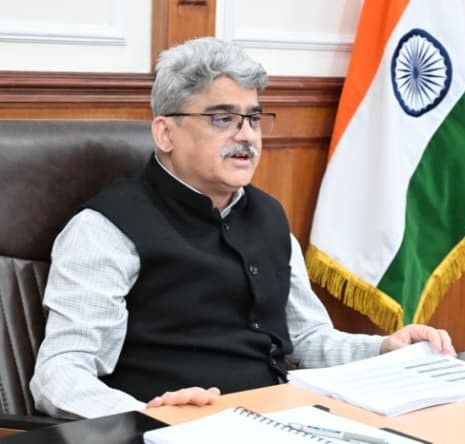
Jammu: Describing the forthcoming Census 2027 as a “National Digital Transformation Mission”, Chief Secretary Atal Dulloo on Thursday said the exercise would lay the foundation for a “Viksit Bharat” and usher in a new era of evidence-based policy planning.
Speaking at the Census 2027 Summit held at Abhinav Theatre, Dulloo said India was at a crucial “data inflection point” and that the census would no longer be merely an enumeration exercise.
“Data is going to be the key driver, the new oil and fuel of any nation’s economy in the AI-driven future,” he said, adding that India’s demographic diversity gives it a strategic advantage in becoming a globally benchmarked data-driven nation.
The summit brought together senior administrators, development partners and policy experts to discuss the roadmap and preparedness for Census of India 2027, which will be the country’s first fully digital and paperless census.
Dulloo contrasted the upcoming exercise with the 2011 Census and said that mobile-based enumeration, artificial intelligence and cloud technology would make the new census faster, more accurate and transparent.
He said integration of trusted national datasets with the JAM Trinity—Jan Dhan Yojana, Aadhaar and mobile connectivity—had already enabled the government to deliver benefits directly to citizens and reduce leakages.
According to the Chief Secretary, the new data ecosystem would move the country away from a “one-size-fits-all” approach and help in scientific planning at the village and district level in areas such as health, education and employment.
Dulloo directed Deputy Commissioners and district administrations to ensure immediate completion of training for Census officers and enumerators.
He said the self-enumeration process would begin on May 17, 2026, followed by house-to-house field work from June 1, 2026.
Earlier, Chief Principal Census Officer and Director Census Operations for Jammu and Kashmir and Ladakh, Amit Sharma, said Census 2027 would be conducted in two phases.
The first phase, House Listing and Housing Census, will include self-enumeration from May 17 to May 31, 2026, and house-to-house field work from June 1 to June 30, 2026.
The second phase, Population Enumeration, will begin in September 2026 in snow-bound areas and in February 2027 in non-snowbound regions.
Sharma said the census would be conducted entirely through a dedicated mobile app and a secure web portal available in 16 languages. Self-enumeration, he added, would be the preferred mode.
He also said a new Census Management and Monitoring System would allow near real-time tracking of field operations.
Among those present at the summit were Andrea M. Wojnar, Praful Kumar Sigtia and Rohit Kumar.
Andrea Wojnar said digital and self-enumeration-based census practices were increasingly being adopted across the world and expressed confidence that India’s Census 2027 would be robust and inclusive.
Praful Kumar Sigtia highlighted similarities between the census and the Aadhaar enrolment process, stressing the importance of secure and meaningful use of data.
Rohit Kumar underlined the global significance of the exercise and said Census 2027 would play an important role in shaping policy-making in India and beyond.