

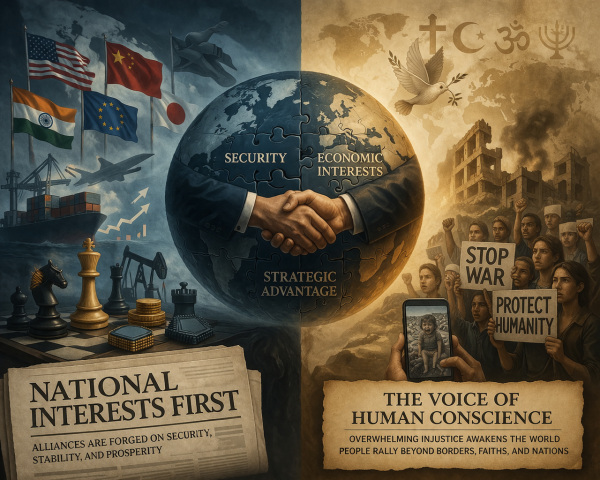
History has repeatedly shown that nations rarely act out of emotion, religion, or cultural affinity. Instead, they act primarily in their own self-interest. Alliances between countries are not built on shared faith or cultural similarity, but on security concerns, economic benefits, and strategic advantage. While public discourse often frames global politics in terms of ideology, religion, or civilisation, the reality is far more pragmatic: nations align first to protect their interests and only then consider common values.
If religion and culture were the main drivers of alliances, the world would look very different. Countries sharing the same religion or cultural background would naturally form unified political and military blocs, creating clear divisions between different civilizations. However, history tells a different story. During the Cold War, for example, alliances were not formed on religious or cultural lines but on ideological and strategic interests. Nations with different religious backgrounds stood together because they saw mutual benefit in cooperation against a common rival. Similarly, in today’s global order, countries often partner with others that have completely different political systems, cultures, and religious identities, simply because it serves their national interest.
The same pattern is visible across the world. Countries that were once adversaries have become partners when their interests aligned, and close allies have drifted apart when their priorities changed. Trade agreements, defence partnerships, and diplomatic relations are often driven by access to resources, market opportunities, military cooperation, and regional stability rather than cultural or religious ties. Economic growth, technological advancement, and national security remain the central pillars of foreign policy.
Human sentiments, however, do play a role in shaping public opinion and emotional polarisation. People across the world often feel strongly about conflicts, humanitarian crises, and injustices, especially when they see images of suffering civilians, destroyed cities, and displaced families. Social media and global news coverage amplify these emotions, creating waves of sympathy, outrage, or solidarity. Yet, while public sentiment may push governments to make statements or apply diplomatic pressure, it rarely overrides national interest in the long run.
Humanity, unfortunately, does not always become the central force in global alignment. Nations seldom unite purely for humanitarian causes unless the scale of injustice becomes overwhelming. Only when crimes against humanity, large-scale civilian casualties, or extreme violations of human rights occur do global powers begin to raise their voices more strongly. Even then, responses are often measured and influenced by political and economic considerations.
The division among Muslim-majority nations is one example of how shared religious identity does not automatically translate into political unity. Differences in governance, regional ambitions, economic dependencies, and security concerns often outweigh religious solidarity. At the same time, public opinion across the world has increasingly shown sensitivity to unjust wars and humanitarian crises. Protests, international debates, and growing criticism of violence against civilians reflect a changing global sentiment. People, regardless of religion or nationality, are becoming more vocal against injustice, showing that human empathy still exists even when political interests dominate decision-making.
This contrast between state behaviour and public sentiment is significant. Governments may act cautiously based on national priorities, but ordinary citizens often rally around humanitarian causes. International pressure, media scrutiny, and public protests sometimes force governments to speak out or reconsider their positions. This shows that while national interest drives alliances, human conscience continues to influence global discourse.
In the end, the world operates on a balance between interest and morality. Nations prioritise safety, security, and economic growth because their primary responsibility is to protect their citizens and maintain stability. At the same time, overwhelming injustices and humanitarian crises remind the global community that humanity cannot be ignored forever. Public opinion, civil society, and international awareness continue to push leaders toward ethical responsibility, even if slowly and imperfectly.
History teaches us a clear lesson: alliances are shaped by interests, not identities. Yet it also offers hope that the human conscience, when awakened by injustice and suffering, can still influence the direction of global politics. The challenge for our time is to ensure that national interests and human values do not stand in opposition, but move together toward a more just and compassionate world.


