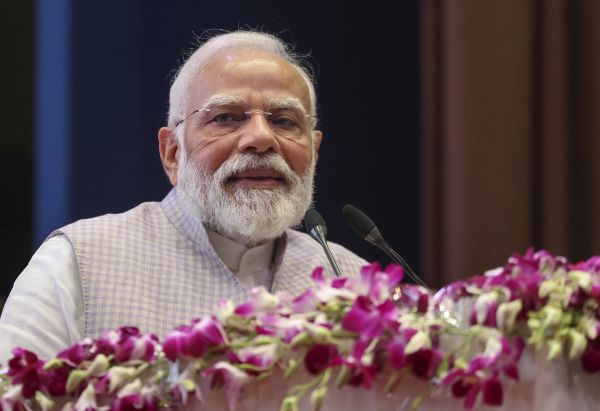
New Delhi: Prime Minister Narendra Modi on Thursday stressed the need to continuously update governance with the rapidly changing times to ensure ease of living for citizens.
Highlighting that the core mantra driving the country’s administration today is “Nagrik Devo Bhava” (treating citizens as supreme), he said that public service is being reoriented to be more capable and sensitive to the needs of citizens.
“Governance is now being given a new identity by making it truly citizen-centric,” Modi said in a video message at the launch of ‘Sadhana Saptah’.
The prime minister said that governance must be the benchmark for improving ease of living and quality of life for citizens, and urged public servants to learn something new every day. “Our governance should ensure that the quality of life of citizens improves day by day. This is our true benchmark,” he asserted.
Calling for a fundamental shift in administrative culture, Modi pointed out that the old system placed excessive emphasis on being an ‘officer’, whereas the country’s focus today is firmly on the spirit of duty.
“Before every decision, when you think about what your duty demands, the impact of your decisions will automatically multiply many times over,” he said, addressing public servants.
India is advancing swiftly amidst fast-changing global systems, and it must continuously update its governance machinery, the prime minister said.
Reminding public servants that for the common citizen, the local government office is the face of the entire government, Modi said that the working style and behaviour of officials directly shape public trust in democracy and constitutional institutions. “Whatever we do, at whatever level, we must safeguard that trust; it is the foundation of our democracy,” the prime minister said.
Addressing India’s federal structure, Modi emphasised that the nation’s success is a collective success of all its states.
He also mentioned the dismantling of outdated categorisations such as “forward states,” “backward states,” and “BIMARU states,” advocating for bridging the gaps between states through coordinated efforts.
“We have to break silos and move forward with better coordination, shared understanding and a whole-of-government approach; only then will every mission succeed,” the prime minister said.
Modi linked the necessity for rapid economic growth, modern infrastructure, technology adoption, and a large skilled workforce to the broader vision of a developed India (Viksit Bharat), asserting that public institutions and servants play a critical role in achieving these goals.
“Today’s India is deeply aspirational, every citizen has dreams and goals, and upon all of us lies the responsibility to provide maximum support to fulfil them,” he said.
Modi encouraged public servants to view their current work within the broader context of the future, challenging them to reflect on how their individual decisions can impact the lives of millions.
“What will be the impact of the work being done by us (public servants) on the development journey of the country? How many citizens’ lives can be changed by one of our decisions? How can our individual transformation become an institutional transformation? These questions should guide our efforts. I can say from experience, it requires significant energy to achieve this,” he said.
Turning to the critical importance of technology, Modi highlighted the substantial integration of technology into government operations over the past eleven years, affecting governance, service delivery, and the economy.
With the advent of Artificial Intelligence, he noted, these changes are set to accelerate even further.
“A better administrator, a better public servant, will possess a strong understanding of technology and data; this will form the very basis of decision-making,” Modi emphasised.
Sadhana (Strengthening Adaptive Development and Humane Aptitude for National Advancement) Saptah, one of the largest collaborative capacity-building efforts across India’s civil services ecosystem, is being organised by the Capacity Building Commission (CBC) from April 2 to 8.The event coincides with the foundation day of the Capacity Building Commission (CBC).
Reflecting on the genesis of the commission, the prime minister observed that while many institutions had been working with varied focuses since independence, there was a clear need for a dedicated body aimed at enhancing the capability of every government employee.
“This very thinking gave birth to the Capacity Building Commission, which is focused on empowering every Karmayogi in the system,” he said.
The commission designs frameworks, sets standards and encourages collaboration to make governance more transparent, accountable, citizen-centric and future-ready. It is the custodian of the Mission Karmayogi framework to drive civil service reforms through capacity-building and competency-based learning.