
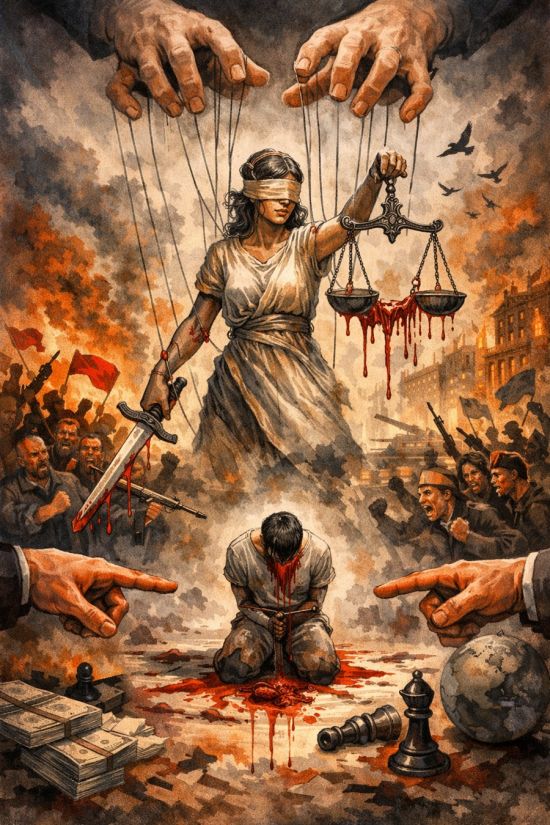
In recent years, the world has witnessed conflicts, wars, and violence unfolding almost daily. Images of destruction and human suffering travel instantly across screens and social media feeds. Yet, a troubling question arises: Are we still emotionally shaken by bloodshed, or have we become numb to it? More importantly, have we begun to judge such events not by the universal standards of right and wrong, but by which “side” we support?
It increasingly feels as if humanity is losing a vital element of its moral fabric, emotional intelligence and ethical clarity. Instead of reacting to violence with a shared sense of grief and concern for human life, many people respond through the lens of political camps, national loyalties, or ideological blocs. The tragedy of human suffering often becomes secondary to the question of which side one belongs to.
The word “wrong” itself seems to be losing its meaning. Rather than condemning wrongdoing wherever it occurs, many of us first ask: Who did it? If the act was committed by the group we oppose, it is loudly denounced. But if it is done by those we support, it is often justified, minimized, or ignored. In this way, morality becomes conditional, shaped more by allegiance than by conscience.
At times, global conflicts are treated almost like sporting events. Just as fans passionately cheer for their team in a tournament, people rally behind nations, leaders, or ideological groups. The focus shifts from human suffering to victory and defeat. But war and bloodshed are not games. Behind every statistic are lives lost, families shattered, and communities destroyed.
Certainly, every society and individual possesses a natural instinct for self-preservation. Nations must ensure their security, and communities must safeguard their economic interests. These are legitimate concerns. Physical safety and stability are essential for survival. However, the critical question remains: Should economic or political interests override basic moral principles of humanity?
When human life is lost or injustice occurs, the moral response should not depend on which flag is raised or which leader is speaking. Ethical values should stand above political calculations. Yet today, our thinking, emotions, and actions often appear guided less by moral reasoning and more by loyalty to the “team” we belong to.
This loyalty is rarely spontaneous. It is often shaped by influential voices, political leaders, media narratives, or ideological groups that tell us what to think and whom to support. As a result, individuals begin to echo predetermined opinions rather than critically examining events themselves. Before the facts are fully understood, many people have already chosen their side.
How often do we truly pause and ask a simple human question: Is this right or wrong? How often do we condemn injustice purely on moral grounds, regardless of who commits it? Unfortunately, such unbiased reflection has become rare. Instead, judgments are frequently passed even before the situation is carefully heard or understood.
This tendency resembles a court where the verdict is announced before the trial begins. Evidence, context, and fairness become secondary. The outcome is predetermined by group loyalty.
Such a mindset poses a serious danger not only to global peace but also to the very idea of justice. When societies abandon impartial moral judgment, they create a world where truth becomes flexible and justice selective.
Humanity must therefore reclaim its independence of thought. People must free themselves from the invisible influence of those who dictate what to believe and whom to favour. Critical thinking, empathy, and moral courage must once again guide public opinion.
Because the reality is simple and sobering: today the victim may be someone far away, but tomorrow it could be any one of us. A society that judges without listening and condemns or justifies based on allegiance rather than truth ultimately undermines its own foundations of justice.
If humanity wishes to preserve its dignity, it must rediscover the courage to stand for what is right, even when it is uncomfortable, even when it challenges the side we instinctively support. Only then can the world move from blind polarization back toward genuine human values.