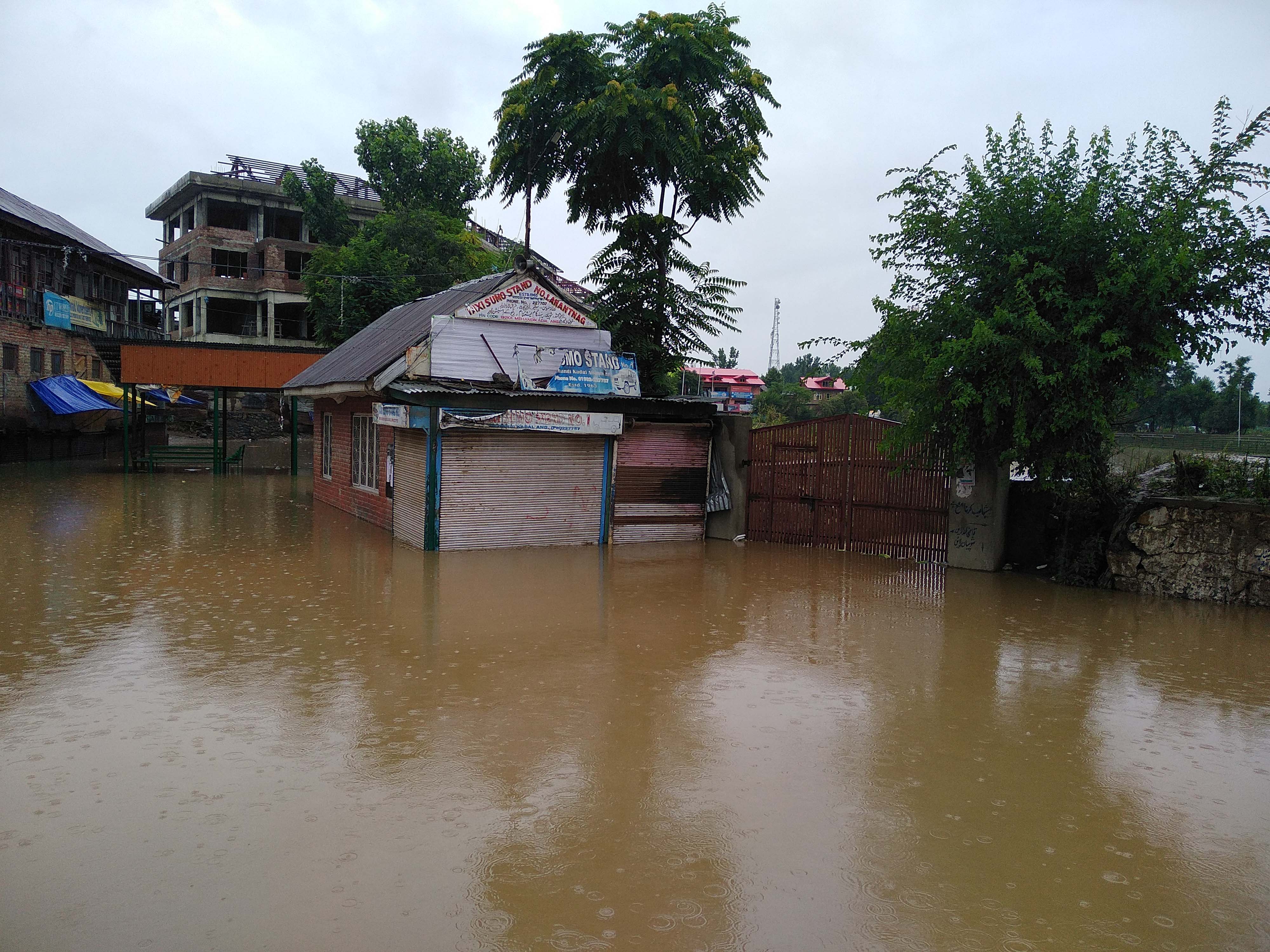
Jammu: The Jammu and Kashmir government has expended over Rs 487 crore on a series of flood management initiatives under various phases of the flood management programme, in the aftermath of the catastrophic 2014 deluge that ravaged the valley.
The investment has been directed towards strengthening embankments, dredging rivers and nallahs, upgrading pumping stations, and reinforcing critical flood control infrastructure to enhance preparedness and mitigate the impact of future flooding events, officials of the Jal Shati department said.
Following the devastating 2014 floods, the Union Ministry of Water Resources (MoWR), RD&GR constituted a three-member core group on September 18, 2014 to prepare a roadmap for flood management in the valley.
The recommendations were categorised into immediate, short-term and long-term measures, the officials said.
While Phase-I of the Flood Management Programme, sanctioned at Rs 399.29 crore, has seen an expenditure of Rs 327.04 crore and is largely complete with improvements such as enhanced carrying capacity of the Jhelum and Flood Spill Channel, the progress under Phase-II (Part A) remains markedly slow.
Against a much larger sanctioned cost of Rs 1,623.43 crore approved in March 2022, only Rs 220.97 crore has been released and Rs 160.563 crore spent, the officials said.
Under immediate measures, the officials said the department restored 4,555 breach and vulnerable spots — 3,320 temporarily and 1,235 permanently — using funds from the State Disaster Response Fund (SDRF) and other sources.
For short-term measures, aimed at mitigating a flood threat of 60,000 cusecs at upstream Sangam in south Kashmir, the government submitted a comprehensive project for the Jhelum river and its tributaries at a cost of Rs 2,083.90 crore under the Prime Minister’s Development Package (PMDP), sanctioned in 2015.
PMDP Phase-I, with a sanctioned cost of Rs 399.29 crore, was implemented from 2015-16 and stands substantially completed. The safe flood carrying capacity of the Jhelum river in the Srinagar reach was enhanced from 31,800 cusecs to 41,000 cusecs, an increase of 22 percent, the department said.
The officials said the major bottlenecks in the flood spill channel at Shariefabad and Nadihal in north Kashmir were removed, doubling its carrying capacity from 4,000 to 8,700 cusecs. An expenditure of Rs 327.04 crore (Rs 223.96 crore Centre’s share and Rs 103.08 crore UT share) has been incurred under Phase-I till date.
PMDP Phase-II (Part A), approved in March 2022 at a cost of Rs 1,623.43 crore, includes 31 bank protection and anti-erosion works worth Rs 276.61 crore, of which 16 have been completed.
Two regulatory gates in the Hokersar wetland have also been completed and commissioned at a cost of Rs 28.45 crore. So far, Rs 160.563 crore has been spent under Phase-II, the officials said.
They said against Phase-II, funds amounting to Rs 220.97 crore (Rs 174.705 crore Centre’s share and Rs 46.27 crore UT share) have been released.
The department said the flood management works are being carried out in a phased manner to strengthen flood mitigation infrastructure in the valley.