In Urdu literature, micro-fiction (afsancha) writing is a delicate yet profoundly meaningful genre that demands immediate attention, deep awareness, and a sensitive heart from its reader. To encapsulate the complex experiences of life, social realities, and the layered states of human psychology within a handful of words is no easy task. Yet it is precisely this quality that elevates the afsancha from mere brief prose to a complete intellectual and emotional experience. Within the literary tradition of the Kashmir Valley, afsancha writing represents a continuation of this creative discipline, where the art of saying more with fewer words is considered an essential condition. In this very tradition, the name of Khalid Bashir Tilgami emerges as a serious and credible reference.
Hailing from the town of Pattan Tilgam in the Baramulla district, Khalid Bashir Tilgami’s vision is not limited to the surface level. Rather, he delves into the inner depths of society, capturing human emotions, silent sufferings, and moral contradictions in the concise yet richly expressive form of the afsancha. Pain in his art does not shout; rather, it manifests itself in the form of silence. This silence, in turn, generates a long-lasting echo in the heart of the reader.
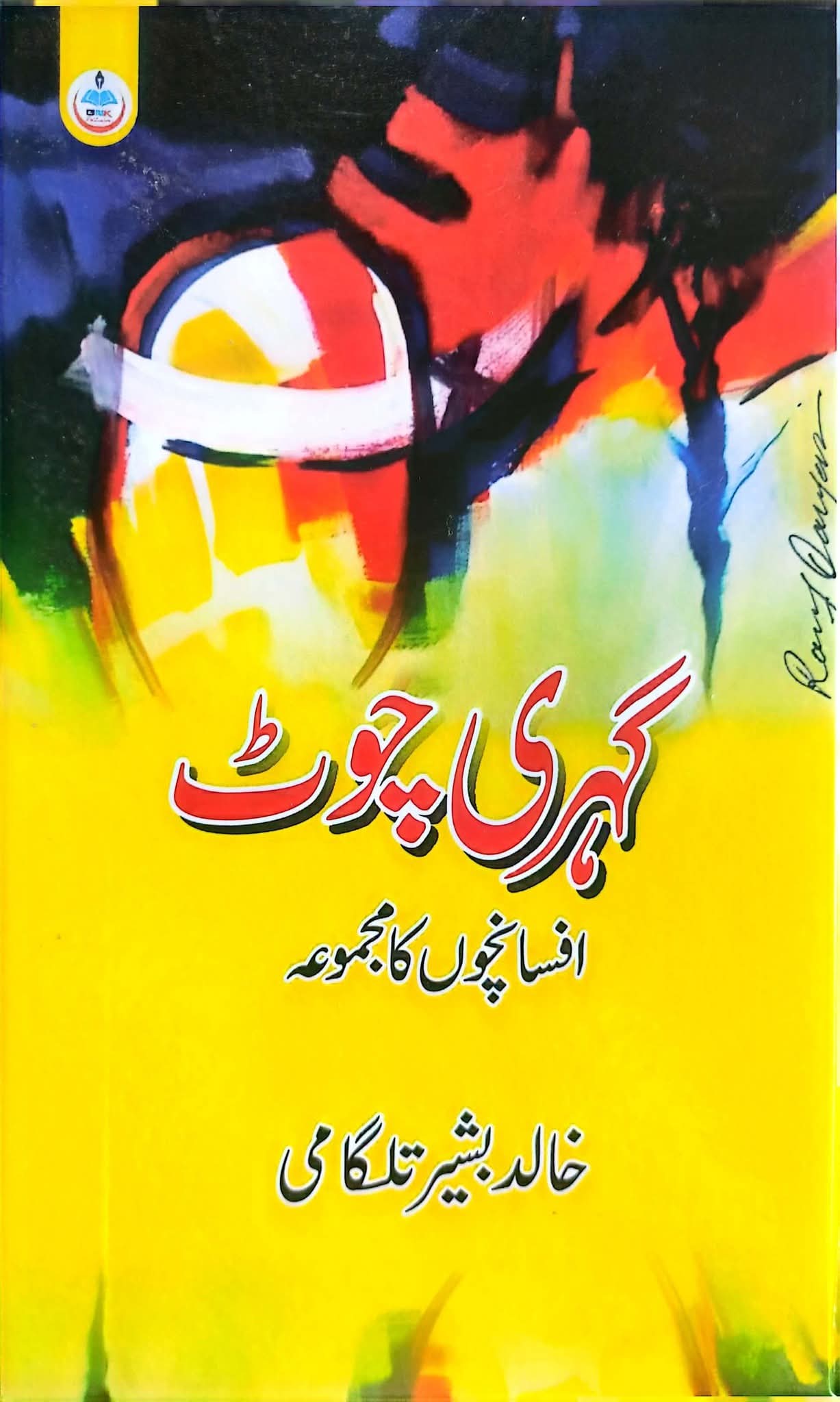
Khalid Bashir Tilgami’s afsancha collection Gahri Chot is more than just an afsancha collection. It is an internal experience, an intellectual journey, and a literary experience that delves deep into the depths of emotions and consciousness. The title itself clearly indicates the semantic richness of the collection. It represents a wound that is not visible to the naked eye but wounds the inner self, moving from the domain of emotion, conscience, and thought for a long time. The afsanche in this collection do not depend on noise, slogans, or emotional outbursts. Rather, they silently penetrate the reader’s mind, and it is this silence that becomes their biggest strength.
Published in 2025, Gahri Chot has 112 pages and has been published by GNK Publications, Budgam, Jammu and Kashmir. The eighty-three afsanche in this volume give a holistic and significant glimpse into the divided human society of the modern era. In the choice of themes, Khalid Bashir Tilgami does not restrict himself to a particular area. Sometimes, with the setting of the Dal Lake, the inner sadness of Kashmir and its aesthetic aspect come together. Sometimes, themes like debt, daughters, the mother tongue, and the concepts of lawful and unlawful hit hard at the bitter realities of life.
One of the most remarkable aspects of these afsanche is the lack of sermonizing and rhetorical statements. What is left behind is a composed, questioning, and thought-provoking style of writing. Khalid Bashir’s writing is plain, transparent, and unpretentious. Instead of entrapping the reader in a whirlpool of words, he leaves behind a question in a few sentences, which chases the reader’s mind long after the reading is over. In his afsanche, pain does not shout loudly; it speaks in a whisper, and that whisper turns into an echo that resonates in the reader’s heart. In this manner, the reader does not remain a passive consumer of the text but is brought into a dialogue with his own self.
As said by the renowned critic Dr. Azeem Rahi, Gahri Chot is an “impact compact” book in which social truths are depicted with remarkable depth and finesse using a minimal number of words. Dr. Reyaz Tawheedi calls it the “effort of a serious afsancha writer,” in which brevity, technical expertise, and diversity of themes meet with a deep resonance of social, psychological, political, and economic issues.
Discussing the artwork of Khalid Bashir, renowned short story writer Noor Shah says: “These afsanche touch the wounds that are embedded in the inner self of the reader, the wounds that may not be visible but are bleeding the human existence.” This way, they become a good representation of the wounds inflicted on the human soul. The design and presentation of the book also add to its impact. The emotional dedication at the start of the book, which the author has written in memory of his late brother-in-law Ghulam Hamza, immediately puts the reader in a personal and pain-conscious environment. The introductory pieces that follow help to understand the intellectual and artistic background of the author. Therefore, the book makes a lasting impact not only on the intellectual front but also emerges as a sophisticated literary endeavour on the visual front.
Khalid Bashir Tilgami’s literary journey started with his first afsancha publication named Dukhti Rag in 2021, which got recognition at both national and international levels. Gahri Chot is the next step in his literary journey, which is mature and serious. Instead of feeling complete, the author feels that he should be involved in a learning process. The creation of literary forums like Gulshan e Afsancha is a reflection of this intellectual seriousness and his commitment to the genre.
Each afsancha in Gahri Chot is a different question, a different wound, and a different mirror. To grasp the semantic richness of these afsanche, their thematic and intellectual pointers are compiled below in a condensed form, where each heading holds in itself a complete social or moral anguish. Sabab, Qarz, Taassub, Dal Jheel, Betiyaan, Thappar, I Am Busy, Adda, Qarz-e-Hasna, Neki, Daaie, Autograph, Shash-o-Panj, Allah Akbar, Sookha Poda, Maa, Faasla, La-Jawab, Tadark, Pehla Roza, Desh Bhakt, Zaiqa, Zehar, Ghareeb Ki Awaaz, Chhutti, Fitrat, Nuskha, Confusion, Haqdaar, Surprise, Aks, Sataish, Munh Kala, Fasal, Commission, Gunjaish, Halal, Nazar, Manfi Soch, Bara Aadmi, Madri Zaban, Aaina, Pasand, Ajr, Khoon-e-Jigar, Shukarguzar, Bechara, Machine, Tazaad-e-Fikri, Dream Eleven, Gumaan, Sirat-e-Mustaqeem, Talash, Bharat, Numaish, Deewar, Pewand, Ilaj, Amma… Amma, Tareekh, Lift, Asli Ghar, Kashmakash, Majboor, Pagal, Santa Claus, Mumta, Dars, Virus, Chamatkar, Duayein, Nazrana, Haddein, Niyat, Dukh Dard, Nafa-Nuqsan, Karishma, Parhezgar, Aaina, Sohbat, Laat, Badlao, and Gahri Chot.
The first evidence of the excellence of Gahri Chot is in the thematic diversity packed into an incredibly short space. Every afsancha is like a legal document, specific, irrefutable, and morally loaded. Religion is analyzed without passion, politics without rhetoric, love without romanticism, and society without hyperbole. Whether it is religion, gender, poverty, power, hypocrisy, or modern alienation, the author never preaches; he only lets situations, silences, and single sentences bear witness. This is not a weakness but a strength where less is more, and the reader is made a participant, not a recipient. The stylistic unity of the book is also very engaging. The language is pure, evocative, and emotionally controlled. Satire is biting but never mean, pain is profound but never showy.
Most afsanche end not with answers but with questions, and this is an artistic choice that reveals literary maturity and moral confidence. The strength of this collection of afsanche is its human perspective. Children lay bare adult prejudice, women lay bare social cruelty, the poor lay bare systems without shouting, and the ordinary becomes an ethical judgment. Taken together, Gahri Chot is the documented proof that the afsancha, in skilled hands, can bear the burden of an age. This book is not only to be read but to be heard, to be confronted with one’s conscience, and to be judged by oneself.
Through this thematic and intellectual analysis of all these afsanches, it becomes abundantly clear that Gahri Chot is not only a compilation of afsanches but also a subtle yet profound statement of the social, moral, and psychological complexities of our times. The artistic awareness, intellectual honesty, and human sensitivity with which Khalid Bashir Tilgami has articulated himself in such a delicate form of literature as the afsancha make this effort a significant and valuable contribution to Urdu literature. This book is not only a source of the pleasure of reading but also forces the reader to think, to pause, and to question oneself. On this serious, thoughtful, and creatively strong literary endeavor, I, Wani Arfat, offer my warm congratulations to Khalid Bashir Tilgami and hope that he will continue to contribute to Urdu literature with the same sincerity, intellectual maturity, and creative awareness in the future.
Mohammad Arfat Wani is a writer, social activist, and nursing student from Kuchmulla, Tral. He is also a B.Sc. Nursing student at Ramzaan College of Nursing & Paramedical Sciences, Galander Pampore. He writes on social issues, culture, and public concerns with the aim of raising awareness and inspiring positive change.
Email: wania6817@gmail.com