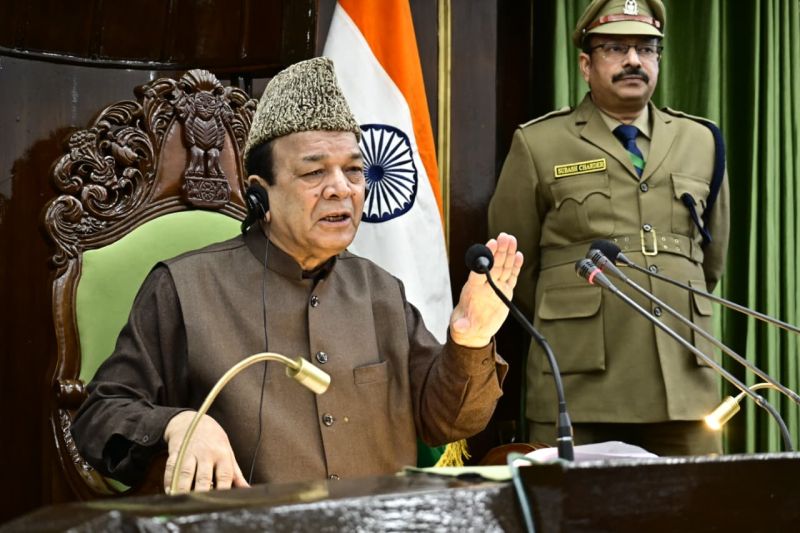
Jammu: Jammu and Kashmir Assembly Speaker Abdul Rahim Rather urged the government on Friday to strengthen the legal framework to combat food adulteration, as members voiced concern over a large-scale seizure of rotten meat and sub-standard cheese across the Union Territory.
Replying to a clubbed question from National Conference (NC) MLAs Saifullah Mir, Mubarak Gul, Pirzada Farooq Ahmad Shah and Hasnain Masoodi, Health Minister Sakeena Itoo informed the Assembly that more than 12,183.5 kg of rotten meat, worth over Rs 29.19 lakh, was destroyed during 1,676 inspections across Jammu and Kashmir during the Financial Year 2025-26, up to December 2025.
In addition, she said 7,665 kg of adulterated cheese worth more than Rs 16.32 lakh was seized in the Jammu region.
A total of 144 samples of meat and meat products and 173 samples of cheese were lifted for analysis at food laboratories within and outside Jammu and Kashmir, Itoo said.
The reports for all the 144 meat and meat product samples have been received, with one declared sub-standard and 17 found unsafe. Similarly, reports have been received for 157 of the 173 cheese samples. Forty-seven of the samples have been declared sub-standard and one was found unsafe, the minister said.
Itoo acknowledged a shortage of technical manpower in both food-testing laboratories in the Union Territory — one each in Srinagar and Jammu — stating that against the 19 sanctioned posts in each, 11 are vacant. However, she said the 22 vacant posts will be referred to recruiting agencies once the recruitment rules are finalised.
To curb food adulteration and safeguard public health, the food safety department has intensified enforcement by conducting regular inspections of food establishments, lifting and testing samples through notified laboratories, and taking strict action against violators, including suspension or cancellation of licences, penalties and prosecution, the minister said.
She said action has been initiated against 18 food-business operators found involved in the sale of unsafe meat and meat products in various districts, including Srinagar and Jammu, with most of the cases currently under process.
In a supplementary to the main question, CPI(M) MLA M Y Tarigami and BJP’s Balwant Singh Mankotia made suggestions and sought more details on enforcement action, inter-departmental coordination, legal follow-up and preventive measures to ensure that such incidents are not repeated.
As the minister acknowledged several shortcomings, including the government’s lack of authority over police to enforce strict action, the speaker intervened and urged her to plug the loopholes by bringing necessary amendments to the law governing food safety and food products.
“If you feel that the current provisions are not sufficient to end this trend, then why does the government not move a bill to amend the Act? The government should amend it and increase the powers of the food safety department and make those powers more effective so that no complaints arise in this regard,” the speaker said, stressing that public health cannot be compromised.
Mir termed the issue “extremely important for the people of Jammu and Kashmir”. The NC MLA questioned how such consignments crossed toll posts and sought clarity on the role of police, food safety authorities and municipal bodies.
Shah, Masoodi and Gul also echoed concerns about systemic weaknesses in policy implementation, highlighting staff shortages, inadequate local testing infrastructure and delays in receiving reports from outside laboratories.
They called for stronger punitive provisions, including sealing of businesses involved in adulteration.
Tarigami called for clearer delineation of powers and stronger coordination with police, suggesting that a specialised enforcement mechanism could be considered.
Mankotia urged the government to bring amendments in the current session of the Assembly itself, instead of waiting for a private member’s bill.