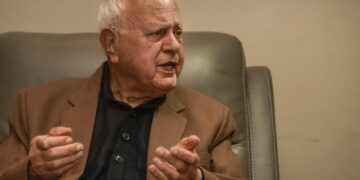
Jammu: CPI(M) leader M Y Tarigami on Monday criticised the recent India-US trade deal, alleging it would severely hurt the country’s agricultural sector and deal a particular blow to the economy of Jammu and Kashmir.
Participating in the discussion on the Budget in the Assembly, Tarigami said the agreement compromised national sovereignty by favouring American interests while exposing Indian farmers — especially apple, peanut, and soyabean growers — to unfair competition without adequate safeguards.
“A meeting had recently taken place regarding a trade deal between the United States and our government, in which the Indian government has agreed to US diktats, including the cessation of oil purchases from our time-tested friend, Russia,” Tarigami, who is an MLA from Kulgam, said.
“This directly impinges upon our sovereignty. Under this arrangement, all American goods, including apples, peanuts (soyabean) and other agricultural products, would be allowed into India at zero tariff, with no protective barriers,” he said.
In contrast, he said Indian goods entering the American market would continue to face an 18 per cent tariff.
“It is therefore not difficult to understand who stands to gain and who stands to lose. This trade deal is bound to have a severe adverse impact on our agricultural sector,” he said.
In the absence of a legally guaranteed Minimum Support Price (MSP) as recommended by the Swaminathan Commission, farmers are left with mere assurances that have not been implemented on the ground, he said.
“This trade agreement will prove to be a major blow not only to the national economy but also to the economy of Jammu and Kashmir in particular,” he said.
Budgeting, in simple terms, is the management of tax revenues and public expenditure. It must be noted that Jammu and Kashmir has, in the past, lost its fiscal autonomy, and in the absence of a viable resource base, it is excessively dependent on central funds, Tarigami said.
Raising the issue of regional imbalance, the legislator said that while the word “discrimination” was repeatedly invoked in the House, what Jammu and Kashmir required was balanced and inclusive industrialisation across all regions.
Citing government data, he alleged a clear pattern of regional and sub-regional discrimination in the creation of industrial infrastructure, pointing out that the Jammu region had 29,713 kanals of industrial land compared to just 2,188 kanals in Kashmir, a disparity for which he said there was no economic, geographic or strategic justification.
He claimed that even within Jammu, nearly 98 per cent of industrial estates were concentrated in the plains, leaving other areas with only a token share, while in Kashmir, regions such as north Kashmir and districts like Kulgam had been virtually neglected in terms of industrial development.
He also raised concerns over the plight of daily wagers and casual labourers, stating that a humane approach alone was insufficient without expeditious and time-bound regularisation.
Talking about the Centre’s support to Jammu and Kashmir, Tarigami said what is urgently required is a much stronger emphasis on boosting internal resource mobilisation through the promotion of local economic activity.
“Farmers in both Jammu and Kashmir are facing severe distress due to floods, erratic rainfall, and repeated highway blockades, which have resulted in massive crop losses. Adequate compensation, particularly a one-time remission of Kisan Credit Card (KCC) loans, would provide much-needed relief to the affected farming community,” he said.
The CPI(M) leader said there is also considerable ambiguity regarding social security measures for scheme workers.
Anganwadi workers and helpers must be provided honorarium at par with their counterparts in other States and Union Territories, he said, adding specially abled persons deserve far greater attention.
The legislator said special police officers, nambardars and chowkidars were being paid a meagre honorarium despite rendering critical services and called for a substantial increase in their remuneration.