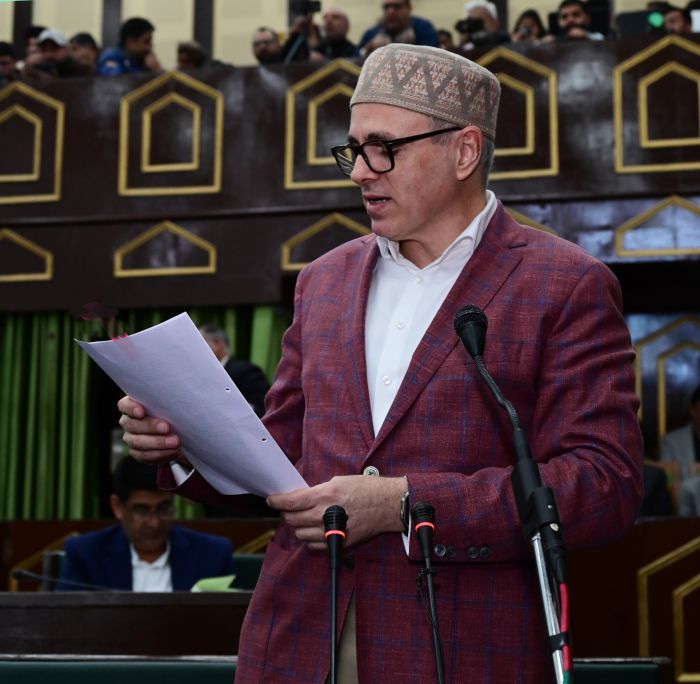
Jammu: Jammu and Kashmir Chief Minister Omar Abdullah, who also holds the portfolio of UT’s Finance Minister, Friday presented his government’s second budget announcing a series of welfare and development measures to boost the economy, strengthen social sectors and promote sustainable growth in Jammu and Kashmir.
While presenting Rs 1.27 lakh crore Budget for 2026-2027 in the Legislative Assembly, Abdullah said his government is committed to transforming the J&K into a modern, progressive and economically vibrant region by promoting investment, innovation and participatory governance and estimated total gross receipts and expenditure at Rs 1,27,767 crore.
He said that the total gross receipts include provision for ways and means advances and overdraft of Rs 14,000 crore. He said the total net Budget estimates for the fiscal stand at Rs 1,13,767 crore, excluding the provision for advances and overdraft, adding, Rs 80,640 crore has been earmarked under revenue expenditure and Rs 33,127 crore under capital expenditure in the Budget estimates for 2026-27.
He said that the expected revenue receipt is projected at Rs 90,018 crore, while capital receipts are estimated at Rs 23,749 crore and UT’s own revenues, including tax and non-tax sources, are estimated at Rs 31,800 crore, while as Rs 42,752 crore as central assistance and Rs 13,400 crore under centrally sponsored schemes (CSS) are expected.
-
Six free LPG cylinders to AAY households
-
Monthly support for poor students, orphan children
-
Scholarships for tribal students; free government transport for persons with disabilities
-
Crop insurance for apple, saffron, mango and litchi crops; expansion of storage facilities
Highlighting fiscal indicators, Abdullah said the tax-to-GDP ratio is projected at 6.6 per cent for 2026-27, compared to 7.5 per cent in 2025-26. He said the fiscal deficit for 2025-26 was estimated at 2.98 per cent, substantially lower than 5.5 per cent in 2024-25 (RE). However, he said the fiscal deficit for 2026-27 is estimated at 3.69 per cent, slightly higher than 3.63 per cent in 2025-26 (RE).
Abdullah said the GDP for 2025-26 was projected at Rs 2,88,422 crore, showing a growth of 9.5 per cent over the previous year, while the GDP for 2026-27 is projected at Rs 3,15,822 crore, indicating a similar growth rate.
He said the Budget aims to sustain economic growth while maintaining fiscal discipline and strengthening development initiatives across Jammu and Kashmir.
Describing the Budget as a roadmap for development, he said, “This Budget is not merely a ledger of figures, it is a fiscal compass charting our path towards a brighter horizon. It lays strong foundations for enduring economic growth, social harmony and sustainable prosperity.”
The chief minister urged members of the House to work collectively for the region’s development.
“As we embark on this shared journey, I invite every honourable member of this august House to come together and work collectively to build a strong and flourishing Jammu and Kashmir,” he said.
Highlighting the resilience of the people, Abdullah said his government is committed to transforming Jammu and Kashmir into a progressive and economically vibrant region. “Together, we will turn obstacles into stepping stones and aspirations into achievements,” he added.
The chief minister said the government is focused on creating a business-friendly ecosystem to attract investment and innovation.
“The Budget was prepared after wide consultations with elected representatives, industry leaders and stakeholders to ensure it remains people-centric”.
Referring to challenges faced during the past year, Abdullah said geopolitical factors, the Pahalgam terror attack and devastating floods in parts of Jammu region adversely impacted economic activity. “All sectors, including tourism, handicrafts, horticulture and agriculture were badly affected, leading to job losses and financial distress for families,” he said.
Abdullah said the Budget focuses on inclusive and sustainable growth through strategic investments in infrastructure, public services and governance.
Flagging fiscal constraints, the chief minister said own tax and non-tax revenues meet only about 25 per cent of the Union Territory’s budgetary requirements.
He said revenue collections stood at Rs 10,265 crore from taxes and Rs 4,964 crore from non-tax sources till December 31, 2025.
The chief minister said nearly 60 per cent of the overall expenditure is committed towards salaries, pensions and debt servicing, adding that the government is taking steps to manage debt and curb non-priority spending.
“We are strengthening debt sustainability by keeping borrowings within approved limits and improving liquidity management. For the third consecutive year, austerity measures have been enforced,” he said.
Abdullah said reforms in the power sector, including expansion of the consumer base and execution of loss reduction works, are being undertaken to ease financial stress.
He also acknowledged the Centre’s support in addressing fiscal challenges. “The central government has remained cognizant of our difficulties and consistently supported us through special assistance,” he said, adding that J&K has been brought under the Special Assistance to States for Capital Investment scheme.
The chief minister said funds under the scheme will be utilised for infrastructure development, hydroelectric projects and disaster mitigation works, particularly in flood-affected areas.
He announced full fee waivers for economically weaker students from Class 9 to college, six free LPG cylinders for per year to AAY households, monthly support for orphan children, scholarships for tribal students and free government transport for persons with disabilities.
The Budget proposes crop insurance for apple, saffron, mango and litchi crops, expansion of storage facilities, promotion of micro and sprinkler irrigation, medicinal plant cultivation, livestock genetic improvement labs in every district and a push for ODF-Plus status in rural areas, he said.
In education and youth empowerment, the government proposed JK e-Pathshala DTH channels for Classes 1–12, modernisation of anganwadi centres, indoor sports facilities in government schools and priority hiring of local youth in subsidised industries.
Abdullah said his government has identified several focused initiatives that will directly improve the lives of people across sectors, including handicrafts, agriculture, healthcare, education, social welfare and infrastructure.
The chief minister said the government will enhance budgetary support to the Jammu and Kashmir Trade Promotion Organisation (JKTPO) to promote handicrafts and handloom products through regular buyer-seller meets to create direct market linkages for artisans.
He said financial support of up to Rs 200 crore has been secured for the construction of a Unity Mall, which will function as a Crafts Bazaar and provide a permanent platform for local handicrafts and traditional enterprises from across the country.
Abdullah also announced major financial management reforms, stating that all Centrally Sponsored Schemes have been transitioned to the SPARSH system, with Aadhaar-based Direct Benefit Transfers made mandatory.
He proposed modernisation of Accountancy Training Institutes in Srinagar and Jammu at a cost of Rs 10 crore and said the government has submitted a proposal to avail Rs 350 crore under incentive schemes.
Addressing staffing challenges in remote areas, the chief minister said the government is contemplating a structured incentive scheme for employees posted in far-flung and hardship areas to improve retention and service delivery.
He further announced that industrial units availing government concessions will be required to prioritise employment of local youth to ensure that industrial growth translates into jobs for residents of the Union Territory.
In the agriculture and horticulture sector, Abdullah announced the implementation of the Restructured Weather-Based Insurance Scheme with an insured sum of Rs 6,594.93 crore for crops, including apple, saffron, mango and litchi.
He also said additional Controlled Atmosphere storage capacity will be created and 40 new CA stores will be set up with an investment of Rs 1,400 crore, with government subsidy support of Rs 600 crore.
The chief minister announced a 25 per cent top-up subsidy for micro and sprinkler irrigation with an allocation of Rs 116.86 crore, expected to benefit farmers across three lakh hectares. He also announced an Aromatic and Medicinal Plants Mission with an outlay of Rs 150 crore.
To boost livestock quality, Abdullah proposed setting up Embryo Transfer Technology labs in every district with an investment of Rs 65 crore.
In the education sector, he said the government has launched the JK e-Pathshala DTH channel to provide curriculum-based lessons for students from Class 1 to 12 without internet dependency. He also announced indoor games facilities in all government schools with an allocation of Rs 18 crore.
The chief minister proposed upgrading 1,000 Anganwadi centres into Bal Vidyalayas and constructing 127 new centres to strengthen early childhood care infrastructure.
Abdullah also announced Rs 70 crore in scholarship support for over three lakh tribal students and financial assistance to promote tribal homestays and artisan clusters.
In healthcare, he said the extension block of Lal Ded Hospital in Srinagar will be commissioned in 2026-27, while a 249-bedded Mother and Child Care Hospital will be constructed at GMC Anantnag. Emergency Medicine Departments will be established in all government medical colleges, he said.
The chief minister announced the strengthening of cardiac care by establishing Cath Labs at Government Medical Colleges in Rajouri, Baramulla and Doda. He also said the government will roll out a comprehensive Cancer Control Strategy in collaboration with Niti Aayog and ICMR.
Abdullah proposed establishing two dedicated emergency and accident hospitals in Uri and Poonch, besides the procurement of bulletproof ambulances for border districts.