
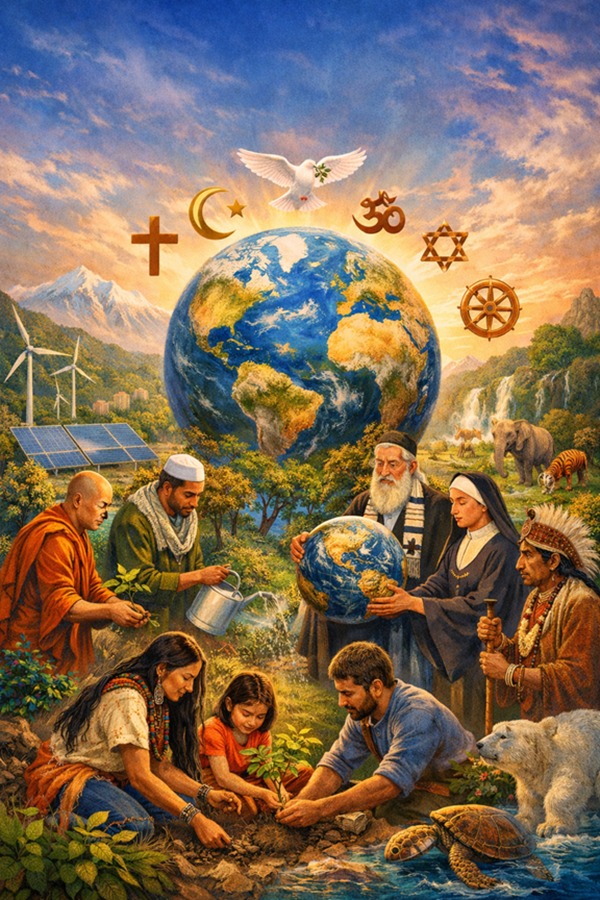
For the first time in human history, humanity has been jolted awake by a shared and urgent alarm: the need to work together to prevent the destruction of nature itself. The rapidly changing climate, manifesting in floods, droughts, wildfires, heatwaves, and collapsing ecosystems has created a moment unlike any before. Divisions that once defined the world, religion, culture, ethnicity, and ideology are increasingly giving way to a common realization: survival demands unity.
For centuries, religious and cultural identities have often been sources of separation. Today, those very identities are becoming bridges. Across the globe, communities are coming together not to debate theology or doctrine, but to discuss conservation, protection, and the revival of the natural world. This emerging alliance is driven by a recognition that humanity may have a final chance to act collectively, not against one another, but against the unchecked consumerism and extractive capitalism that have pushed the planet to the brink.
At the global level, this spirit of cooperation is visible in ambitious international initiatives. Partnerships such as ENACT (Enhancing Nature-based Solutions for an Accelerated Climate Transformation) and the High Ambition Coalition for Nature and People reflect a growing consensus that protecting biodiversity and stabilizing the climate must be a shared responsibility. These initiatives emphasize inclusive, science-based approaches that transcend political and ideological bias, focusing instead on safeguarding the Earth for future generations.
The High Ambition Coalition for Nature and People, now comprising more than 115 countries, has committed to protecting at least 30 percent of the planet’s land and oceans by 2030, a goal widely known as “30×30.” Similarly, India’s Mission LiFE (Lifestyle for Environment) has reframed environmental protection as a mass movement, encouraging individuals and communities to become “Pro-Planet People,” regardless of nationality, faith, or social background. These efforts operate under the broader framework of the Paris Agreement, a near-universal treaty that recognizes climate action as a moral obligation owed to future generations.
Alongside governments, global civil society has played a decisive role in turning concern into action. International networks such as the Climate Action Network, Greenpeace, World Wide Fund for Nature (WWF), Friends of the Earth International, Rainforest Alliance, and 350.org operate across continents, linking advocacy, scientific research, and grassroots action. While diverse in strategy, these organizations share a common goal: reducing humanity’s destructive footprint while advancing environmental justice.
Yet the most powerful stories of transformation often emerge at the local level. Indigenous peoples and community-led initiatives, frequently overlooked, have proven to be among the most effective stewards of nature. In Kenya, the community-run Mikoko Pamoja project pioneered the world’s first mangrove carbon credit system. In the Amazon, Brazil’s Apiwtxa community blends ancestral knowledge with modern mapping technology to defend its forests. In India, Swayam Shikshan Prayog has empowered tens of thousands of women farmers to adopt water-efficient and organic practices in drought-prone regions. In Pakistan’s Baltistan region, local communities have protected endangered snow leopards by creating innovative livestock insurance schemes. These efforts demonstrate that environmental protection is most sustainable when rooted in local culture, cooperation, and shared benefit.
What distinguishes the current moment, however, is the unprecedented rise of cross-religious collaboration in environmental action. Faith traditions that once operated in isolation are now discovering deep ethical common ground in the idea of Earth stewardship. Across religions, principles such as care for creation, non-violence, restraint, compassion, and justice are being reinterpreted for an age of ecological crisis.
Organizations such as GreenFaith bring together people from multiple religions to advocate for climate justice and a transition away from fossil fuels. The Interfaith Rainforest Initiative, supported by the United Nations Environment Programme, mobilizes religious leaders to defend rainforests and the rights of Indigenous communities. Interfaith Power & Light has united churches, synagogues, mosques, temples, and monasteries in practical action, from lobbying for climate legislation to converting places of worship to renewable energy.
Global institutions are increasingly recognizing the moral influence of faith communities. UNEP’s Faith for Earth Initiative integrates religious perspectives into efforts to achieve the Sustainable Development Goals. The Interfaith Center for Sustainable Development, based in Jerusalem, promotes dialogue and education across faiths on sustainability. Long-standing efforts by the Alliance of Religions and Conservation and the Yale Forum on Religion and Ecology have laid the intellectual and ethical foundations for this movement, demonstrating that environmental responsibility is deeply embedded in spiritual traditions worldwide.
Together, these initiatives signal a profound shift. The climate crisis has forced humanity to confront a simple truth: no single nation, ideology, or religion can face this challenge alone. As ancient faiths rediscover their shared commitment to protecting life, and modern movements align science with ethics, a new form of global solidarity is taking shape.
In an era defined by division, the fight to save the planet has become a rare unifying force, one that transcends belief systems and borders alike. Whether this unity arrives in time remains uncertain. But for the first time, humanity is learning to speak with one voice, not in prayer or protest alone, but in collective action for the Earth that sustains us all.
The author is a painter, writer, and senior marketing professional with more than 25 years of experience working with leading semiconductor companies and can be reached at aijazqaisar@yahoo.com.