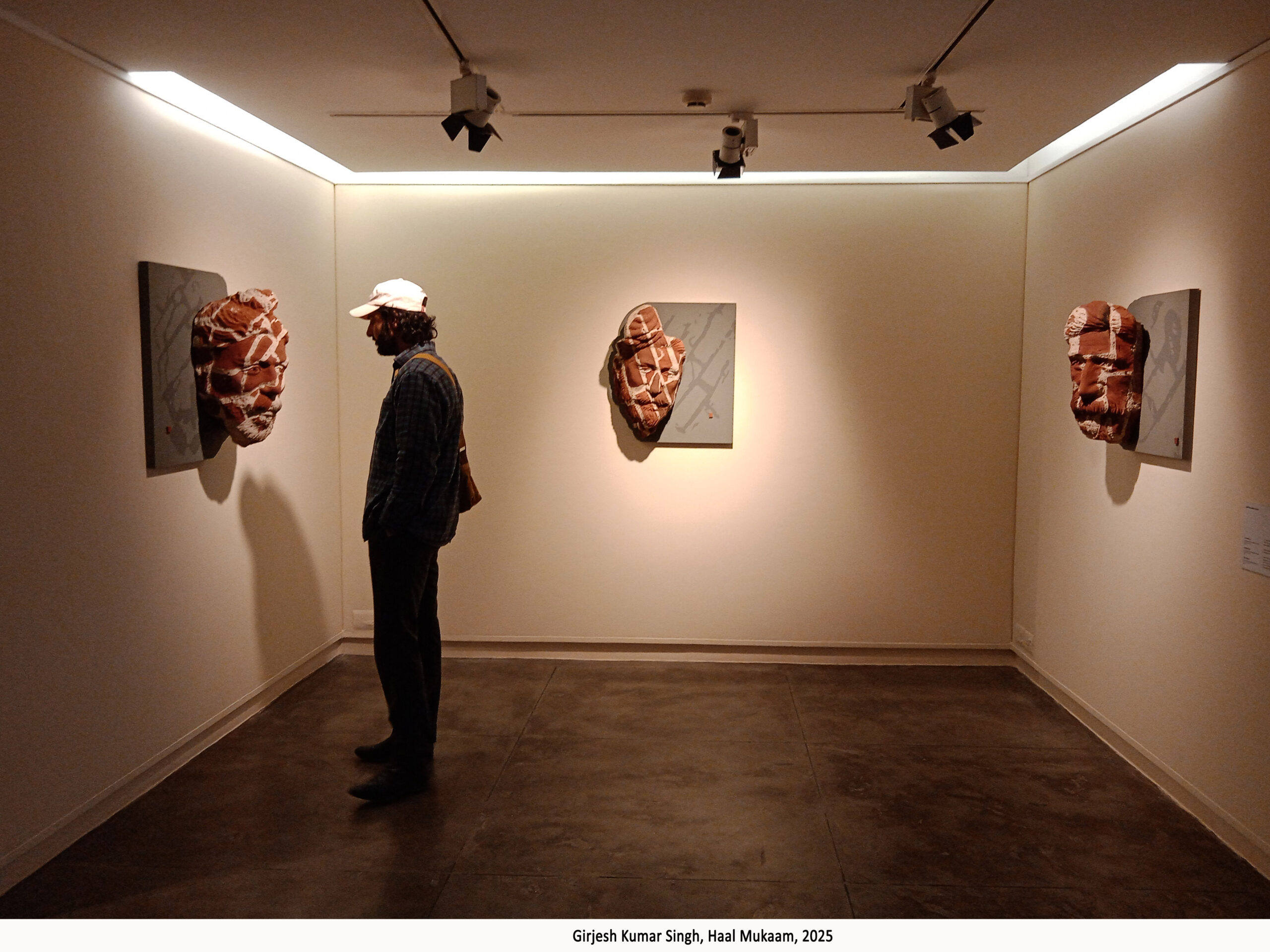
Sculpture 2025 is a group exhibition that foregrounds the richness, complexity, and evolving language of contemporary sculptural practice in India. On view from December 21, 2025, to January 8, 2026, at Gallery Espace, New Delhi (India), the exhibition brings together the works of Aditi Kulkarni, Ajay Kanwal, Bhuvanesh Gowda, Debasish Mukherjee, Dipalee Daroz, George Martin P.J., Girjesh Kumar Singh, Gurpreet Kaur, Jagdish Kumar, Manohar Lal, Ravikumar Kashi, Shanthamani Muddiah, Santanu Dey, Sumedh Rajendran, and Skarma Sonam Tashi. Curated by sculptor and academic Rajendar Tiku and exhibition design by Rajat Sodhi, the exhibition offers a nuanced reflection on materiality, form, and the changing priorities of sculptural discourse in India today.
 The curator notes in the exhibition text that “the show offers a glimpse into the depth and diversity of contemporary sculptural practice, with particular emphasis on materiality. It brings together artworks that demonstrate originality in concept and an innovative handling of material and form. Moving beyond metropolitan centres, the exhibition also draws attention to lesser-known sculptural practices from regional contexts, foregrounding marginalized ways of thinking, making, and being. By internalizing the impact of their processes, the participating sculptors create emotive and psycho-spatial connections through their works. While engagement with material has always been central to sculpture, the range of materials has expanded significantly in recent years. Artists now work with non-traditional materials such as textiles, paper, reclaimed wood, and even debris from demolished structures, while others employ traditional materials like metal, wood, and stone in unconventional ways. This shift reflects artistic curiosity, innovation, and autonomy, as well as the ability to infuse works with an aesthetic sensibility shaped by intelligence, humor, and introspection. Philosophically, this transformation stems from artists adopting a holistic view of life and its visual dimensions, translating everyday surroundings, socio-political realities, environmental concerns, and visual culture into independent sculptural languages. The works in the exhibition invite viewers to sense and reflect on how diverse materials shape our perception and understanding of the world around us.”
Rajendar Tiku is careful to avoid the increasingly technical and overdetermined term “curation.” Instead, he prefers to describe his role as taking responsibility for “putting the show together.” For him, curation has become a rigid framework, often detached from the lived values of making and material engagement. When those values are not central, he believes, an exhibition should not be burdened with the label of curation.
At the heart of Sculpture 2025 lies a return to material. From the earliest days of his own training, Rajendar Tiku recalls being taught that material is not secondary to sculpture but its very point of origin. Many sculptors, particularly stone carvers, have described their practice as a response to material itself, even as a declaration of strength and resistance. In this sense, material carries both physical and ideological validity. For Rajendar Tiku, sculpture begins with touch, with an instinctive response to matter, and this conviction shaped the exhibition’s core premise.
The exhibition brings together works that use traditional materials in unconventional ways, alongside works made from materials rarely associated with sculpture. This approach resists easy categorization and refuses the comfort of familiar sculptural languages. Equally important to Rajendar Tiku was the inclusion of what he calls “outgraph” works—sculptures that are entirely new, unburdened by excessive prior interpretation or established narratives.
 Underlying this selection is a long process of observation and “survey.” Having spent decades as an academic, Rajendar Tiku considers it essential to know who is making sculpture, where, and under what conditions. He notes that metropolitan centres like Delhi often circulate a limited selection of practices, while significant work continues to emerge in places farther afield—Kashmir, the Northeast, the southern sculpture hubs of Mahabalipuram and Cholamandalam. His long-standing relationships with many of the participating artists, most of them younger practitioners, stem from encounters with their work across these geographies. Sculpture 2025 thus becomes, in part, a fulfillment of a personal promise: to bring overlooked or under-seen works to wider attention.
There is also a deeper conceptual motivation behind the exhibition. Rajendar Tiku observes that contemporary art has increasingly privileged narrative over form. Artists and audiences alike have become adept at producing and consuming stories, often at the expense of formal experience. This exhibition consciously pushes back against that tendency. Many of the works resist narrative altogether, refusing to be read through familiar phrases or symbolic shortcuts.
Ajay Kanwal’s Sculpture Package is one such work. Created several years ago but never previously exhibited, it produces a compelling illusion between the real and the unreal. When Rajendar Tiku first encountered the work six or seven years ago, it left a lasting impression precisely because it could not be easily resolved into a story. Its strength lies in perception, not explanation.
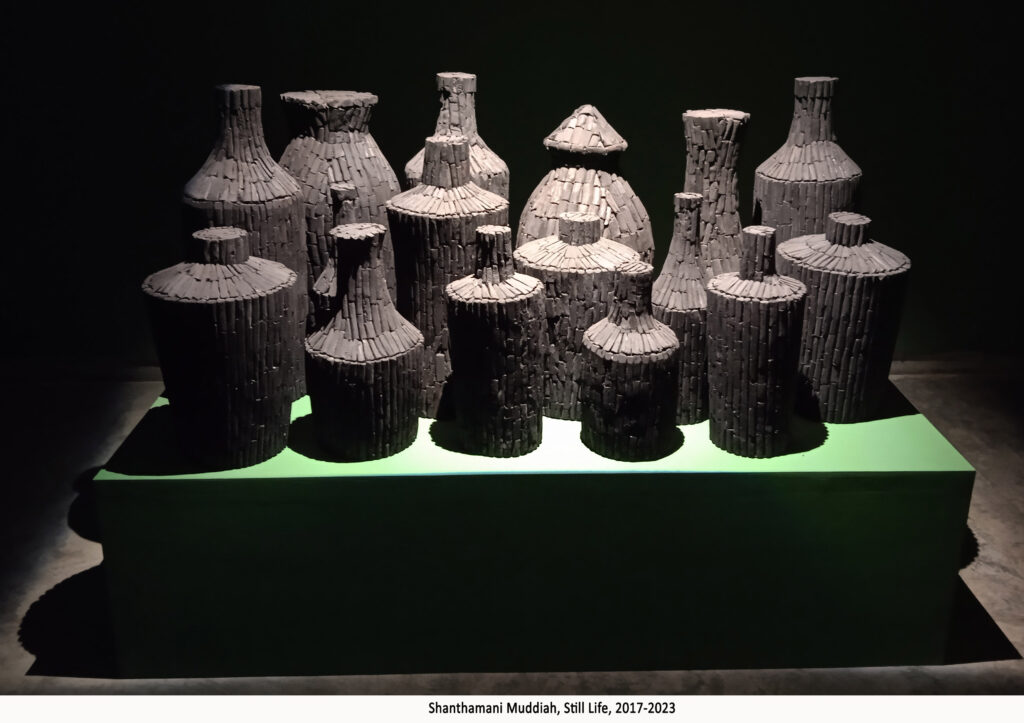
A similar resistance to narrative appears in Shanthamani Muddiah’s still life composed of charcoal sticks. While the artist has spoken of the work as a comment on carbon emissions, Rajendar Tiku situates it within the history of art rather than external discourse. For him, the work resonates with the quiet intensity of Giorgio Morandi’s still lifes, which seem to solidify time itself. The charcoal forms evoke a sense of suspension and aftermath, recalling images that emerge from historical trauma rather than environmental slogans.
Manohar Lal’s plaster-of-Paris sculptures further extend the exhibition’s material inquiry. Trained initially as a sculptor, Lal later moved into design, working extensively with steel and large-scale industrial projects in India and France. Yet he never abandoned sculptural practice. The plaster works included here, preserved for years, deliberately employ an impermanent material. For Lal, plaster becomes a metaphor for transience, underscoring the fragile nature of form and existence. Despite their material vulnerability, the works possess a gem-like intensity that left a strong impression on Rajendar Tiku.
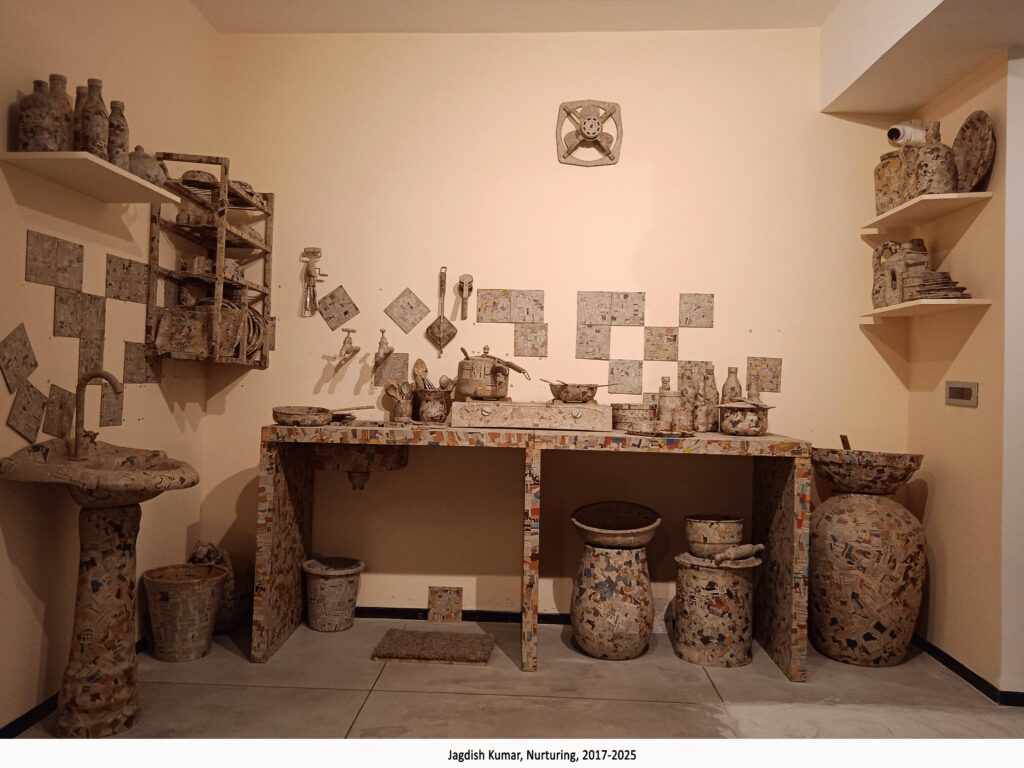
Jagdish Kumar’s paper sculptures introduce a different kind of material poetry. His meticulously crafted kitchen, made entirely of newspaper and without any internal armature, blurs the line between illusion and function. In Kumar’s practice, everyday objects—bread, utensils, cookware—are transformed into acts of quiet magic. His work is playful yet rigorous, empathetic yet technically astonishing. The kitchen, often described as the centre of life, becomes here a meditation on care, labour, and the extraordinary possibilities of an ordinary material.
Together, these works do not seek to instruct or narrate. Instead, they ask viewers to encounter sculpture through form, texture, weight, fragility, and illusion. Sculpture 2025 ultimately stands as an exhibition shaped by experience rather than theory, by looking rather than labeling. It reasserts sculpture as a field where material speaks first—and where meaning emerges not from stories imposed upon objects, but from the silent, persistent presence of form itself.