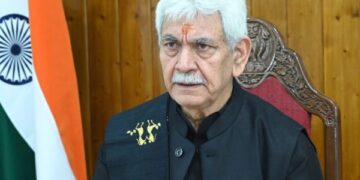
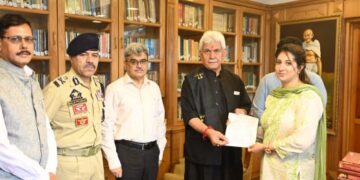
JAMMU/SRINAGAR: Lieutenant Governor Manoj Sinha on Saturday unveiled the poster of “The Last Dose”, an awareness film on drug abuse produced by Khwaish Gupta Productions, at Lok Bhawan.
LG congratulated the entire team and conveyed his best wishes to them.
Khwaish Gupta, Founder of Khwaish Gupta Productions; Shivdeep Gupta and Priya Gupta, Producers of the film, along with other team members, were present at the unveiling ceremony.
Meanwhile, at a function in Srinagar, Divisional Commissioner Kashmir Anshul Garg said that drug addiction has witnessed a three-fold increase in the valley in the last three years, with the consumption of heroin rising among the younger population.
“Drug addiction has become a huge problem for all of us. There has been a three-fold increase in the last 3 to 3.5 years. It is a warning signal for all of us,” Garg told reporters here.
He said the consumption of heroin is increasing among the youth and described it as a huge concern.
“Young people, whether they are in educational institutions, colleges, or coaching centres are getting involved in this. Data from previous years shows a disturbing upward trend, which has raised serious concerns across society,” Garg told media on the sidelines of a one-day orientation-cum-training program under the Nasha Mukt Bharat Abhiyan at the Psychiatric Diseases Hospital, Rainawari.
“The consumption of heroin is increasing and it is a huge concern for us. We need to fight this together as a society,” he said.
To tackle the problem at its roots, the administration, he said, has intensified efforts to connect all stakeholders, including religious clergy and civil society, as part of a comprehensive drug de-addiction campaign.
He said the ongoing extensive anti-drug campaign, aimed at raising public awareness, has actively involved religious scholars across Srinagar.
“Our first strategy is prevention. Drug addiction is a grave issue that affects all of us equally. As a society, we must fight this threat together. Every medical facility working in this direction must be supported, and the government infrastructure—whether it is the Social Welfare department or the district administration—will be fully available to those combating this menace,” Garg said.
“An extensive drug de-addiction campaign is currently underway across Jammu and Kashmir under the direct supervision of the chief secretary,” he said, adding that comprehensive initiatives, including specialised training programs for counsellors in educational and health institutions, are also being planned.
Urging religious clerics to step up public outreach, Garg said they should continue educating people about the harmful effects of drug abuse on children.
“Our helpline numbers, including IMHANS and Tele-MANAS, are available for those seeking assistance. Similar programs will be organised in other districts of the Valley as well,” he added.
Authorities rope in religious scholars to fight rising substance abuse
Orientation-cum-Capacity-Building Prog on substance abuse held for religious scholars at IMHANS
In a bid to highlight the role of religious scholars in eradication of substance abuse, District administration Srinagar organized an Orientation-cum-Capacity Building Workshop for Masjid Imams and religious scholars at the Institute of Mental Health and Neurosciences (IMHANS), here today.
The workshop aimed at highlighting the crucial role of religious scholars in eradicating the growing menace of drug abuse in society, and was attended by over 100 prominent religious scholars, including Imams and Ulemas from across the Valley, besides a large number of eminent citizens and civil society members, an official press release informed.
It said the Divisional Commissioner Kashmir, Anshul Garg, was the chief guest at the programme, while Deputy Commissioner (DC) Srinagar, Akshay Labroo, attended the event as the guest of honour.
Addressing the workshop, Divisional Commissioner Kashmir sought active support and cooperation from religious scholars in sensitising people, especially the youth, about the harmful and dangerous effects of drug abuse. He urged scholars to convey through Friday sermons that drug consumption is not only prohibited in all religions but also severely damages individuals, families, and society at large.
He said that concerned departments and institutions shall adopt a three-stage approach, including awareness campaigns, identification of victims and counselling to curb the surge in cases.
He also emphasised the importance of early reporting of drug abuse cases, urging affected individuals and their families to approach Drug De-addiction Centres for timely rehabilitation through professional counselling and expert guidance.
Speaking on the occasion, the Deputy Commissioner Srinagar termed the rising drug menace as a matter of serious concern and called for collective efforts from all sections of society to uproot the grave problem. He noted that drug abuse not only destroys the life of an addict but also leads to the breakdown of entire families.
The DC highlighted that while the administration is taking strong measures to curb drug abuse, religious scholars and parents must play a pivotal role alongside the government. He also outlined key aspects of the rehabilitation policy of the District Administration aimed at reintegrating drug victims with their families, as well as the deterrence measures being taken to break the supply chain and curb drug peddling in the district.
The DC also highlighted the key points of the rehabilitation policy of the District Administration to bring back the drug victims to their families and deterrence measures taken by the District Administration Srinagar to break the supply chain and crush the drug peddling in the District.
During the programme, prominent religious scholars spoke about the vital role of religious scholars and Ulemas in creating awareness about the ill effects of drug abuse and stressed the need for such targeted awareness initiatives to safeguard society.
Prof. (Dr.) Iffat Hassan Shah, Principal, GMC Srinagar, highlighted the crucial role of Imams as trusted community leaders in prevention, early intervention, and stigma reduction.
Prof. (Dr.) Arshad Hussain, Head of the Department of Psychiatry, IMHANS-GMC Srinagar, highlighted the growing burden of substance use disorders in the region and stressed the importance of early intervention and community participation in prevention efforts.
Earlier, mental health experts delivered detailed presentations on drug abuse, its systematic treatment, existing policies, and available preventive and rehabilitation services. They underlined the importance of early identification of signs and symptoms of drug abuse and raising sustained awareness at the community level.