New Delhi: A bill to repeal the MGNREGA and bring a new law for rural employment — Viksit Bharat Guarantee for Rozgar and Ajeevika Mission (Gramin) (VB-G RAM G) Bill, 2025 — is set to be introduced in the Lok Sabha.
According to a copy of the bill, it seeks to introduce the VB-G RAM G Bill, 2025, in Parliament and repeal the Mahatma Gandhi National Rural Employment Guarantee Act of 2005.
The bill aims at establishing a “rural development framework aligned with the national vision of Viksit Bharat 2047”, by providing a statutory guarantee of 125 days of wage employment in every financial year to every rural household whose adult members volunteer to undertake unskilled manual work.
The bill has been listed in the Lok Sabha in the supplementary list of business issued on Monday.
Rural Development Minister Shivraj Singh Chouhan, in the statement of purpose of the Bill, said MGNREGA has provided guaranteed wage-employment to rural households over the past 20 years.
However, “further strengthening has become necessary in view of the significant socio-economic transformation witnessed in the rural landscape driven by widespread coverage of the social security interventions and saturation-oriented implementation of major government schemes”, he said.
While the MGNREGA focused on the goal to “enhance the livelihood security”, the new bill says it aims to promote “empowerment, growth, convergence and saturation for a prosperous and resilient rural Bharat”, and lays emphasis on “empowerment, growth, convergence and saturation through public works aggregating into forming Viksit Bharat National Rural Infrastructure Stack”.
Water security through water-related works, core rural infrastructure, livelihood-related infrastructure, and special works to mitigate extreme weather events will be the “thematic focus”. It will also facilitate adequate farm-labour availability during peak agricultural seasons.
According to the bill, it is crucial to facilitate the availability of farm labour, especially during the peak agricultural season. It has a provision to empower states to notify in advance, for a certain duration, covering peak sowing and harvesting seasons, during which execution of works under this bill will not be undertaken.
With a focus on institutionalised convergence, the bill seeks to integrate ‘Viksit Gram Panchayat Plans’ with the PM Gati Shakti to address the “varying needs” of village panchayats.
A comprehensive digital ecosystem, including biometric authentication at various levels, global positioning system or mobile-based worksite monitoring, real-time management information system dashboards, proactive public disclosures, and use of artificial intelligence for planning, audits and fraud risk mitigation, will be used to modernise governance, accountability and citizen engagement, the bill stated.
It will be a centrally sponsored scheme, and every state government will have to prepare a scheme for giving effect to the guarantee proposed under this bill, within a period of six months from the date of the commencement of the Act.
The centre would make an allocation for each state, to be estimated based on certain parameters. Further, expenditure in excess of the approved normative allocation shall be the responsibility of the state governments.
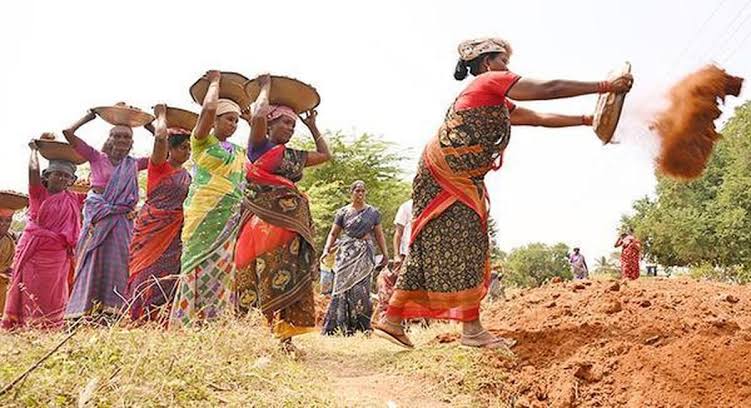
The Mahatma Gandhi National Rural Employment Guarantee Scheme, better known as MGNREGA, aims at enhancing the livelihood security of households in rural areas by providing at least 100 days of guaranteed wage employment in a financial year to every household whose adult members volunteer to do unskilled manual work. It was enacted in 2005.
The Winter Session of Parliament, which started on December 1, will conclude on December 19.