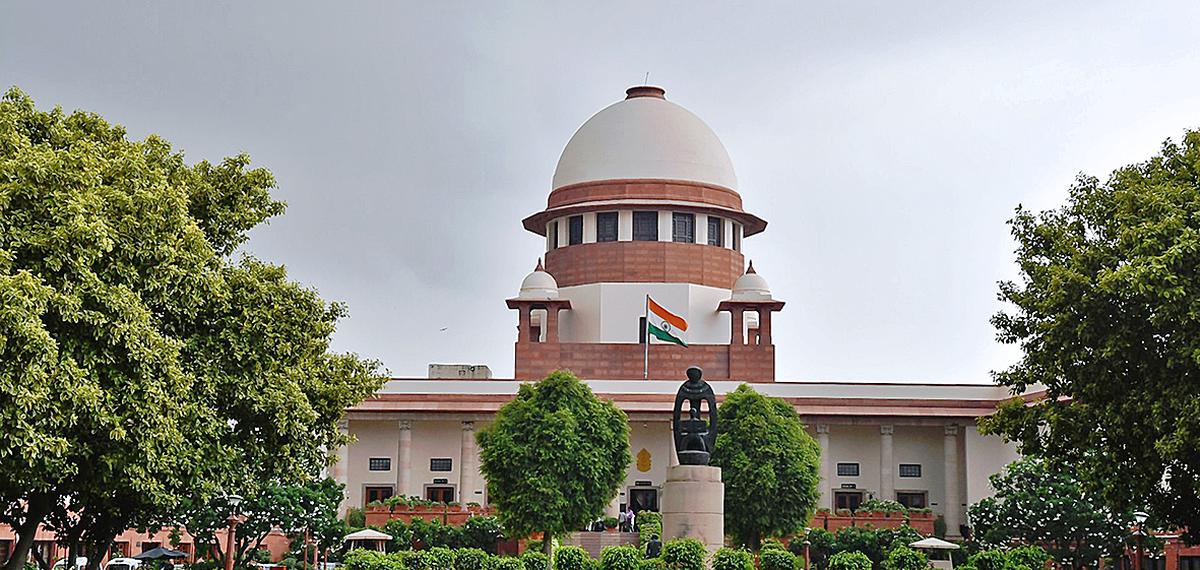
New Delhi: The Supreme Court on Tuesday said governors were expected to act within “reasonable time” even if the term “as soon as possible” were not there in Article 200 that governs powers to assent to bills passed by the state legislature.
A five-judge Constitution bench headed by Chief Justice B R Gavai, hearing arguments on the eighth day on the presidential reference, whether the court could impose timelines for governors and President to deal with bills passed by assemblies, reiterated it would only interpret the Constitution and not examine facts of individual cases.
Article 200 governs powers of Governor regarding bills passed by the state legislature, allowing them to either assent to the bill, withhold assent, return the bill for reconsideration or reserve the bill for the consideration of President.
The first proviso of Article 200 says Governor may, as soon as possible, after the presentation to him of the bill for assent, return the bill, if it is not a money bill, to the house for reconsideration and shall not withhold the consent after the assembly reconsiders and sends it back to him.
The bench, also comprising Justices Surya Kant, Vikram Nath, P S Narasimha and A S Chandurkar, was urged by senior advocate Arvind Datar, appearing for the Punjab government, that the framers of the Constitution put “as soon as possible” in Article 200 and there was no fetters for the court in setting the timeline of three months for grant of assent to bills.
“Even if the term ‘as soon as possible’ were not there, the Governor was expected to act within reasonable time,” the bench said.
Senior advocate K K Venugopal, appearing for Kerala, said former state Governor Arif Mohammad Khan had followed a practice of sending bills to the ministries concerned for briefing him whenever he received them.
“We will not be deciding individual matters,” the CJI said.
Senior advocate Gopal Subramanium, appearing for the Congress-led Karnataka government, said under the constitutional scheme, President and governors were only “titular heads”, bound to act on the aid and advice of the council of ministers, both at the Centre and in states.
Article 361, said Subramanium, granted immunity to President and governors from any criminal proceeding, for they did not perform any executive function and when it came to Governor’s satisfaction required for acting on bills passed by assembly, it meant satisfaction of the council of ministers.
Referring to verdicts, he said neither President nor governors exercised executive power in their personal capacity.
“Article 361 grants immunity because executive powers are exercised not by them individually but under ministerial advice through rules of business,” Subramanium said.
The Constitution, he said, did not envisage “parallel administrations” or allow governors to override elected governments.
Referring to the 44th constitutional amendment, he said it permitted President to send ministerial advice back for reconsideration but it ultimately bound her to accept the bill.
“The President is a constitutional head, bound by aid and advice,” he said, pointing out the same principle applied to governors under Article 163 except in the “narrowly defined” discretionary areas such as Article 356 (President’s Rule) or few other special provisions.
He said if the Centre’s submissions were to be accepted, then governors would be above judicial review, becoming an “all-pervading authority”.
“The Governor is not an agent of the union but takes oath for the well-being of the state,” he submitted, cautioning against resurrecting such a doctrine and hark back to colonial frameworks.
Referring to Article 200, he said the Constitution provided only three options, granting assent, returning the bill for reconsideration or reserving it for President.
“There is no fourth option of withholding assent indefinitely. Any suggestion of an unqualified veto is antithetical to the Constitution,” he added.
Venugopal said Articles 200 and 201 must be read as mandating governors to act “as soon as possible” without scope for an indefinite delay.
He warned even money bills, which deal with urgent financial matters such as salaries, could not be kept pending.
“Could one imagine a Governor sitting over a money bill for 10 months?” he asked, pointing out the constitutional urgency attached to such legislation.
Datar weighed in, “Governor has options under Article 200. He does not have the discretion.”
He said governors had no unqualified discretion and the term “as soon as possible” appeared multiple times in the Constitution and statutory laws, denoting urgency.
“To accept the union’s stand that Governor can withhold a bill indefinitely creates a constitutional paradox. The Governor is not a constitutional filter,” Datar said.
Governor’s power to withhold assent, he said, was intrinsically linked to the obligation to send a message to the legislature, and not a standalone pause button.
“If he wishes the legislature to reconsider, he must send a message. To say he can simply withhold it forever is absurd,” he said.
The hearing is likely to conclude on September 10.
The court is examining 14 questions referred by President Droupadi Murmu, including whether constitutional authorities can indefinitely withhold assent to bills and whether courts can impose mandatory time frames.