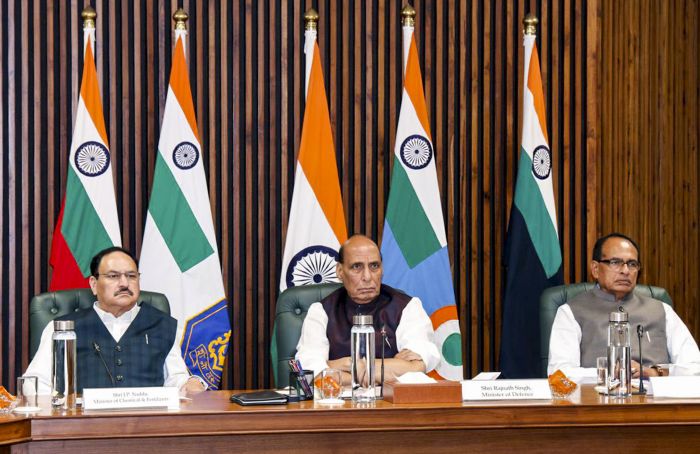
New Delhi: An informal group of ministers headed by Defence Minister Rajnath Singh on Wednesday reviewed India’s preparedness in view of the continuing crisis in West Asia, with the government asserting that adequate stocks of fuel, fertilisers and foodgrains are being maintained to cushion any fallout.
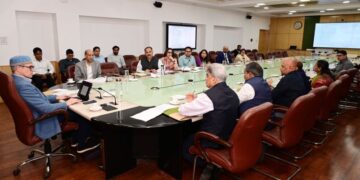
At the meeting of the Informal Empowered Group of Ministers (IGoM), the Centre said it was closely monitoring the evolving situation and had taken steps to ensure uninterrupted supplies of LPG, petrol, diesel and essential commodities while strengthening coordination and contingency planning across departments.
The meeting was attended by Finance Minister Nirmala Sitharaman, External Affairs Minister S Jaishankar, Agriculture Minister Shivraj Singh Chouhan, Commerce Minister Piyush Goyal, Oil Minister Hardeep Singh Puri, Chemicals and Fertilizers Minister JP Nadda, Consumer Affairs Minister Pralhad Joshi and Electronics and Information Technology Minister Ashwini Vaishnaw.
“In his remarks, the defence minister directed all departments to continue focusing on preparedness, coordination, and resilience building to stay ready to deal with any eventuality,” the defence ministry said in a statement.
The meeting came on a day the US and Iran agreed on a two-week conditional ceasefire.
“The government is ensuring continued availability of LPG, petrol and diesel, fertilisers for farmers and facilitating supply of essential commodities in the country,” Rajnath Singh said on social media.
He said the government under the leadership of Prime Minister Narendra Modi has been doing “exceptional work in safeguarding our citizens from the impact of the conflict.”
The ministry said the IGoM was informed that India has ensured the evacuation of the highest number of vessels than any other country, from the Strait of Hormuz over the past 40 days.
“A total of eight LPG vessels, carrying approximately 340 TM (thousand metric tons), equivalent to around 11 days of India’s import requirement have successfully transited the Strait, reinforcing the country’s energy security and supply stability,” it said.
“There have been no reports of dry-out at LPG distributorships, and delivery of domestic LPG cylinders continues despite all across the country,” it said.
“In order to support the vulnerable communities including migrant labourers, the supply of 5 kg Free Trade LPG cylinders has been doubled beyond the 20 per cent allocation earmarked for priority segments on April 7,” it added.
The readout said Oil PSU retail pump outlets continue to dispense auto LPG to support the public transportation requirements.
“However, some supply constraints are being faced by private operators due to their procurement challenges, causing increased footfall in PSU outlets,” it added.
It said a major decision was taken on April 8 to further ease supply of LPG to industrial segments by allocating 70 per cent of fuel demand to non-domestic bulk consumers with supply prioritised for key sectors such as pharma, food, polymers, agriculture, packaging, paints, steel, defence-related materials, etc.
“This measure is expected to prevent supply-chain disruptions, avoid shortages of essential goods and ensure continuity of industrial operations despite the ongoing global crisis,” it said.
The readout said that adequate buffer stocks of rice and wheat are available, ensuring sufficient supply for PDS (public distribution system) as well as to meet any emergency requirements.
The National Food Security Act ensures continued access to foodgrains for vulnerable populations, it said.