JAMMU: Chief Minister Omar Abdullah on Wednesday unveiled a twin-pronged strategy to transform Jammu and Kashmir through heritage-led tourism and a broader social movement against drug abuse, mental health stigma and environmental degradation, asserting that both development and social reform require active public participation.
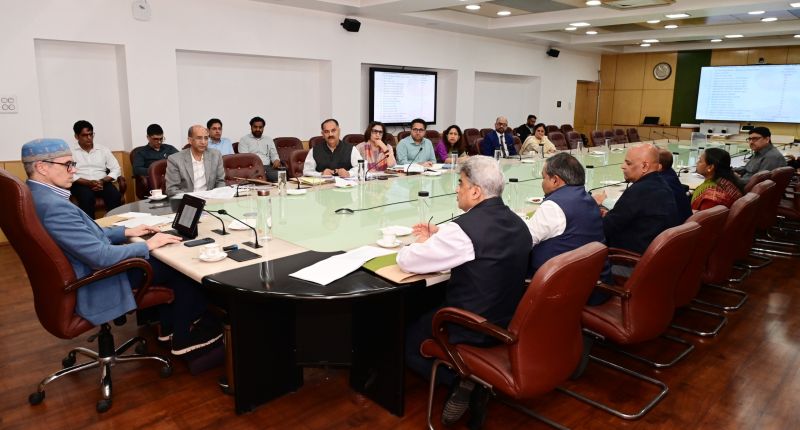
Chairing a high-level meeting on heritage promotion and cultural tourism here, the chief minister called for the adaptive reuse of heritage assets and the creation of tourism circuits to position Jammu and Kashmir as a premier cultural destination.
Abdullah stressed the need to strengthen institutional mechanisms and draw lessons from successful conservation models across the country and abroad. He said Jammu and Kashmir’s vast heritage wealth must be preserved and simultaneously developed as a dynamic engine of tourism and economic growth.
“Conservation has to go hand in hand with commercialization and community engagement,” he said, while advocating structured consultations with national and international agencies that have successfully restored heritage properties and converted them into tourism assets.
The meeting reviewed the proposal for reconstituting the J&K Heritage Conservation and Preservation Authority under the chief minister’s leadership to address long-standing gaps in heritage management.
Officials informed the meeting that more than 600 heritage sites, including monuments, forts, shrines and traditional art forms, have been identified across Jammu and Kashmir. However, many remain neglected due to weak institutional mechanisms, inadequate technical expertise and lack of coordinated policy support.
The chief minister was told that heritage structures could be revived through Public-Private Partnership (PPP) models, citing examples such as Qila Mubarak in Patiala, Neemrana Fort in Rajasthan and Orchha Fort in Madhya Pradesh, where neglected sites were converted into heritage hotels, museums and experiential tourism destinations.
The proposed reforms include strengthening the Heritage Conservation Authority, promoting heritage hotels through PPP mode, developing integrated tourism circuits and branding Jammu and Kashmir as a leading cultural and wedding destination.
Later, while inaugurating a three-day divisional-level awareness programme organised by the School Education Department at the Convention Centre, Abdullah underlined the need for collective responsibility in addressing social challenges, particularly drug addiction, mental health concerns, environmental degradation and road safety.
Drawing a distinction between responsibilities that belong solely to the government and those that require societal participation, he said roads, hospitals and bridges can be built by the government, but a cleaner, healthier and safer society can only emerge through public cooperation.
“Besides the government, the public has a crucial role in maintaining environmental safeguards and key public assets as part of their civic responsibility,” he said.
Abdullah expressed concern over the tendency to blame the government alone for issues such as cleanliness and environmental damage, urging people to adopt responsible behaviour in their daily lives.
“If you act on the pledges taken today, we can compete not just within the country but with the world,” he told students, while calling upon the younger generation to help build a more responsible society.
On mental health, the chief minister said the issue continues to remain stigmatised and appealed for greater empathy towards those facing psychological challenges.
“Even a few words of sympathy can make a difference and give someone the courage to overcome difficult times,” he said.
Regarding drug abuse, Abdullah asserted that the menace cannot be tackled by the government alone and called upon civil society, educational institutions, religious leaders and families to contribute towards making Jammu and Kashmir drug-free.
“If we leave it to the government alone, we will not succeed. Everyone has to play their part,” he said.
The chief minister also advocated plantation drives and suggested replacing ceremonial gestures with environmental action.
“Instead of shawls, plant trees in our name. Even if a few survive, it will be a lasting contribution,” he said.
Minister for Health, Medical Education and School Education Sakeena Itoo said the awareness campaign was an opportunity to address pressing issues such as drug abuse, mental health, environmental protection and career guidance, and urged students and other stakeholders to take part actively.