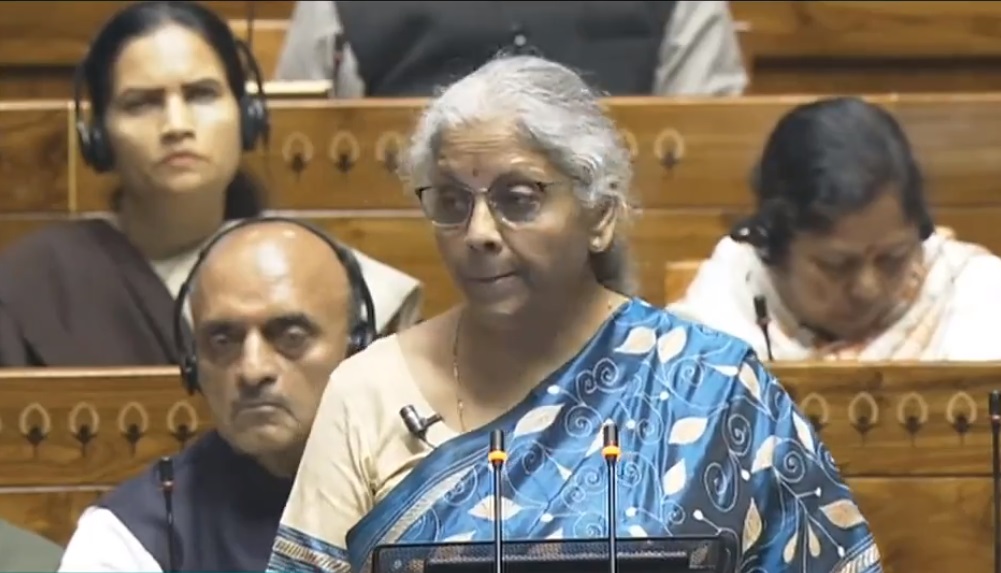
New Delhi: Finance Minister Nirmala Sitharaman on Wednesday said the Union Budget has taken several “facilitative” measures for the middle class and MSMEs, and the government is moving forward with reforms not out of compulsion, but with conviction and clarity.
Replying to the debate on Finance Bill 2026 in the Lok Sabha, Sitharaman said the fiscal deficit is projected to come down to 4.3 per cent of GDP in FY27, from 9.3 per cent in FY21, and the country’s debt-to-GDP ratio is on a declining path and is lower than most major economies.
The Lok Sabha passed the Finance Bill 2026, by a voice vote after including 32 government amendments.
The Finance Bill, 2026, Sitharaman said rests on five key principles — trust-based tax administration; ease of living for citizens; empowering farmers, MSMEs and cooperatives; making India stronger global business hub; and seamless trade facilitation and customs reforms.
Rejecting opposition charge that the middle class have been left out in the Budget for 2026-27 fiscal year, the minister listed out measures like reduction in TCS rate on payments made under Liberalised Remittance Scheme (LRS) for foreign education and medical treatment. Also, TCS on overseas tour packages have been slashed to 2 per cent from 20 per cent earlier.
She also said the Finance Bill provided for exempting customs duty on 17 critical drugs and duty-free import of medicines and personal use.
Besides, to make life easier for taxpayers, the facility to file updated I-T returns have been allowed even where reassessment proceedings have been initiated, and a foreign asset disclosure scheme for small taxpayers have been brought in.
To reduce disputes at airports with customs officers, the Finance Bill provides for rationalising tariffs on gifts and items brought into India. “The passengers will now have far less to worry about when they land in India,” she said, adding that these are aimed at facilitating middle class, passengers, ordinary citizens, and are not for high networth individuals.
With regard to MSMEs, the government is taking an approach that is friendly for MSMEs and is moving away from the concept of “penalising first and giving them relief later” to “facilitating first, enforcing later”.
“Individuals or MSMEs have been given more facilitative treatment (in the Finance Bill),” Sitharaman said.
Sitharaman said India is riding on the “reform express” with reforms not happening out of compulsion, but out of conviction, clarity, confidence and commitment.
She further said there is a trust-based tax administration that is being improved by reducing unnecessary hardship for honest taxpayers.
The government has taken various steps to empower MSMEs, farmers, and cooperatives because they are at the heart of creation of employment for production and for the overall development of India, she said.
The Finance Bill aims to support them with very many measures that improve liquidity but also reduce compliance burden and give them the opportunity to have greater contribution towards the larger economy, she added.
Elaborating further on the Bill, the Finance Minister said customs reforms have been proposed by altering many provisions with the objective to promote trade facilitation.
Contesting DMK member Arun Nehru’s remarks that GST rate cuts in September 2025, have not worked, Sitharaman said retail passenger vehicle sales recorded a 26.1 per cent increase, the highest-ever for any February. Rural passenger vehicle sales surged by 34 per cent, while urban sales grew by 21 per cent.
The minister said GST collections reflect this growth in sales with a 6.1 per cent year-on-year increase in December 2025, 6.2 per cent in January 2026, and 8.1 per cent in February 2026, with overall growth of 8.3 per cent in 2025-26.
Tamil Nadu’s GST revenues have also risen significantly with 8 per cent growth in December 2025, 5 per cent in January 2026 and a sharp 18 per cent increase in February 2026 (post-SGST settlement).
“These figures clearly show that the GST reduction has boosted demand, strengthened manufacturing in Tamil Nadu and increased revenues for the state,” Sitharaman said.
On opposition charge that Centre is levying cess, Sitharaman said the Constitution allows Centre to levy cess and surcharge and the government is using that provision that is legitimately provided.
“Resources from many cesses are 100 per cent transferred to states,” she said, adding that in the last six-year period, 2019-20 to 2024-25, the cumulative utilisation of cesses has exceeded the collection.
As much as Rs 15.14 lakh crore were collected from cess, while Rs 15.97 lakh crore was sent to the states under various schemes. Similarly, health and education cess, Rs 74,000 crore extra has been spent over and above what has been collected under cesses and education health cess.
Between FY15 to FY27, Rs 7.03 lakh crore was collected, while total utilisation stands at Rs. 7.77 lakh crore. “More than what is collected under cesses and surcharges is being spent,” she said.
She accused the TMC government in West Bengal of not implementing central schemes and making poor people suffer. She said while the Assam government has implemented the ‘Pradhan Mantri Cha Shramik Protsahan Yojana’, the West Bengal government has done injustice to 3.79 lakh tea workers by not rolling out the scheme.