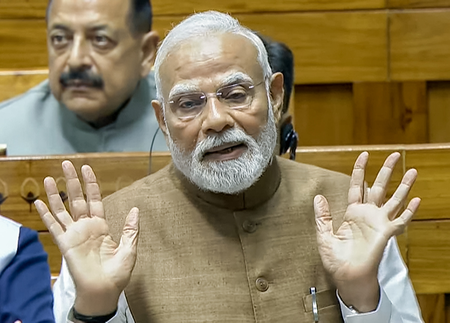
New Delhi: Prime Minister Narendra Modi on Monday said the difficult global conditions caused by the West Asia conflict are likely to persist for a long time and called upon the nation to remain prepared and united, just as it had stood together during the COVID-19 pandemic.
In a statement in the Lok Sabha, PM Modi addressed concerns related to the impact on fuel, fertilisers, national security and other areas in India as well on its nationals residing in the West Asia region, detailing steps taken by the government to ensure that “ordinary families face as little trouble as possible”, and said a unanimous voice should go out to the world from India’s Parliament on this crisis.
Reaffirming India’s unwavering commitment to humanity and peace, the prime minister said the dialogue and diplomacy remain the only path to resolution and every Indian effort is directed at de-escalation and the cessation of hostilities.
Informing the House that he has engaged with all relevant West Asian leaders and urged them to reduce tensions and end the conflict, Modi emphasised that attacks on commercial ships and obstruction of international waterways like the Strait of Hormuz, through which 20 per cent of the world’s energy is transported, are”wholly unacceptable”.
He said endangering any life in this war runs counter to the interests of humanity and “India’s effort is to encourage all parties to arrive at a peaceful resolution as soon as possible”.
On India’s diplomatic response to the West Asia conflict, the Prime Minister said India’s stand has been clear from the very beginning, when the US and Israel attacked Iran and the latter retaliated by targeting its Gulf neighbours and Israel, “one of expressing deep concern, advocating de-escalation, and opposing attacks on civilians and on energy and transport infrastructure”.
“India, through diplomacy, is making continuous efforts for the safe passage of Indian ships even amidst the war environment. Due to such efforts, several of our ships that were stuck in the Strait of Hormuz have also arrived in India in recent days,” he said.
The prime minister also drew the attention of the House to the internal security dimension of the crisis, warning that certain elements attempt to exploit such situations.
He said all security agencies have been placed on alert and that security across all domains, coastal, border, cyber, and strategic installations, is being further strengthened.
“Whether it is coastal security, border security, cyber security, or strategic installations, the security of all is being reinforced,” he said.
Urging patience, restraint, and vigilance, and cautioning against those who may seek to exploit the situation by spreading falsehoods, engaging in black-marketing, or hoarding, Modi appealed to all state governments to ensure strict monitoring and swift action against such elements.
Expressing his abiding faith in the collective resolve of the nation, the Prime Minister said that when every government and every citizen of this country walk together, “we can challenge every challenge, this is our identity, and this is our strength”.
The prime minister remarked that the difficult global conditions caused by this war are likely to persist for a long time and called upon the nation to remain prepared and united, just as it had stood together during the COVID-19 pandemic.
The prime minister said the crisis has been going on now for more than three weeks and it is having a very adverse impact on the global economy and on people’s lives. The entire world is urging all parties for the earliest resolution of this crisis, he said.
This region is important to India for yet another reason, as nearly one crore Indians live and work in the Gulf countries and among the commercial ships that sail in these seas, the number of Indian crew members is also very high, he said.
“India’s concerns are naturally greater, and therefore it is essential that a united and unanimous voice goes out to the world from India’s Parliament on this crisis,” he said.
Modi underscored how the energy diversification strategy pursued over the past decade has proven its worth in the current crisis.
He informed the House that India has expanded its energy import sources from 27 countries to 41 countries over the past 11 years, thereby reducing dependence on any single region.
Emphasising the foresight of this approach, Modi said in today’s circumstances, the steps taken over the past decade regarding energy security have become even more relevant.
Modi said India has more than 5.3 million metric tonnes of strategic petroleum reserves, and the country is also working on arrangements for more than 6.5 million metric tonnes of storage.
Apart from this, he said, there are reserves held by the domestic oil companies.
“In the last 11 years, our refining capacity has increased significantly, and the government is in constant touch with suppliers from different countries. The effort is to ensure that oil and gas supplies continue from wherever possible,” he said.
Highlighting the scale of the evacuation effort, the Prime Minister said more than 3,75,000 Indians have safely returned to India since the war began, including approximately 1,000 Indians from Iran alone, of whom over 700 are young medical students.
Addressing the broader economic ramifications, Modi acknowledged that energy is the backbone of the modern economy and that West Asia is a major source for global energy needs, making the current crisis a challenge for economies worldwide.
He said the government is working with a comprehensive short-term, medium-term, and long-term strategy, supported by strong economic fundamentals, sector-specific stakeholder consultations, and a dedicated Inter-Ministerial Group that meets daily to assess and resolve every difficulty in India’s import-export chain.
“I am fully confident that through the joint efforts of the government and industry, we will be able to face these circumstances effectively,” he said.
The prime minister said, unfortunately, several lives were lost and some people were injured during the conflict and their families are being given the necessary help, and treatment of the injured is being ensured.
He said another question is the impact of the war on agriculture, but the good part is that the country’s farmers have filled the food grain reserves, so India is well prepared in terms of food security.
“We are also making efforts to ensure that the Kharif sowing takes place properly. For this, the government has made adequate arrangements for fertilisers to deal with any emergency. In the past as well, our government did not let any global crisis impact our farmers,” he said.
Modi said that as the summer season has begun in India, electricity demand has increased, but all power plants in the country have adequate coal stock available.
“India has created a record by producing more than 1 billion tonnes of coal for the second consecutive year. In the last decade, the country has also taken major steps towards renewable energy,” he said.