

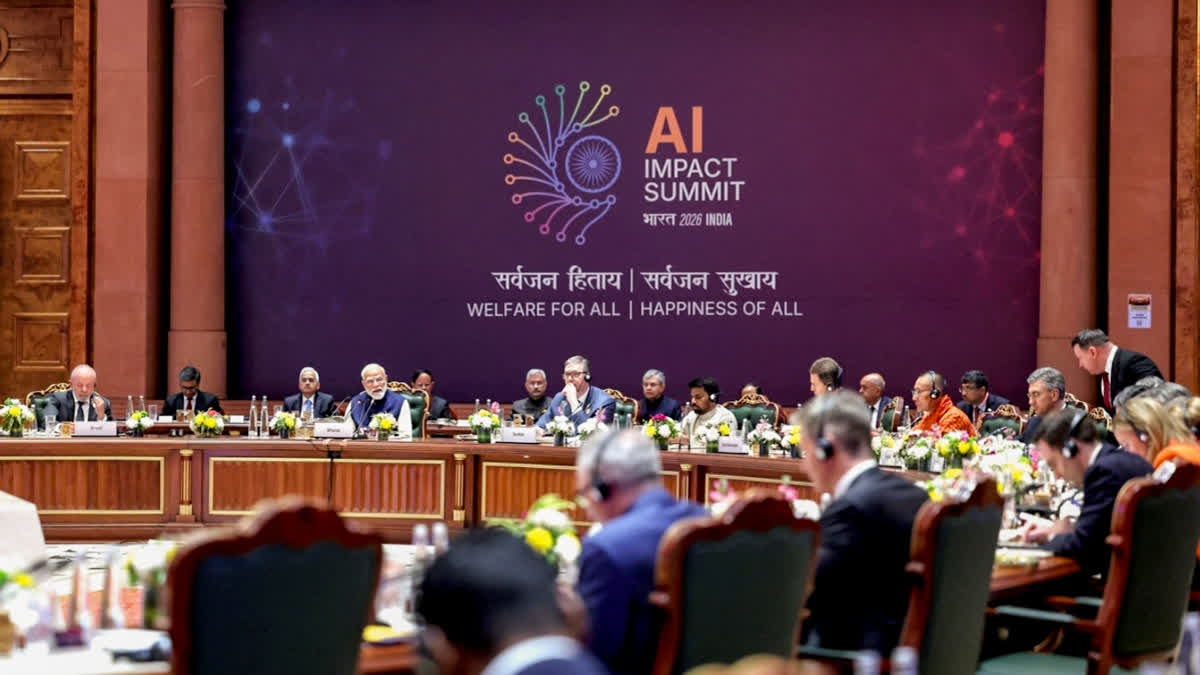
The India AI Impact Summit 2026 unfolded as another energetic day at Bharat Mandapam. Thousands of visitors filled the halls, moving from one stall to another, asking questions, watching demonstrations and exchanging ideas. Conversations between innovators, policymakers, students and industry leaders gave the venue a steady buzz.
A clear message echoed across the exhibition floor: Artificial Intelligence is no longer limited to experiments or prototypes. It is being applied to real systems that people use every day.
The focus of the Summit was simple. It highlighted how AI is being shaped into practical public solutions, reflecting the Government’s emphasis on turning emerging technologies into tools that serve citizens. Ideas were not just displayed on screens; they were demonstrated, tested and discussed with real-world use in mind.
One of the busiest stalls featured SATHEE (Self Assessment, Test and Help for Entrance Exams), an initiative by the Ministry of Education and IIT Kanpur, launched in 2023. The platform offers free AI-powered preparation for eight major competitive exams: JEE, NEET, CLAT, ICAR, CUET, SSC, RRB and IBPS.
Students gathered around a live dashboard as the system was explained. Dhruv Garg, Software Engineer at IIT Kanpur, said, “We realised students don’t always study from 10 to 6. So, we added AI features such as AI Conventional Tour, Mnemonics and memory aids especially helpful for Gen Z learners and AI Visual Problem Solver so they can study at home, anytime.”
(Dhruv Garg, Software Engineer at IIT Kanpur)
SATHEE provides AI-based doubt resolution, personalised study plans, confusion detection tools and automatic transcript summaries. Students can generate plans based on the hours they have available. The platform extracts key formulas from lectures and highlights recurring conceptual confusion. Content is available in 13 Indian languages, with further expansion underway. Early use in selected government schools has shown encouraging results, including up to a 50 percent increase in JEE qualifiers and an 80 percent increase in NEET qualifiers. The aim is to widen access, especially for students who may not be able to afford private coaching.
At another stall, attention shifted to security systems. Gurugram-based iiris: Value Catalysts demonstrated how AI can strengthen traditional surveillance. Zia Ahmad, Manager – Security Design, explained, “Let’s say you have a warehouse or real estate property. We begin with a comprehensive security risk assessment and design AI based security solutions tailored to the requirements.”
(Zia Ahmad, Manager – Security Design)
Zia added, “Earlier, surveillance systems relied heavily on manual monitoring. If an incident occurred, the entire recording had to be reviewed, making the process extremely time-consuming and resource-intensive.”
According to him, with AI-enabled tools, a single command can retrieve all relevant information at once. Intelligent filtering can narrow footage instantly by attributes such as clothing colour or time span. Integrated systems linking cameras and sensors generate real-time alerts, improving response time and efficiency. The company is also conducting security risk assessments for major infrastructure projects, including the Vrindavan Chandrodaya Mandir in Mathura.
Rail safety was another strong focus. RailLabs showcased Arista, an autonomous track inspection robot. Co-Founder Mr. Sumit Anand explains that, “It is trained based on its surroundings. We primarily use ultrasonic flaw detection to identify cracks in the railway track, both surface-level and internal cracks.”
(Co-Founder Raillabs Sumit Anand)
He added, “Let us say fish plates are missing, bolts are absent, or there are other structural defects, the system will detect them all.” According to him, this increases inspection efficiency by up to 200 percent compared to manual methods.
Standing nearby, Nischal Ranjan, Operational Manager at RailLabs, spoke about ChakrVue, a wheel shelling prediction system already operational in 20 LHB and Tejas coaches across cities including Mumbai, Agartala and Ranchi. “By identifying potential wheel defects before failure, the system strengthens preventive railway safety,” he said.
He emphasised the importance of early detection: “Even a crack above two millimetres can be dangerous.”
As the day progressed, the Summit maintained its steady rhythm. Screens glowed, machines operated quietly and discussions continued. The event did not promise overnight transformation. Instead, it showed how AI is steadily being integrated into classrooms, transport systems, infrastructure and public spaces — practical, grounded and focused on everyday impact.
Courtesy: Press Information Bureau


