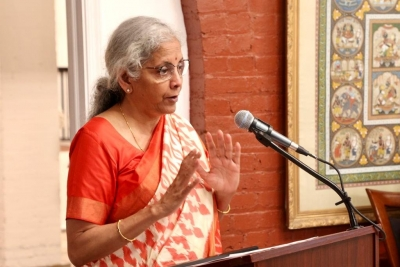
New Delhi: Recent trends under the MGNREGS revealed a notable decline in work demand, and it was in this backdrop that the government enacted the Viksit Bharat-Guarantee for Rozgar and Ajeevika Mission (Gramin) Act, 2025, or VB-G RAM G, which is a comprehensive statutory overhaul of the earlier scheme, the Economic Survey said.
The Survey, which was tabled in Parliament by Finance Minister Nirmala Sitharaman on Thursday, said that since its enactment in 2005, the Mahatma Gandhi National Rural Employment Guarantee Scheme (MGNREGS) provided wage employment, stabilised rural income, and created basic infrastructure, but over time, the nature of rural employment requirements transformed, emphasising both the programme’s achievements and the need to reassess its design and aims.
The Survey quoted NABARD’s latest Rural Economic Conditions and Sentiments Survey (RECSS) from November 2025, which showed a broad-based strengthening of rural economic fundamentals, with robust consumption, high income growth, rising investment, improved formal credit access, lower inflation perceptions, better loan repayment conditions, and strong satisfaction with infrastructure.
Another research report said rural consumption has risen to its highest level in 17 quarters, and the developments collectively indicate improving rural economic conditions, the Survey said.
These findings were complemented by a decline in dependence on the MGNREGS for employment in rural areas, it said.
“While MGNREGS has long served as a critical safety net for rural households, recent trends reveal a notable decline in work demand under the scheme. Person days declined significantly from a pandemic peak of 389.09 crore person days in FY21 to approximately 183.77 crore in FY26 (up to December 31, 2025), representing a decline of more than 53 per cent,” the Survey said.
This decline in MGNREGS demand coincided with a decrease in rural unemployment, from 3.3 per cent in 2020-21 to 2.5 per cent in 2023-24, suggesting that many rural households may be accessing nonfarm or other non-MGNREGS work.
The Survey said these developments highlighted a marked improvement in the rural economy, driven by strong macroeconomic fundamentals and a reduced dependence on MGNREGS as a source of livelihood.
“At the same time, they underscored the need to re-examine the design and objectives of employment guarantee programmes in light of changing rural realities,” it said.
Over time, increasing incomes, enhanced connectivity, widespread digital adoption, and diversified livelihoods have transformed the nature of rural employment requirements, the Survey said, emphasising both the programme’s achievements and the need to reassess its design and aims.
Women’s participation rose steadily from 48 per cent to 58.1 per cent between FY14 and FY25, Aadhaar seeding expanded sharply, the Aadhaar-based payment system was widely adopted, and electronic wage payments became nearly universal while monitoring of works also improved, it said.
However, alongside these gains, deeper structural issues persisted, and monitoring in several states revealed gaps, including work not being done on the ground, expenditure not matching physical progress, the use of machines in labour-intensive work, and frequent bypassing of digital attendance systems.
“Against this backdrop, the government enacted the Viksit Bharat-Guarantee for Rozgar and Ajeevika Mission (Gramin) Act, 2025. The Act is a comprehensive statutory overhaul of MGNREGS, aligning rural employment with the long-term vision of Viksit Bharat 2047, while strengthening accountability, infrastructure outcomes and income security,” the Survey said.
“The new Act represents a significant upgrade over MGNREGA, fixing structural weaknesses while enhancing employment, transparency, planning, and accountability,” it said.
Highlighting the features of the scheme, it said the Act specifies that wages will be disbursed on a weekly basis, or at the latest within a fortnight of work completion, planning will be grounded in local realities through the Viksit Gram Panchayat plans, which are spatially integrated with national systems such as PM Gati Shakti, and assets will be aggregated into the Viksit Bharat National Rural Infrastructure Stack, ensuring a unified and coordinated development strategy.
The Survey also said that rural development stood at the core of India’s journey towards inclusive economic growth, with a substantial majority of the population residing in 6.65 lakh villages and 2.68 lakh gram panchayats, which form the backbone of the nation’s social and economic development.
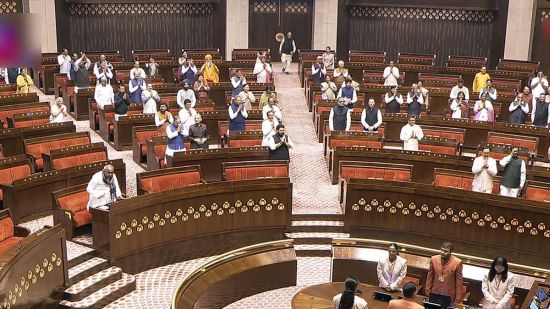
The VB-G RAM G Bill was passed with a voice vote amid protests in the Rajya Sabha on December 18, 2025, hours after the Lok Sabha cleared it.
On December 21, President Droupadi Murmu gave her assent to the Bill, making it an Act, which replaced the rural employment law, MGNREGA, guaranteeing 125 days of wage employment per rural household every financial year.