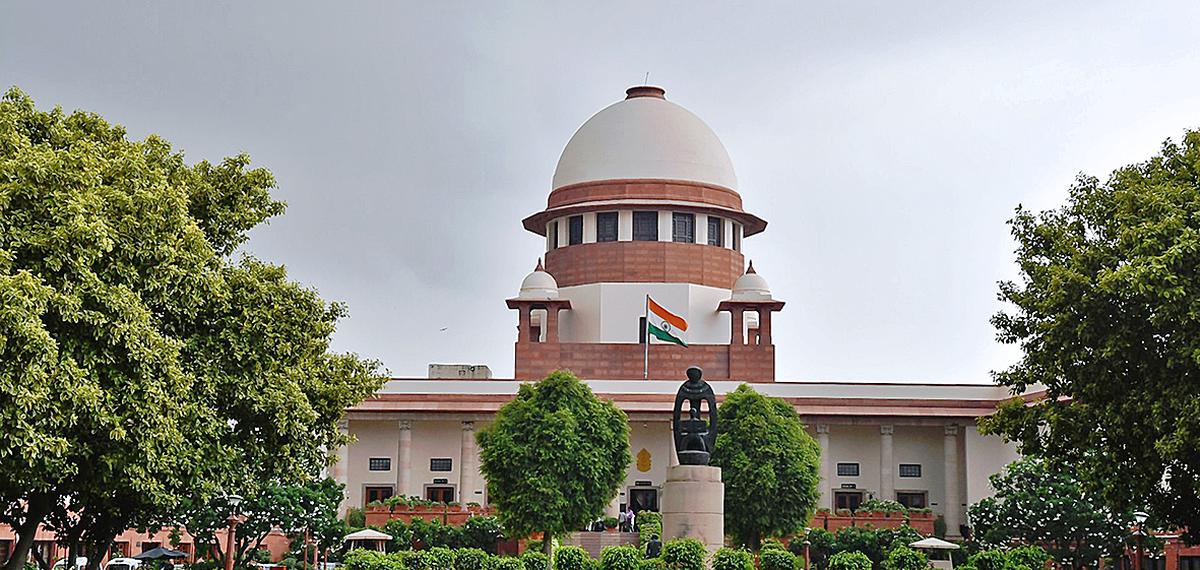
New Delhi: In a significant development, the Supreme Court on Thursday stayed the recent UGC equity regulations on preventing caste-based discrimination on campuses, saying the framework is “prima facie vague”, can have “very sweeping consequences” and may end up dividing society with a “dangerous impact”.
The top court also sought responses by March 19 of the Centre and the UGC on three pleas against the University Grants Commission (Promotion of Equity in Higher Education Institutions) Regulations, 2026 on the grounds that caste-based discrimination is defined strictly as discrimination against members of the SCs, STs and OBCs.
“If we do not intervene it will lead to dangerous impact, will divide the society and will have grave impact… Prima facie we say that the language of the regulation is vague and experts need to look into for the language to be modulated so that it is not exploited,” a bench of Chief Justice Surya Kant and Justice Joymalya Bagchi said.
While keeping at abeyance, the “non-inclusionary” definition of caste-based discrimination that excluded general categories from institutional protection under rule 3(1)(c), the bench revived the UGC (Promotion of Equity in Higher Educational Institutions) Regulations, 2012.
“In exercise of our powers under Article 142, we direct that the 2012 Regulations shall continue in force till further orders,” the bench ordered, noting that the repeal of the earlier framework would otherwise leave students without any remedy.
“Issue notice returnable on March 19. The Solicitor General accepts notice. Since issues raised in 2019 plea shall also have bearing while examining constitutionality.. let these petitions be tagged with the same. Meanwhile let the UGC Regulations 2026 shall remain in abeyance,” it said.
The 2026 regulations triggered protests at various places, with student groups and organisations demanding its immediate rollback.
The CJI suggested that the matter be revisited by a committee comprising eminent jurists and experts familiar with social realities.
“Some committee should be there with two or three eminent persons who understand social values and the ailments society is facing. How society should grow, and how people are going to behave outside the campus if we create such a framework, they must apply their mind,” the CJI said.
At the outset, the bench flagged concerns with the 2026 regulations and questioned the need for a separate definition of “caste-based discrimination” under regulation 3(1)(c), when regulation 3(1)(e) already provides a broad definition of “discrimination”.
It also questioned why ragging had been left out of the scope of the regulations, despite being a common form of harassment within educational institutions.
“Why is caste-based discrimination separately defined when the definition of discrimination already takes care of all forms of discriminatory treatment? And why is ragging not addressed at all,” the bench asked.
The bench said the language of the regulations appeared to be “prima facie vague” and “capable of misuse”.
Advocate Vishnu Shankar Jain, appearing for one of the petitioners, assailed Regulation 3(1)(c), which defines caste-based discrimination as discrimination “only on the basis of caste or tribe” against members of SCs, STs, and Other Backward Classes.
Jain said the definition excludes discrimination against persons belonging to the general category and creates a presumption that only certain sections face caste-based discrimination.
He contended that the provision violates Article 14 of the constitution and sought a stay on its operation.
“There was no need for a separate definition when Regulation 3(1)(e) already defines discrimination in an all-encompassing manner,” he said.
The CJI posed a hypothetical scenario involving regional discrimination and said if a student from South India faces humiliation in a northern Indian institution where caste identities are unknown and asked whether Regulation 3(1)(e) would address such situations.
Jain responded in the affirmative.
Another counsel highlighted a scenario where a general category fresher faces ragging at the hands of a senior belonging to a SC, submitting that the present regulations offer no remedy and may even expose the victim to retaliatory proceedings.
This prompted the bench to question why ragging was not addressed at all under the regulations.
“Most harassment happens on junior-senior lines. Why is it assumed that only caste-based discrimination exists,” the bench asked, adding, “Whatever we have gained in terms of achieving a casteless society, are we now becoming regressive?”
The bench expressed strong disapproval of measures such as separate hostels for different castes.
“For God’s sake, don’t do this! We all used to stay together. There are inter-caste marriages also,” the CJI said.
Justice Bagchi said the ideal of “unity in India” must be reflected in educational institutions. Senior advocate Indira Jaising, appearing in the 2019 PIL filed by the mothers of Rohith Vemula and Payal Tadvi, which led to the framing of the 2026 Regulations, defended the Regulations.
The CJI cautioned that the Regulations could have “very sweeping consequences” and may end up “dividing society” with a “dangerous impact”.
The bench was hearing pleas challenging the validity of the regulations filed by Mritunjay Tiwari, advocate Vineet Jindal and Rahul Dewan.